A 27-inch adult racquet looks like a bargain if you think one purchase will last until your child stops growing. Wilson, though, is blunt about the risk: a racquet that is too big can put a child at risk of injury, and one that is too small can stall their progress. Junior frames are sold by length, not by the head-size labels used on adult racquets, and height matters more than the age printed on the packaging.
This guide covers how official 10-and-under competition rules pair racquet length with stage balls, how USTA, Wilson and Babolat height and age charts compare, a stand-beside test you can do in a shop, what the frame is made of, and when it is time to move to an adult racquet.
The short answer
- Size by height first, then check that the child can swing the racquet comfortably. Age on a label is only a starting point. Wilson and Babolat both say to go up a size if the child is tall for their age, and down a size if they are short.
- Do not start with a 27-inch adult racquet "to grow into." That is our advice, based on Wilson's warning about injury and stalled progress, and on Babolat's note that a racquet that is too large and heavy will tire a child more quickly.
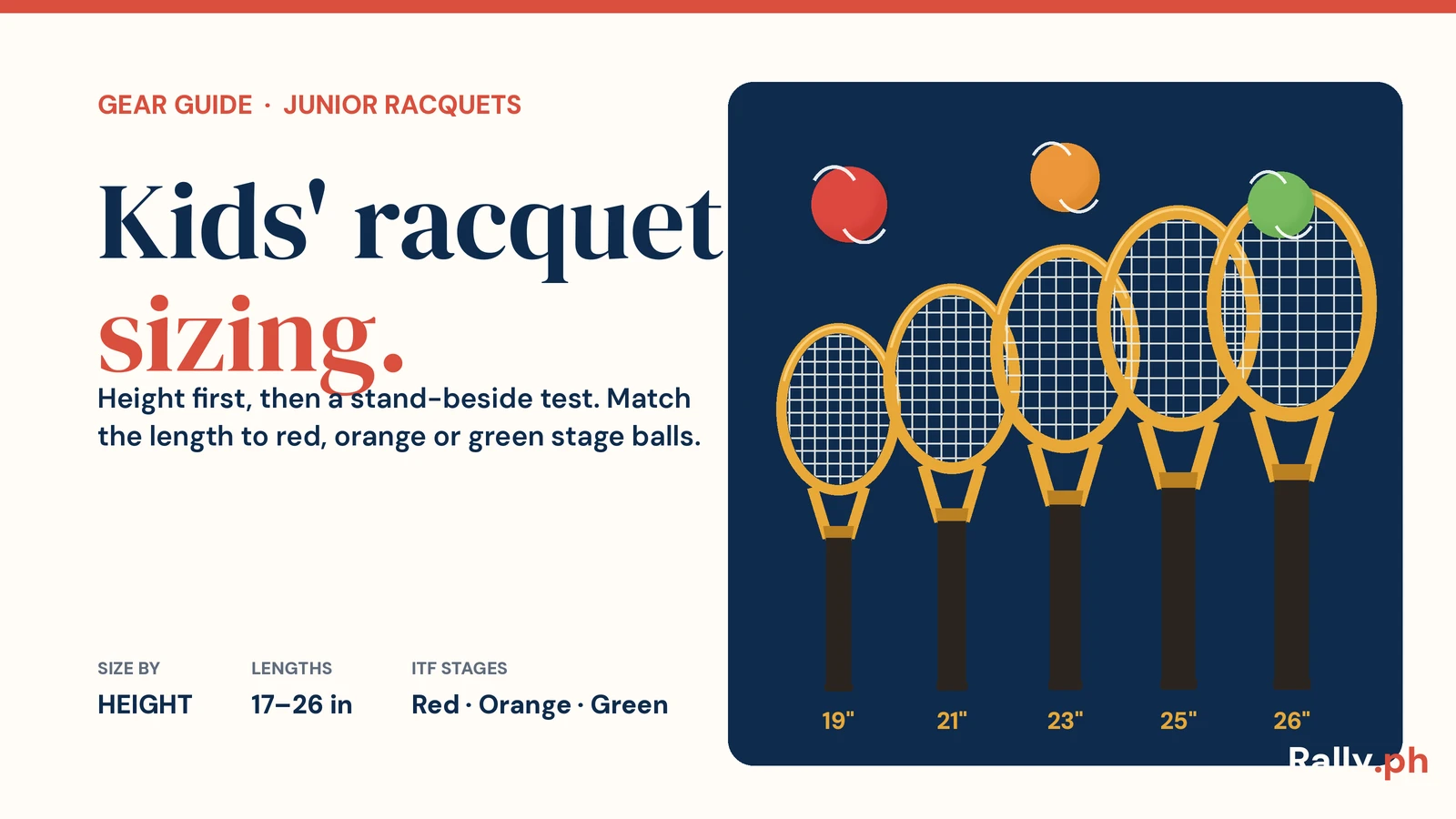
- Match the racquet to the ball and the court. The ITF Rules of Tennis (Appendix VIII, 2026 edition) recommend a racquet up to 23 inches for Stage 3 (red) balls, 23 to 25 inches for Stage 2 (orange), and 25 to 26 inches for Stage 1 (green).
- If two lengths both seem close, Babolat says to choose the smaller one.
- A first adult racquet is 27 inches. Wilson says there is no exact formula for when to make that move, and points to lighter "UL" (ultra-light) adult frames when height warrants it.
Why length comes first
Adult racquets are usually discussed by head size, weight and balance. Children are still growing, so the first decision is overall length. Junior racquets typically run from 17 or 19 inches up to 26 inches. The standard adult length is 27 inches.
Wilson's junior sizing guide puts it this way: unlike adult racquets, which are categorised by head size, kids' racquets are categorised by length. Each length corresponds roughly with an age group, but a child who is very tall or very short for their age needs that taken into account. Babolat's junior equipment guide adds that a properly sized racquet makes it easier to learn to hit the ball correctly and helps protect the child's arm.
A racquet that is too long is also usually heavier and harder to get around. The child will late on the ball, wring the handle, or shorten the swing to cope. That is the opposite of what 10-and-under tennis is designed to do.
Official stage lengths: red, orange and green
The ITF's 10-and-under rules do not replace a height chart, but they do tell you which lengths belong with which ball and court. Appendix VIII of the 2026 Rules of Tennis recommends:
- Stage 3 (red) ball, on a red court, for players aged up to 8 years, using a racquet up to 23 inches (58.4 cm) long. A red court is between 36 and 42 feet long and 14 and 20 feet wide, with the net 31.5 to 33.0 inches high at the centre.
- Stage 2 (orange) ball, on an orange court, for players aged 8 to 10 years, using a racquet between 23 inches (58.4 cm) and 25 inches (63.5 cm) long. An orange court is between 58 and 60 feet long and 20 and 27 feet wide, with the net 31.5 to 36.0 inches high at the centre.
- Stage 1 (green) ball, on a full-size court, for advanced players aged 9 to 10 years, using a racquet between 25 inches (63.5 cm) and 26 inches (66.0 cm) long.
Those age bands overlap on purpose, and the green recommendation is for advanced 9- and 10-year-olds. A late starter who is nine should still begin with the slower ball and the shorter racquet that fits, not jump to green or yellow because of their age. Our tennis balls guide covers how red, orange and green balls differ, and what to look for on a can.
If a junior programme in your city is still feeding yellow balls to six- and seven-year-olds on a full court, the racquet will not fix that. The ball and the court have to fit as well.
Height charts: they do not all agree
Makers and federations publish their own charts. They are close, but they are not identical, and none of them is a Philippine national standard. Use them as a first cut, then confirm with a stand-beside test and, if you can, a coach.
USTA (from its Eyes on the Ball equipment page) sizes by height, with age only as a general guide:
- Under 39 inches tall (under about 99 cm): 19-inch racquet (generally younger than 5)
- 40 to 44 inches (about 102 to 112 cm): 21-inch racquet (ages 5 to 6)
- 45 to 49 inches (about 114 to 124 cm): 23-inch racquet (ages 7 to 8, and some 9 to 10)
- 50 to 55 inches (about 127 to 140 cm): 25-inch racquet (ages 9 to 10)
- Over 55 inches (over about 140 cm): 26-inch racquet (ages 11 to 12)
The centimetre figures are our conversions from USTA's inch ranges.
Wilson publishes age bands, and tells parents to adjust for height:
- 19 inches for children up to 4 years old
- 21 inches for ages 5 to 6
- 23 inches for ages 7 to 8
- 25 inches for ages 9 to 10, with both recreational frames and heavier performance models
- 26 inches for ages 11 and up, as a step toward an adult frame when height warrants it
Wilson's 19-, 21- and 23-inch racquets come pre-strung and are recommended on age and height rather than skill. At 25 and 26 inches, Wilson says skill and experience start to matter: performance models such as its Blade 25 and Ultra 25 are slightly heavier and use the same carbon fibre as its adult performance frames.
Babolat publishes a height chart (from its official help centre, metric version):
- Under 90 cm: 17 inches (432 mm)
- 90 to 105 cm: 19 inches (483 mm)
- 105 to 120 cm: 21 inches (533 mm)
- 120 to 130 cm: 23 inches (583 mm)
- 125 to 135 cm: 24 inches (610 mm), a length Babolat sells in some junior models
- 130 to 140 cm: 25 inches (635 mm)
- 140 to 150 cm: 26 inches (660 mm)
The bands overlap, especially around 23, 24 and 25 inches. That is expected. A 128 cm eight-year-old might sit in Babolat's 23- or 24-inch range and in USTA's 25-inch range. In that situation Babolat's own rule is to take the smaller racquet if you are between sizes. Our suggestion is to do the stand-beside test below and, if you can, ask the child's coach which length they are already swinging well.
A stand-beside test you can do in the shop
Charts get you to the right shelf. A quick physical check stops you leaving with a frame that only looked right on a size tag. Two official tests are in circulation, and they are not worded the same way, so we are keeping them separate.
USTA: Have the child stand up straight. Stand the racquet next to their foot, handle end up (right foot if they are right-handed). The child should be able to hold the handle near the end without the racquet touching the ground, but the racquet should extend below the ankle.
Babolat: Have the child stand upright in tennis shoes, holding the racquet by the handle with the arm hanging toward the ground. If the racquet is less than 5 cm from the ground, Babolat calls that the correct size. In a separate product-guide note, Babolat also says that if the racquet hangs above the ankle it is too small, and if it touches the ground it is too big.
If those two checks disagree, trust the one that keeps the racquet slightly off the ground and easy to swing, and prefer the shorter length. That is our reading of Babolat's "choose the smaller one" rule, not a third official test.
The child should also be able to take a comfortable shadow swing without the head dipping or the handle twisting in their hand. If they cannot, go shorter or lighter, even if the chart said otherwise.
What the racquet is made of
Length is the first decision. The frame material is the second, and it should follow how seriously the child is playing, not which paint job they like.
Babolat's junior guide splits it this way:
- Beginners: the lightest aluminium frames, with a larger head, so the first balls are easier to hit. Babolat points to its Nadal Junior, B'Fly and Ballfighter lines for young children.
- Players who practise regularly and are improving: graphite-composite frames, which Babolat says add performance while remaining easy to handle (its Aero Junior and Drive Junior ranges).
- Players already in tournaments: 100% graphite frames modelled on adult performance racquets, in junior lengths (Pure Aero, Pure Drive and Pure Strike junior models for players under 1.5 metres).
Wilson draws a similar line at 25 and 26 inches, between recreational junior frames and performance frames made with adult carbon fibre. Those performance frames are slightly heavier. They are for a child who is already competing, not for a first racquet.
You do not need a performance graphite frame for a child who plays once a week. A lighter aluminium or composite junior racquet that is the right length will do more for them than a heavier "tour" paint job they cannot get around.
When to move to a 27-inch adult racquet
The next size after 26 inches is a standard 27-inch adult racquet. USTA notes that some adult racquets are longer still, and that those extra-long frames may be difficult for a child to swing with a controlled stroke. The ITF's Rules of Tennis cap overall racquet length at 73.7 cm (29.0 inches), but that is a legal maximum, not a target for a junior.
Wilson says there is no exact formula for the move to an adult frame, and that choosing the first adult racquet carefully matters. It points parents to UL (ultra-light) adult models, which are adult-sized but slightly lighter, and names its Pro Staff 97UL and Clash 100UL as examples. Babolat similarly suggests lighter "Lite" or "Boost" adult frames for taller beginners and for teens who are stepping up.
Our suggestion: move when the child's height has grown past the 26-inch chart, they can already swing that junior frame easily, and a 27-inch demo (if a shop or coach has one) does not leave the head lagging behind. Do not skip 25 or 26 inches to "get it over with."
For a first adult racquet after that, our beginner equipment guide and budget racquets guide cover weight, head size and what is worth paying for.
What you can find in the Philippines
Junior lengths are sold here, but the range on a single shelf is often narrower than a global catalogue. On 19 November 2026, Wilson Philippines listed a pre-strung Ultra Power junior racquet in 19, 21, 23 and 25 inch lengths, described as a lightweight beginner frame. We have not attempted a full stock survey of every shop, and listings change, so treat that as evidence that those junior lengths are sold locally, not as a shopping shortlist.
If you are buying online, check the length in inches or centimetres in the product title or size options. A "junior" label without a number is not enough. Bring the child's height, in centimetres, and do the stand-beside test if you are in a store. And buy the matching stage balls at the same time; a new 21-inch racquet with a can of standard yellow balls will still be a hard way to start.
Babolat also warns, in its junior care notes, not to leave a racquet in the sun or in a very hot place, because heat can damage the frame and the strings. That advice is familiar to anyone who has left a bag in a parked car here. Keep the racquet in a cover, out of the boot at midday.
Sources
- International Tennis Federation, ITF Rules of Tennis 2026, Appendix II (maximum racquet length) and Appendix VIII (10-and-under courts, balls and recommended racquet lengths)
- Wilson, How to choose a kids tennis racket
- Babolat, How to choose the good racquet length and How to choose your junior/kids tennis racquet
- USTA, Racquets (Eyes on the Ball equipment)
- Wilson Philippines, Ultra Power 19/21/23/25in Junior Tennis Racket product listing