Every point in tennis starts with a serve, which is why beginners feel the pressure on that first ball. The shot looks complicated from the stands, but it breaks into two parts: what the rules require, and a motion you can build in pieces.
The rules below come from the ITF Rules of Tennis 2026. The technique comes from LTA expert coach Matt Smith, writing for Britain's Lawn Tennis Association. The coaching is a starting method, not the only legal way to serve. An underarm serve, for example, is allowed under the rules if the other conditions are met. This guide is the overarm serve most club players are trying to learn.
The short answer
- Stand behind the baseline, between the imaginary extensions of the centre mark and the sideline, and stay there until you hit the ball.
- Serve diagonally into the opposite service box. The first point of a standard game is served from the right half of the court, then you alternate sides.
- You get two serves. A first-serve fault is followed by a second serve from the same side. Miss both and it is a double fault: the receiver wins the point.
- A let is not a fault. If the serve hits the net, strap or band and still lands in the correct box, you take that serve again. A let does not cancel a previous fault.
- Start sideways, with a continental (chopper) grip, toss the ball slightly in front of you at about "one o'clock", and think of the swing as a throw. You can practise the toss and the throwing action without a partner.
What the rules require
Where you stand. Immediately before the service motion, Rule 16 says the server shall stand at rest with both feet behind the baseline — further from the net than the line — and within the imaginary extensions of the centre mark and the sideline. In a singles match you may not stand behind the bit of baseline between the singles and doubles sidelines; in doubles you may. That is Case 1 under Rule 18.
How the ball is put in play. The server releases the ball by hand in any direction and must hit it with the racket before it hits the ground. The motion ends when the racket hits or misses the ball. A player who can use only one arm may release the ball with the racket. After tossing, you may decide not to hit the ball: Rule 19, Case 1, says catching it with the hand or the racket, or letting it bounce, is not a fault.
Where the serve must land. Rule 17 says that in a standard game the server stands behind alternate halves of the court, starting from the right half in every game. The serve must pass over the net and land in the service court diagonally opposite. That box is the singles service court — a ball that lands in the alley is a fault, in singles and in doubles. In a tie-break, the first point is also served from the right half, then the sides alternate.
Foot faults. During the motion, Rule 18 says the server shall not change position by walking or running (slight foot movements are allowed); touch the baseline or the court with either foot; touch the area outside the imaginary extension of the sideline; or touch the imaginary extension of the centre mark. Breaking any of those is a foot fault. You may have one or both feet off the ground.
Faults and the second serve. The serve is a fault if you break Rules 16, 17 or 18, miss the ball when trying to hit it, hit a permanent fixture, singles stick or net post before the ball hits the ground, or if the ball touches you or your partner, or anything you are wearing or carrying. If the first serve is a fault, Rule 20 says you serve again without delay from behind the same half of the court, unless that serve was from the wrong half. Miss the second serve as well and the receiver wins the point. That is the double fault.
Lets. Under Rule 22, the service is a let if the ball touches the net, strap or band and is otherwise good, or if you serve when the receiver is not ready. That particular serve does not count, and you serve again, but a service let does not cancel a previous fault. So a let on a second serve is still a second serve. Rule 21 adds that you must not serve until the receiver is ready, and that a receiver who tries to return the ball is considered ready.
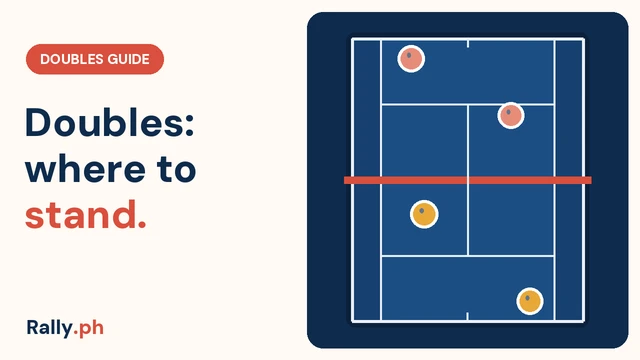
Our scoring guide covers games, sets and tie-breaks, and our doubles guide covers service order and where your partner may stand.
A beginner motion, in four steps
These steps follow Matt Smith's LTA guide for beginners. You can start from the trophy position, then add a fuller swing once the contact is comfortable.
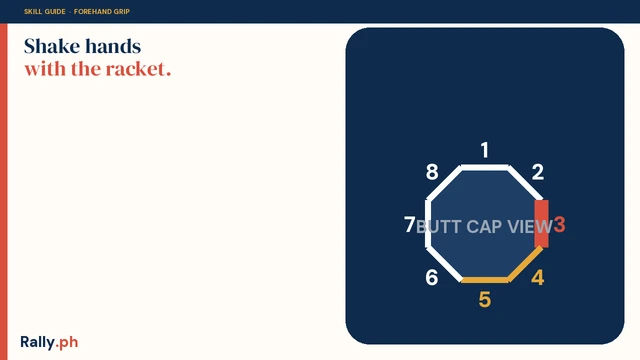
1. The grip. Smith says to hold the bottom of the handle with your dominant hand as if you are shaking hands with it. He calls this the chopper or continental grip, and notes that you can also use it for volleys and smashes. In a later LTA practice article he describes the same grip as a "V" between the thumb and index finger, running down the edge of the handle. Our forehand grip guide uses a "shake hands" image for the eastern forehand, which is a different grip. If the two descriptions disagree in your hand, ask a coach to place the continental grip on the bevels. The LTA's point is that the serve grip should feel like a throwing grip, not like a forehand.
2. Stand sideways. Stand sideways-on behind the baseline. As a beginner, Smith says you can start in a throwing position, also called the trophy or tick position: your non-dominant hand points down the court holding the ball, and your dominant arm is behind you at a 90-degree angle, holding the racket. Your feet cannot go over the baseline.
3. The toss. Place the ball up above head height and slightly out in front. Smith uses a clock face: for a right-hander, toss at about one o'clock and just in front of you. This is the part you can practise anywhere, with the non-dominant hand only. In his solo-practice article he adds that the toss should be slightly over towards the hitting arm, which makes the ball easier to hit. A consistent toss matters more than a pretty swing.
4. Throw the racket. Not literally. Smith says the motion of hitting a serve is very similar to throwing the racket towards the far end of the court. When the ball is above head height, often at the top of the toss, make contact at a comfortable stretch, and try to keep the racket face pointing towards your target. Once that feels natural, he suggests a fuller rhythm: start with the racket and ball in front of you, move both arms down together, part them at your waist, and go up together into the same trophy position before you hit.
You do not have to serve to start a rally in practice. Smith notes that an overarm throw or an underarm shot is fine when you are just rallying. The serve itself is still worth practising, because it starts every point in a match.
How to practise without a partner
Smith's beginner drill starts with a throw, then adds the racket.
Stand in the trophy position with a ball in each hand. Toss with the non-dominant arm, and throw the other ball overarm into the diagonal service box. When both actions feel comfortable, pick up the racket and use the same motion to serve into that box. He suggests ten serves from each side, with the toss just in front and slightly towards the hitting arm, and a consistency target of 80 percent, or 16 out of 20. To build rhythm, practise the pendulum of both arms down, then up, in front of a mirror at home, with or without a racket.
Once you can land the ball in the box, his next drill is direction: divide the service box with a cone or a water bottle, call the side before you hit, and try ten serves with at least half landing on the side you named. Spin and change of pace belong later; they are in the same LTA article if you want them, but they are not the first job.
Warm up before a basket of serves. Our 20-minute warm-up is built for Philippine sessions, and it is a better start than going straight to a full motion on a stiff shoulder.
A lesson will still help. The toss, the grip and the foot-fault line are easier to correct when someone is watching from the side. Until then, a consistent toss and a throwing motion into the correct box will win you more points than a complicated swing you cannot repeat.
Sources
- International Tennis Federation, Rules of Tennis 2026: Rules 16 to 22 (the service, serving, foot fault, service fault, second service, when to serve and receive, the let during a service)
- LTA, Matt Smith, How to serve in tennis: rules and techniques for beginners
- LTA, Matt Smith, How to practise your serve without a partner