A child who is handed an adult racket and a can of yellow balls on a full-size court is being asked to play a game built for grown-ups. The court is 78 feet long. The net is three feet high at the centre. The ball bounces up near the child's shoulder. Rallies are short, serves go into the net, and it is easy to conclude that tennis is too hard.
The International Tennis Federation designed a different starting point. In the 2026 Rules of Tennis, official competition for players aged 10 and under must use the slower Stage 3 (red), Stage 2 (orange) or Stage 1 (green) balls, not a standard yellow ball. Each stage has a recommended court size and racket length. This guide is for parents and carers in the Philippines who want to start a child properly: which stage to ask for, what to take to a first lesson, and how 10-and-under matches are allowed to be scored.
The short answer
- Start with a slower ball and a smaller court, not a yellow ball on a full court. That is the ITF's system for players aged 10 and under.
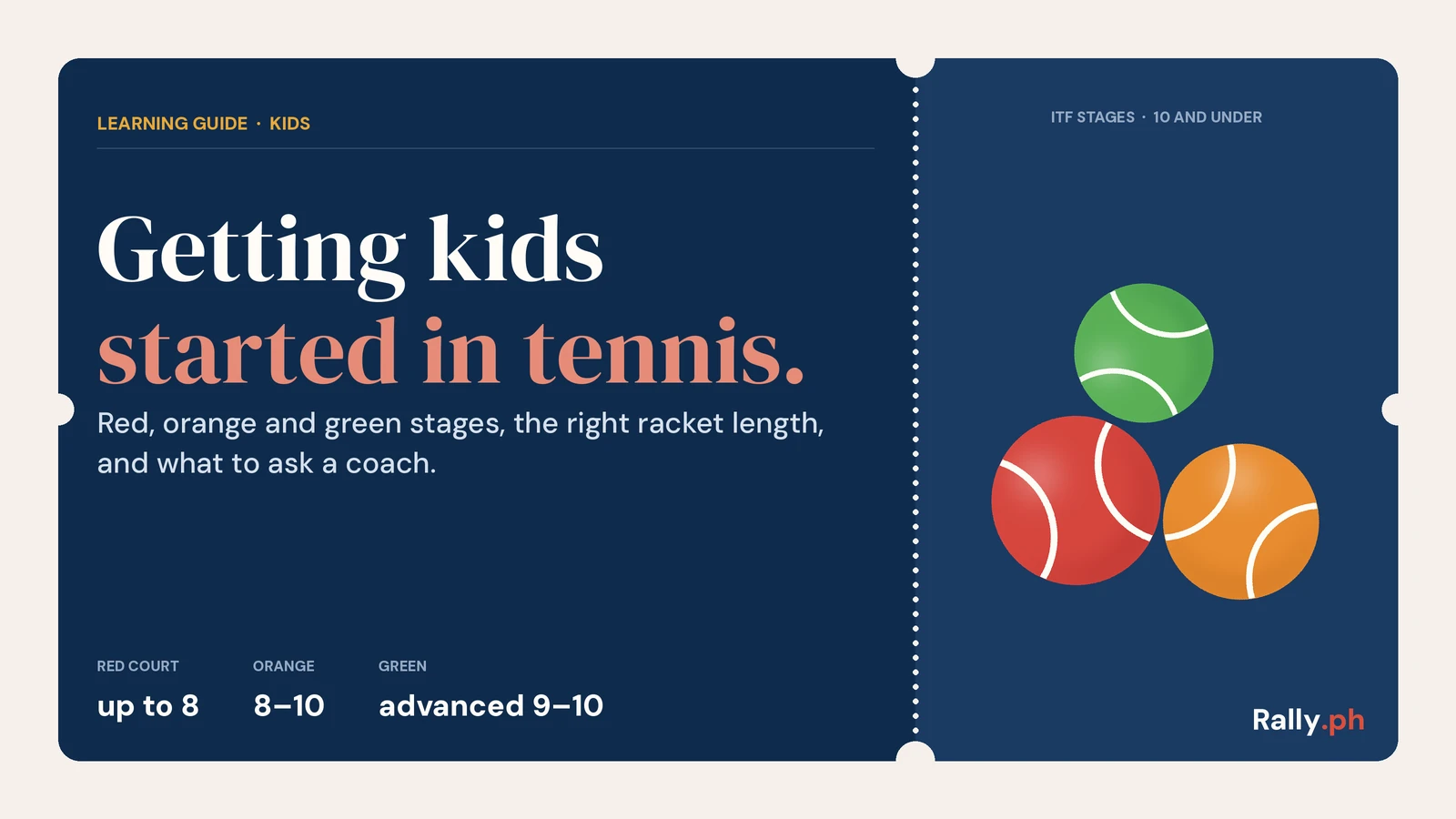
- Red (Stage 3): recommended for players up to 8, on a red court, with a racket up to 23 inches.
- Orange (Stage 2): recommended for ages 8 to 10, on an orange court, with a racket between 23 and 25 inches.
- Green (Stage 1): recommended for advanced 9 and 10 year olds, on a full-size court, with a racket between 25 and 26 inches.
- Ask the coach which stage they use, and whether they can mark a smaller court on a regular one. Ages are recommendations; a child's height and skill matter as much as the birthday.
- Official 10-and-under competitions cannot use a standard yellow ball. Short formats and timed matches are allowed.
Why the smaller game exists
A full tennis court, under ITF Rule 1, is 78 feet (23.77 m) long and 27 feet (8.23 m) wide for singles, or 36 feet (10.97 m) wide for doubles. The net is 3 feet (0.914 m) high at the centre. Those measurements suit adults. They do not suit a seven-year-old.
The slower, low-compression balls give a child time to get in position and make a swing. Our tennis balls guide covers how the ITF describes those balls — generally lighter and softer than standard balls, and easier to control — and how the felt versions are marked (a red, orange or green mark, not just a coloured can). The ITF expects players to move from Stage 3 to Stage 1 and then to the standard yellow ball.
The same idea sits behind the ITF's Tennis Play and Stay campaign, launched in 2007: starter players should be able to serve, rally and score from the first lesson, using slower balls. In 2010 the ITF's member nations approved a rule, later written into the Rules of Tennis, that 10-and-under competition may not be played with a regular yellow ball. That rule is still in the 2026 code, as Appendix VIII.
The three stages, as the ITF writes them
These figures are from Appendix VIII of the 2026 Rules of Tennis. The ages and racket lengths are recommendations for 10-and-under competition. A coach may keep a child on a stage for longer, or move them on sooner, if the child's size and skill support it.
Red, or Stage 3. A red court is a rectangle between 36 and 42 feet (10.97 to 12.80 m) long and between 14 and 20 feet (4.27 to 6.10 m) wide. The net is between 31.5 and 33 inches (0.800 to 0.838 m) high at the centre. The Stage 3 (red) ball is recommended for play on that court by players aged up to 8, using a racket up to 23 inches (58.4 cm) long. The ball comes as foam or felt.
Orange, or Stage 2. An orange court is between 58 and 60 feet (17.68 to 18.29 m) long and between 20 and 27 feet (6.10 to 8.23 m) wide. The net is between 31.5 and 36 inches (0.800 to 0.914 m) high at the centre. The Stage 2 (orange) ball is recommended for players aged 8 to 10, with a racket between 23 and 25 inches (58.4 to 63.5 cm).
Green, or Stage 1. This stage uses a full-size court. The Stage 1 (green) ball is recommended for advanced players aged 9 to 10, with a racket between 25 and 26 inches (63.5 to 66.0 cm). It is the last step before a standard yellow ball.
You will sometimes see other age bands in national programme charts. The USTA, for example, describes red tennis as a target of about 4 to 9 years in some programming, orange often used at 9 to 10 (and in some community programmes older than that), and green typically at 11 to 12. Those are United States programme ages, not the ITF recommendations, and they are not a Philippine pathway. If a chart you find online disagrees with the ITF figures above, ask the coach which system they are following, and go by the child's actual hitting rather than the birthday alone.
How a smaller court is set up
Most clubs and public courts in the Philippines are full-size hard courts. That does not block a red or orange lesson. The USTA's youth stages page describes a common setup for red tennis on a full court: play in the area between the service line and the baseline, with a portable net placed perpendicular to the full-size net and some extra lines added. It also notes that a child can practise on a small section of a regular court, such as a service box plus the alley, using the existing net.
Coaches often mark the smaller court with throw-down lines, cones or chalk. Our suggestion is to ask, before the first paid lesson, whether the coach has red and orange balls and a way to mark the court, rather than assuming a "kids' class" already uses them.
What to take, and what to ask
You do not need a full adult kit. A racket of the right length, the right stage of ball, water, a cap and court shoes with a non-marking sole are enough to start. Our beginner equipment guide covers the rest of a starter kit, and the balls guide explains how to recognise Stage balls on a shop shelf.
Questions worth asking a coach:
- Which stage will my child play, and why?
- Do you use red, orange and green balls, or only yellow ones?
- How will the court be marked?
- How many children are in the group, and for how long?
- What should we practise at home, if anything?
Our guide to finding a tennis coach in Metro Manila covers where to look and what to expect. For a court, start with our Metro Manila court guide or the beginner's guide to starting tennis in the Philippines. We have not listed academies or prices here, because those change and we have not independently checked a national kids' programme list for this piece. The PHILTA guide explains what the national association does if you later want a competition pathway.
Philippine courts are hot. Our conditioning guide covers timing, hydration and recovery for players. The same ideas — earlier or later sessions, water, a break in the shade — are worth taking seriously when you bring a child. That is our advice, based on that guide, not a paediatric medical protocol.
How 10-and-under matches work
If your child is ready to play a match, the rules are more flexible than a televised tour event. Appendix VIII says that 10-and-under competitions using red, orange or green balls may use the usual scoring methods in the Rules of Tennis, and may also use short formats: one match tie-break, a best of three tie-breaks or match tie-breaks, one short set, or one regular set. The tournament committee may also set a specific time period for matches.
Adult scoring — 15, 30, 40, deuce — still appears, and our scoring guide explains it in plain language. For a first match, a short set or a timed format is often easier for children and for the parents watching. Which format is used is the organiser's decision.
A simple way to think about progress
The aim at the start is not a perfect serve. It is that the child can serve, rally and score with a ball and a court that fit. When rallies become easy on red, orange is the next step; when orange feels small, green; when green feels slow, yellow. That sequence is the ITF's, not a timetable. Some children will spend a year on red. Some will move faster. The mistake is to skip the first stages to "play real tennis" and then wonder why the child cannot keep a rally going.
Sources
- International Tennis Federation, Rules of Tennis 2026: Rule 1 (court dimensions) and Appendix VIII (10 and under tennis competition)
- International Tennis Federation, Tennis Play and Stay campaign background, as described in the IOC Sport and Active Society case study, ITF Tennis Play and Stay Campaign, and Dave Miley, "Tennis10s", ITF Coaching and Sport Science Review, issue 51, August 2010
- USTA, Youth tennis stages (for the common method of marking a red court on a full-size court, and for a note that US programme ages can differ)