Most weekend tennis in the Philippines is doubles, and most of the confusion on court is not about the score. It is about where to stand, who takes the ball in the middle, and whether your partner is about to cross. The official rules say less about that than people think.
The ITF Rules of Tennis 2026 fix the order of serving and receiving, and they say where the server must stand to start the point. They do not require a one-up, one-back formation. The server's partner and the receiver's partner may stand anywhere on their own side of the net. What follows is in two parts: what the rules actually require, and what coaches at Britain's Lawn Tennis Association tell club players about positioning, covering the middle, poaching and signals. The second part is coaching advice, not law.
The short answer
- Each team chooses its first server and its first receiver in a set, then partners rotate in a fixed order until the set ends.
- After the return of serve, either partner may hit the ball. There is no "it's your side" rule in the book. If both partners touch the return of serve, the team loses the point.
- Net players may stand anywhere on their own side, including outside the court, unless they hinder the opponents.
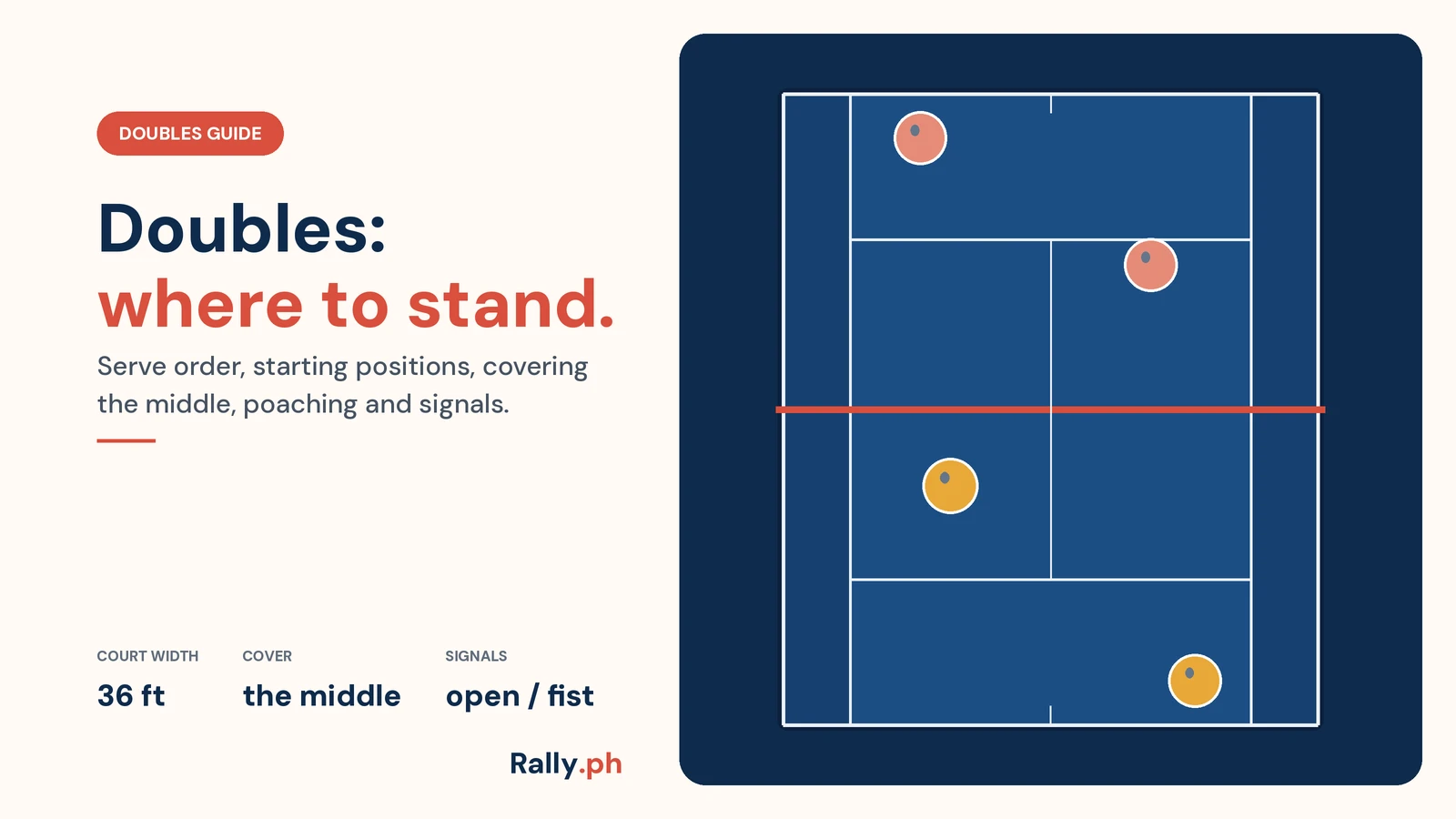
- In the usual club formation, do not start in the tramline (the doubles alley). LTA coaches tell the server's partner to stand in the middle of the service box, the returner's partner at the back of the service box in the centre, and the server about two feet from the tramline.
- Cover the middle, move with your partner, and agree before the point if you plan to poach. An open hand at the net can mean you will cross; a clenched fist can mean you will stay.
What the rules actually require
A doubles court, under ITF Rule 1, is 78 feet long and 36 feet wide, which is nine feet wider than a singles court. Those extra strips along the sides are the doubles alleys, often called tramlines in British coaching.
Serving and receiving order is set in Rules 14 and 15. The team due to serve in the first game of a set decides which player serves that game. Before the second game, the other team decides which of them serves. After that, partners take turns: the partner of the first server serves the third game, the partner of the second server serves the fourth, and so on until the set ends. Receiving works the same way, point by point. The team due to receive in the first game chooses who receives the first point; the other team makes that choice before its first receiving game. The partners then alternate: the player who received the first point of the game receives the odd-numbered points, and the partner receives the even-numbered ones, through the rest of the game and the set.
If you serve out of turn and the error is found before the game ends, the correct server takes over at the current score. If the game is already over, the new order usually stands. A receiving-order error is left as it is until the end of that game, then the original order is restored in the next receiving game. Those details are in Rule 27. The practical habit is to agree, before the first point of a set, who serves first and who receives first on the deuce side, and to stick to it.
Where you may stand. Immediately before the service motion, Rule 16 requires the server to stand at rest, with both feet behind the baseline and within the imaginary extensions of the centre mark and the sideline. In a standard game the server starts from the right half of the court, then alternates halves, and the serve must land in the diagonally opposite service court, which is the singles service box — an alley serve is a fault. The receiver, under Rule 8, may stand anywhere on the receiver's side, inside or outside the lines. Rule 26, Case 5, gives the same freedom to the server's partner and the receiver's partner: any position on their own side of the net, inside or outside the court. If a position or a movement hinders the opponents, the hindrance rule applies. A deliberate hindrance costs the point; an unintentional one usually means the point is replayed.
After the return, either of you can hit the ball. Rule 15 says so in those words. There is no rally rotation. The team does lose the point, under Rule 24(l), if both players touch the ball when returning it. Call "yours" or "mine" early, and if you both freeze, the player who can take it with a forehand should, in our view, take it — that last part is our suggestion, not a rule.
Our scoring guide covers games, sets and tie-breaks, including the doubles service rotation in a tie-break. Our etiquette guide covers line calls, the warm-up and behaviour between points.
Where LTA coaches want you to start
The positions below come from Sophie Cockell, an LTA Accredited Level 4 coach and doubles specialist, in the LTA's "Four easy fixes" advice, and from LTA coach Matt Smith in the LTA's doubles tactics guide. They describe a starting shape, not a place you have to freeze.
When your partner is serving. Cockell says club players often gravitate to the net and stand in the tramlines. Once the ball is in play and is opposite you, she wants the net player directly in the middle of the service box, not including the tramline, so you can move, cover more of the court and make it harder to be lobbed. Matt Smith adds that the net player's depth should change with the point: further in when you are attacking, in the middle of the service box when the point is neutral, and closer to the service line when you are defending.
When you are serving. Cockell suggests standing about two feet from the tramline, rather than in the usual singles position closer to the centre (the "tee"). She says that gives your partner more space and gives you more angle on the serve. The server still has to obey Rule 16: behind the baseline, between the centre mark and the sideline.
When you are the returner's partner. Cockell wants you at the back of the service box, in the centre, so you can still defend the middle if the return does not go cross-court.
When you are returning. Cockell's general rule is to hit down the line only if you are sure the ball will not come back; otherwise, keep the return cross-court, away from the opposing net player, so your own net player can move into a more positive position in the middle of the service box.
Cover the middle. Cockell calls the centre of the court the key area to control in doubles. She tells players to imagine the court is about a foot smaller and to stay inside that, forcing opponents to hit the lower-percentage ball down the line, over the higher part of the net. Net players, she says, should be careful not to hug their tramline. Louis Cayer, the LTA's "British doubles guru", makes the same point about a common club fear of being passed down the line: if you guard the tramline when the opponent is under pressure and hitting a difficult ball, you give them more space and almost no chance of a poach. When they are under pressure, he says, squeeze the middle and be ready to attack.
Move with your partner. Smith's version of teamwork is simple: if your partner is pushed wide, you come in towards the middle; if your partner squeezes in, you can push out. Doubles players need to move in tandem.
Get to the net, but staggered. Cockell says one of the easiest ways to win when you are first playing doubles is to get to the net with your partner as soon as you receive a short ball. The best formation, in her view, is both at the net against a one-up, one-back team. She does not want the pair shoulder-to-shoulder on top of the net. They should be staggered, standing around the service line, so one can cover a lob. The space that feels like "no man's land" in singles, she says, gives you options in doubles. Cayer's advice on lobs is consistent with that: stand too close to the net and you will be lobbed often; from the middle of the service box you only have to cross the service line behind you to intercept the lob.
Poaching, the I-formation and signals
A poach is the net player moving across to intercept a ball that was heading for their partner, usually the return of serve. Cayer describes three moments to poach when your partner is serving:
- By reaction: you had not planned to poach, but the return is a slow, easy cross-court ball and you volley it away.
- By anticipation: you read the cross-court return and cut it off.
- By agreement: you decide with your partner before the point. If you move early and the return goes down the line, the server already knows to cover that side.
For the net player's starting place on a poach, Cayer says: if the serve is wide, be in the middle of the court without crossing the centre; if the serve is down the T, have both feet just over the centre line. You can poach from a regular formation or from the I-formation. The I-formation, Cayer says, is the most common poaching setup, because both players start near the middle and can move in either direction.
Cayer also notes that you do not only poach on the serve. When the server stays back — which he says happens 60 percent of the time at pro level, and even more at recreational level — and the rally is going cross-court, the net player can move towards the middle and poach in the rally. That 60 percent figure is Cayer's, not a Rally PH statistic.
Talk between points. Smith's LTA guide says that when partners are not talking, they often use hand signals, usually from the net player, and that there are usually at least two signals before each serve. The first is serve direction: little finger, index finger or thumb for a serve down the T, into the middle of the service box, or out wide. The second is what the net player will do: an open hand means they will come across to intercept the return; a clenched fist means they will stay. You do not need a professional signal book for a barangay court. You do need a shared plan. A simple "I stay" or "I'm crossing" before the serve is enough.
Cayer's other beginner advice is about the partnership, not the pattern. Doubles is a team sport. Praise a good shot, encourage after a mistake, and agree a short routine after every point — even a few seconds to meet, talk about the next point, and go back into position. If you are anxious about being hit at the net, he recommends waiting with a continental grip, ready for a backhand volley, because that protects you and gives you reach; it is easier to switch to a forehand than the other way around. Our forehand grip guide explains the main grips, including the eastern "shake hands" grip; a coach can show you the continental volley grip on court.
A first checklist for Philippine club doubles
Before the set: decide who serves first and who receives the first point on the deuce court, and keep that order.
As the point starts: server about two feet from the alley, server's partner in the middle of the service box, returner's partner at the back of that box in the centre — those are Cockell's starting points, inside the ITF's freedom to stand anywhere on your side.
During the point: cover the middle, move together, and if you plan to cross, say so. After the return, either of you may take the ball; do not both take it.
None of that replaces a lesson. It should, at least, stop the most common club mistake: four people standing in the alleys, leaving the middle of the court open.
Sources
- International Tennis Federation, Rules of Tennis 2026: Rule 1 (court), Rule 8 (server and receiver), Rules 14 and 15 (order of service and of receiving in doubles), Rule 16 (the service), Rule 17 (serving), Rule 24(l) (both partners touching the return), Rule 26 and Case 5 (hindrance and partner positions), Rule 27 (correcting errors)
- LTA, Sophie Cockell, Four easy fixes to help you win more doubles matches
- LTA, Matt Smith, Essential doubles tactics and hand signals
- LTA, Louis Cayer, How to improve your doubles skills