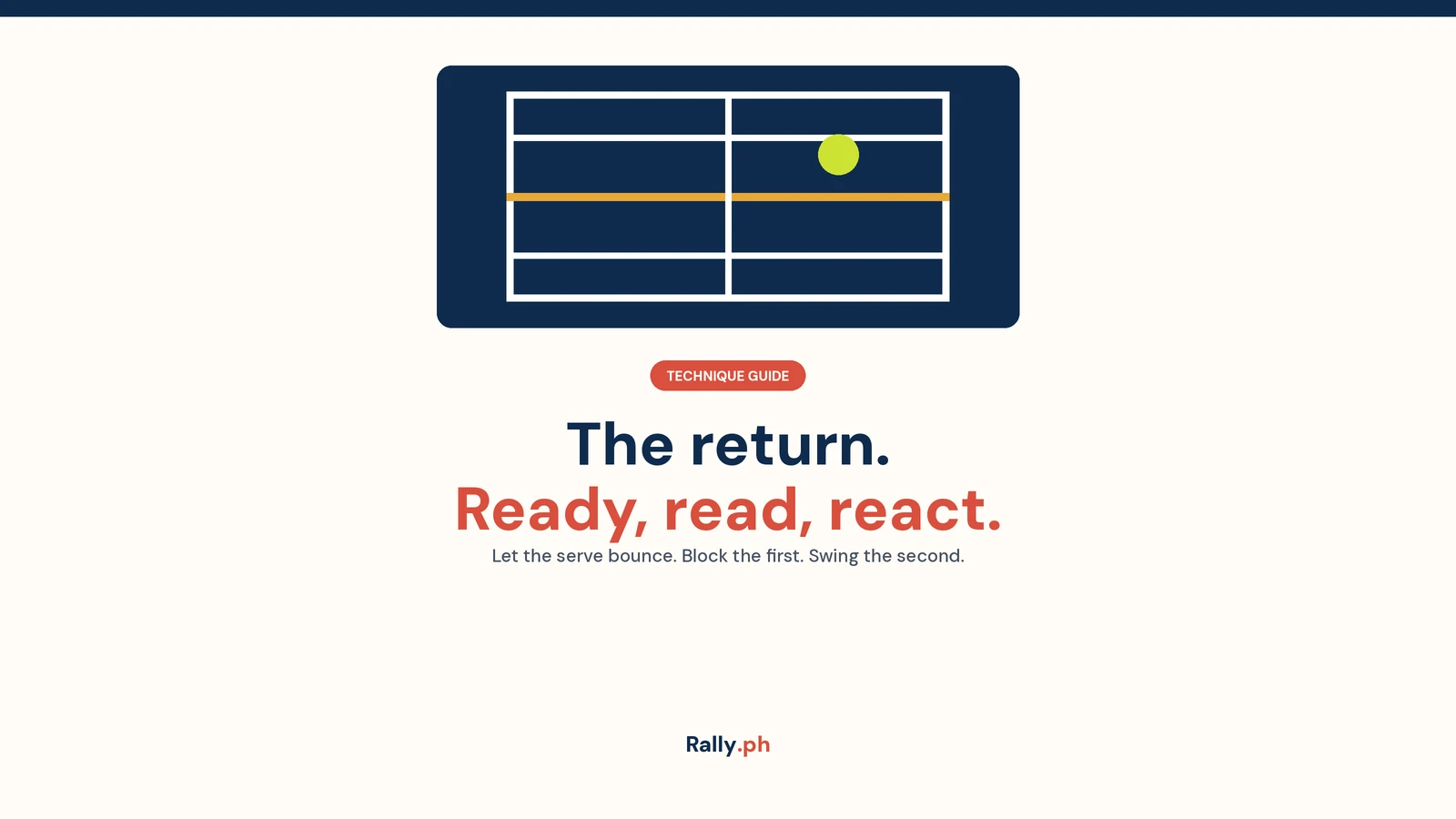
The return of serve is the first ball you hit in every game you do not serve. It is also the shot that decides whether you get into the point at all. A first serve can arrive quickly; a second serve often gives you more time. The job, especially for beginners, is to make a high-percentage return and start the rally.
The rules below come from the ITF Rules of Tennis 2026. The method comes from the Lawn Tennis Association's return guide: ready, read, react. The tactics are coaching, not rules.
The short answer
- Let the serve bounce. Rule 24(e) says the receiver loses the point for returning the service before it bounces. You may stand anywhere on your side of the net, inside or outside the lines.
- Ready, read, react. Be in an athletic stance with the racket in front of you. Watch the server's body and contact point. Get the racket behind the ball before it bounces and hit out in front, around waist height if you can.
- Block a fast first serve; swing on a slower second serve. The LTA's first priority on a hard first serve is to get into the point. On a slower second serve you can take a longer swing.
- Play the percentages. As a starting guide, the LTA suggests: a serve down the T, return down the middle (down the line is a slightly lower-percentage option); a serve to the centre of the box, return to the middle, to the server's feet; a serve out wide, return cross-court over the middle of the net.
What the rules require
The serve must bounce. Under Rule 24(e), the point is lost if the receiver returns the service before it bounces. A volley of the serve is not a legal return. Our volley guide is for balls after the serve has already been put in play.
You may stand anywhere on your side. Rule 8, Case 1, asks whether the receiver is allowed to stand outside the lines of the court. The decision is yes: the receiver may take any position inside or outside the lines on the receiver's side of the net. That is why you will see club players step well behind the baseline for a fast serve, or move inside the baseline for a slower one. Both can be legal.
The server has to wait until you are ready. Rule 21 says the server must not serve until the receiver is ready. A receiver who attempts to return the service is considered ready. If it is demonstrated that the receiver is not ready, the service cannot be called a fault. A serve made when you are not ready is a let under Rule 22, not a free point. Our serve guide covers faults, lets and where the server must stand. Our scoring guide covers which side you receive from in a game.
Ready, read, react
If you remember one phrase, the LTA says it should be ready, read, react.
Ready. Get in a good position: racket out in front, legs nicely wide in an athletic stance, knees bent, chest up, and on the balls of your feet, ready to pounce. If the server has a fast serve, you might stand further back to give yourself more time. If it is a slow serve, you might stand a bit further in, in front of the baseline.
Read. Watch your opponent closely. From their body shape and where they contact the ball, you can read the ball's height, depth, direction, spin and speed, and make a quick judgement about how and where it is likely to land.
React. Adjust your body and racket so you can reach the ball and send it back. Before the ball bounces, the LTA says, you are looking to get your racket back behind the ball and hit out in front of your body, at about waist height if possible. Get your full body weight behind the shot to help guide it back over the net — true, the LTA says, whether you are a beginner or a pro.
The first movement often starts with a split step as the server makes contact. Our footwork guide covers that hop and the recovery after you hit.
Block versus swing
Once the three steps are in place, the LTA turns to what kind of swing you use. That is largely dictated by the serve you are receiving and how much time you have.
First serve — block. When the ball is coming faster and you have less time, focus on blocking it back over the net and use the incoming pace to direct it. The most important thing, the LTA says, is to get into the point.
Second serve — swing. When the ball often comes a bit slower, you can take the time to lengthen your swing and generate some of your own pace, which takes time away from the server.
If it is a slower second serve you also have more options on direction. The LTA notes that a good idea is to hit to the server's weaker side, but only once getting the ball in remains the first job.
Where to send it
When you have time, placement can help you start the point on the front foot. The LTA still puts getting the ball back first. As a rough, high-percentage guide:
- If the serve goes down the T, return down the middle, or you can go down the line (a slightly lower-percentage option).
- If the serve goes to the centre of the box, return to the middle, to the server's feet.
- If the serve goes out wide, return cross-court over the middle of the net.
This is guidance, not a rule. The LTA presents it as a starting point that gives you the best chance of being in the rally.
Two drills with a partner
The LTA offers two short practices.
Reaction tree. A partner stands in front of you with a ball in each hand, arms stretched out like a tree. You stand a couple of feet away, in a ready position as if you are about to hit a return. The partner drops a ball on one side; you catch it in one hand after one bounce, out in front of you. The partner should mix sides so you do not know which ball is coming.
Serve and return. Start in the service boxes. Your partner stands in the opposite diagonal box and throws the ball into your box like a serve. Catch it with two hands and throw it back side-on, like a rugby ball. The feeder can also use a racket. When that feels comfortable, take a racket, move back to the baseline, and have your partner hit with a bit more power, replicating a serve, while you return into court and aim for those percentage targets. As a bonus, the LTA says your partner can serve from their service line, which cuts your time and tests the reaction further.
Warm up before a basket of returns. Our 20-minute warm-up is a better start than standing in for first serves on a cold shoulder.
Sources
- International Tennis Federation, Rules of Tennis 2026: Rule 8 Case 1; Rules 21 and 22; Rule 24(e)
- LTA, How to improve your return of serve in tennis