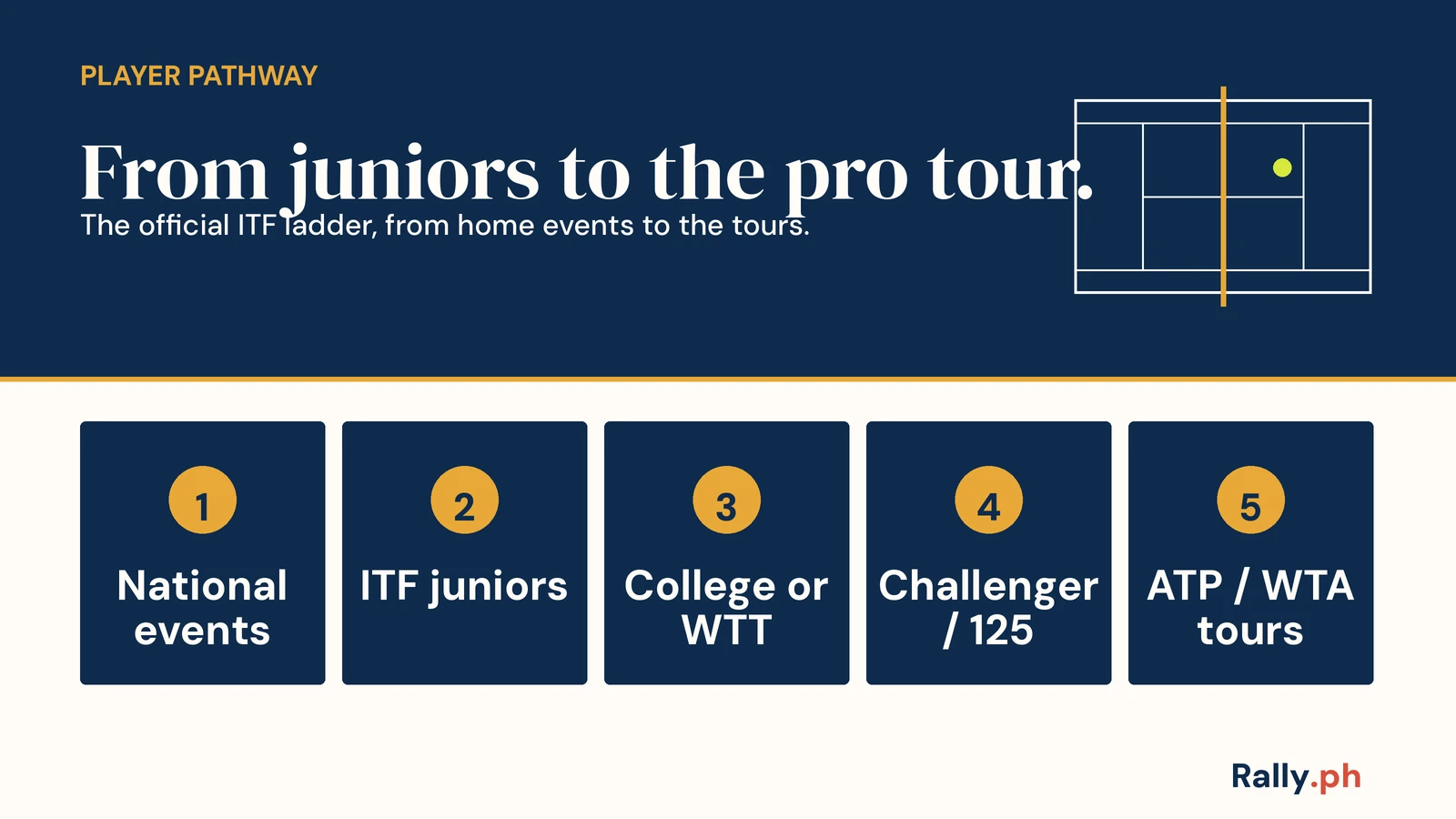
There is no single exam that turns a junior into a professional. The official path runs through events that already exist: national tournaments at home, the ITF World Tennis Tour Juniors, then either the professional ITF World Tennis Tour — where players start earning ATP or WTA ranking points — or a college season that the ITF also recognises through its College Accelerator programme.
This guide is a map of those official 2026 rules, not a coaching plan and not a list of scholarships, fees or visas. Those change, and we have not verified them here. For current calendars, allocations and eligibility, use the ITF, ITA, WTA, ATP and PHILTA channels linked in Sources. Our rankings explainer covers how points on each list are counted.
The short answer
- Start at home. PHILTA, the national association, publishes national rankings and is the ITF member body for the Philippines. Which local events count toward the national list is PHILTA's call. Our PHILTA guide explains membership, rankings pages and how to enter events it sanctions.
- The international junior tour is the ITF World Tennis Tour Juniors. In 2026 it is open to players born between 1 January 2008 and 31 December 2013, from the year they turn 13 (if that birthday falls on or before the start of the singles main draw) until the end of the year they turn 18. Players need an IPIN Juniors membership and the required ITF Academy courses. The Combined Junior Ranking uses the six best singles results and one quarter of the six best doubles results from the previous 52 weeks.
- The first professional step is the ITF World Tennis Tour. Men's events are M15 and M25 (US$15,000 and US$30,000 in prize money, including +H hospitality events). Women's events are W15, W35, W50, W75 and W100. Both tours require an IPIN membership and completion of the Tennis Integrity Protection Programme (TIPP). Players under 14 are not eligible to enter, using their age on the Monday of the tournament week.
- Juniors and college players can get reserved professional places. The 2026 regulations include a Junior Accelerator programme, Junior Reserved places for some top-100 junior rankings, and a College Accelerator programme based on year-end ITA NCAA Division 1 collegiate rankings.
- A separate ITF World Tennis Tour ranking is being wound down. The ITF says that ranking will be discontinued in 2027, and that the World Tennis Number will matter more for acceptance in 2027. ATP and WTA points earned at these events are a different system and are not part of that discontinuation.
National events, then the junior tour
Most Filipino juniors first play events organised or sanctioned in the Philippines. PHILTA is the national governing body recognised by the ITF. It publishes national rankings, and it has hosted ITF junior events in Manila. How you join, where the national lists appear, and how to ask whether a tournament counts are covered in the PHILTA guide. We have not restated a national points formula, because that is PHILTA's to publish and confirm.
The ITF junior tour sits above that national layer. Under the 2026 ITF World Tennis Tour Juniors regulations, a player must be under the jurisdiction of an ITF member nation, hold a valid IPIN Juniors membership (through ipin.itftennis.com) and pay the annual fee, and complete the mandatory ITF Academy courses before using the online entry system. Nationality on the junior ranking follows the nationality on the player's passport at IPIN registration.
Tournament grades on the junior tour run from J30 up through J60, J100, J200, J300 and J500, plus junior Grand Slams, the ITF World Tennis Tour Junior Finals, and international team competitions. A junior Grand Slam or Youth Olympics singles title is worth 1,000 ranking points; a J500 title is 500, down to 30 for a J30 title. Ranking points start only after a player has played and won a main-draw round.
The Combined Junior Ranking, which is what juniors mean when they talk about an "ITF junior ranking," takes the six best singles results and one quarter of the six best doubles results from the previous 52 weeks. To be eligible for a 2026 year-end junior ranking, a player must have played at least six individual junior singles tournaments, including at least four Grand Slam, Junior Finals and/or J500 events, and including at least three ranking tournaments outside his or her own country. Each Grand Slam or J500 title counts as two tournaments played and as one foreign tournament. The full point tables and tie-break rules are in the rankings explainer.
ITF junior events in the Philippines, when they are on the calendar, are entered through the same IPIN system, not through a separate local form. Fact sheets and deadlines live in the player's IPIN account and on the ITF junior tournament pages.
Stepping onto the professional tour
The 2026 ITF World Tennis Tour regulations classify professional men's tennis as the Grand Slams, the ATP Tour, the ATP Challenger Tour and Men's WTT events, and they treat Men's and Women's WTT tournaments as the ITF's own professional events. That is the official ladder: juniors, then WTT, then Challenger or WTA 125 events, then the ATP and WTA tours.
Men's WTT events offer US$15,000 or US$30,000 in prize money and are named M15 and M25, including the +H hospitality versions. Women's WTT events offer US$15,000, US$30,000, US$40,000, US$60,000 and US$100,000 and are named W15, W35, W50, W75 and W100, again including +H versions.
To enter either tour, a player must register for an applicable IPIN membership, accept its terms, and complete the Tennis Integrity Protection Programme (TIPP). Missing either step makes the player ineligible to enter and compete. Entries are made through the IPIN account at ipin.itftennis.com. On the men's tour, a player may apply for up to six Men's WTT tournaments in the same week and must indicate a priority; the ITF assigns a priority if none is given. A player's place is not official until the entry deadline and the publication of the acceptance list.
Minors under the age of 14 are not eligible to enter Men's or Women's WTT events. Age is taken on the Monday of the tournament week. Players under 14 also cannot obtain an ITF World Tennis Ranking, and they cannot obtain a WTA ranking.
On the men's tour, the 2026 regulations state that all players — those with an ATP ranking, an ITF World Tennis Ranking, an eligible ITF Combined Junior ranking, a national ranking, or no ranking — may enter Men's WTT events by the entry deadline, subject only to the age and play-down rules, and will appear on the acceptance lists. Who actually gets into the main draw or qualifying is then decided by the System of Merit in the same book. One of those methods, Method E (Junior Reserved), says entered players with an approved ITF Combined Junior Ranking of 1–100 shall be selected for a maximum of three main-draw places, on the terms set out there. Women's WTT events have their own System of Merit in the same document; players should read the current acceptance rules for the tour they are entering.
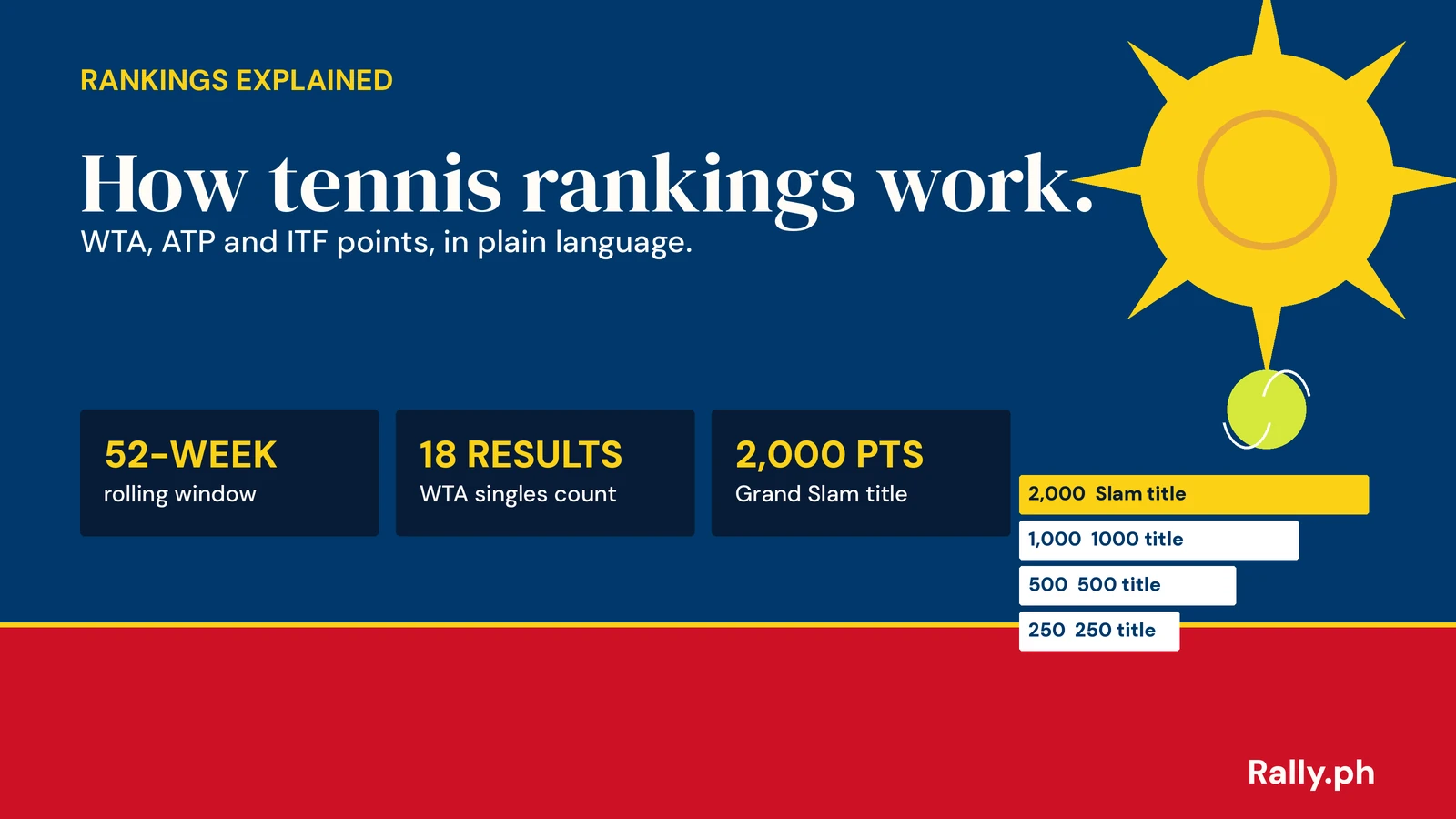
Results at these events can earn ATP or WTA ranking points as well as, during 2026, the ITF's own World Tennis Tour ranking points. The ITF's 2026 points tables say the separate WTT ranking will be discontinued in 2027. Points awarded during 2026 count only toward 2026 WTT ranking calculations and are removed at the end of the year. The ITF says the World Tennis Number will then matter more for acceptance into professional WTT tournaments. That change does not, by itself, remove ATP or WTA points from these events; those points are set out in the WTA and ATP rulebooks described in the rankings explainer.
Junior Accelerator places
Appendix D of the 2026 WTT regulations describes a Junior Accelerator (JA) programme that gives eligible juniors direct entry they would not otherwise get on their professional or national ranking. The ITF allocates only one JA position per tournament. The player must still enter the allocated tournament through IPIN; the ITF does not enter the player automatically. A JA application form has to be sent to the ITF.
The 2026 tables are built on 2025 year-end ITF junior rankings, plus junior Grand Slam winners and runners-up who are not already inside the named bands:
- Girls. JA places are in the singles main draw of Women's WTT events, for the top 20 players who received an ITF year-end junior ranking in 2025, and for junior Grand Slam winners and runners-up outside that top 20. The number and level of events (up to and including W100, W75, W50 or W35) depends on the year-end position, as set out in the appendix. The WTA Age Eligibility Rule is taken into account.
- Boys. JA places are in the singles main draw of Men's WTT events and in ATP Challenger Tour events, for the top 30 players who received an ITF year-end junior ranking in 2025, and for junior Grand Slam winners and runners-up outside that top 30. The 2026 table awards the top 10 (and junior Grand Slam winners) up to eight Challenger 50 and Challenger 75 singles main draws plus up to two M25 and/or M15 main draws, with smaller Challenger or M15/M25 allocations further down the list, through positions 21–30.
Applications received by 24 December 2025 for published tournaments were processed against those year-end lists. Later applications are treated in the order received. A player may change or add tournaments as the calendar grows, but must ask the ITF to use the JA place at least one week before the relevant entry deadline. If two or more players apply for the same tournament, the place goes to the player with the higher year-end junior ranking.
These are the 2026 programme rules. Later years will have their own year-end lists and application dates; use the current regulations, not this summary, when you apply.
College tennis, and the College Accelerator
College tennis is an official, recognised alternative in the same ITF rulebook, not an unofficial detour. The 2026 College Accelerator (CA) programme uses year-end ITA Collegiate Tennis rankings for NCAA Division 1, and the Division 1 NCAA Championships, to grant direct entry into professional WTT events. As with the junior programme, the number of tournaments depends on whether the player is returning to college in autumn.
- Women. The top five year-end ITA NCAA Division 1 women's rankings, plus the winner and finalist of the Division 1 NCAA Championships, may apply for direct entry into the main draw of up to five Women's WTT tournaments. The 2026 allocation table gives players who are not returning a mix of events up to and including W75, W50 and W35; players who are returning receive a smaller set, up to and including W75 and W50.
- Men. Players with a year-end ITA NCAA Division 1 men's ranking between 21 and 30 inclusive may apply for direct entry into the main draw of up to eight Men's WTT tournaments. The 2026 table gives eight events up to and including M25 if the player is not returning to college, and six such events if the player is returning.
The regulations do not, in that appendix, describe a College Accelerator band for men ranked 1–20, and we have not inferred one. Anyone relying on a CA place should read Appendix D in the current WTT regulations, confirm the ITA ranking list that is being used, and apply through the process the ITF publishes for that year.
This article does not cover college admissions, athletic scholarships, eligibility hours, or the cost of playing US college tennis. Those sit with the ITA, the NCAA, and each university. Philippine university leagues are organised separately; they are not described in the ITF appendix above, and we have not invented a local college-to-pro rule for them.
What to take from the map
The official pathway is a sequence of lists and entry systems: a national ranking at home, an ITF junior ranking built from graded junior events, then professional acceptance through ATP or WTA points, the ITF's remaining World Tennis Tour ranking (through 2026), the World Tennis Number, Junior Reserved and Accelerator places, or a College Accelerator place after an NCAA Division 1 season.
None of those lists is a promise of a tour career, and none of this is a substitute for the current fact sheet of the event you want to enter. If you are already following Filipino juniors, Meet the PH Juniors profiles some of the players on that path. For the weekly professional rankings those players are chasing, use the rankings explainer and the official WTA, ATP and ITF pages.
Sources
- International Tennis Federation, 2026 ITF World Tennis Tour Juniors Regulations, regulation 4 (eligibility, IPIN, Academy courses, birth-year window) and regulations 10–14 and 30–31 (Combined Junior Ranking, grades and points)
- International Tennis Federation, 2026 ITF World Tennis Tour Regulations (men's and women's sections: purpose and event classifications; IPIN and TIPP; under-14 entry and ranking rules; men's entry by ranking status, including unranked players; IPIN entry, six-event weekly cap and acceptance lists; Method E Junior Reserved places; Appendix D, 2026 Junior Accelerator and College Accelerator programmes)
- International Tennis Federation, World Tennis Tour Ranking points tables, 2026 (discontinuation of the separate WTT ranking after 2026)
- Women's Tennis Association, 2026 WTA Official Rulebook, Section VIII.A.2 (players under 14 cannot obtain a WTA ranking)
- Philippine Tennis Association membership and national rankings, as described in our PHILTA guide