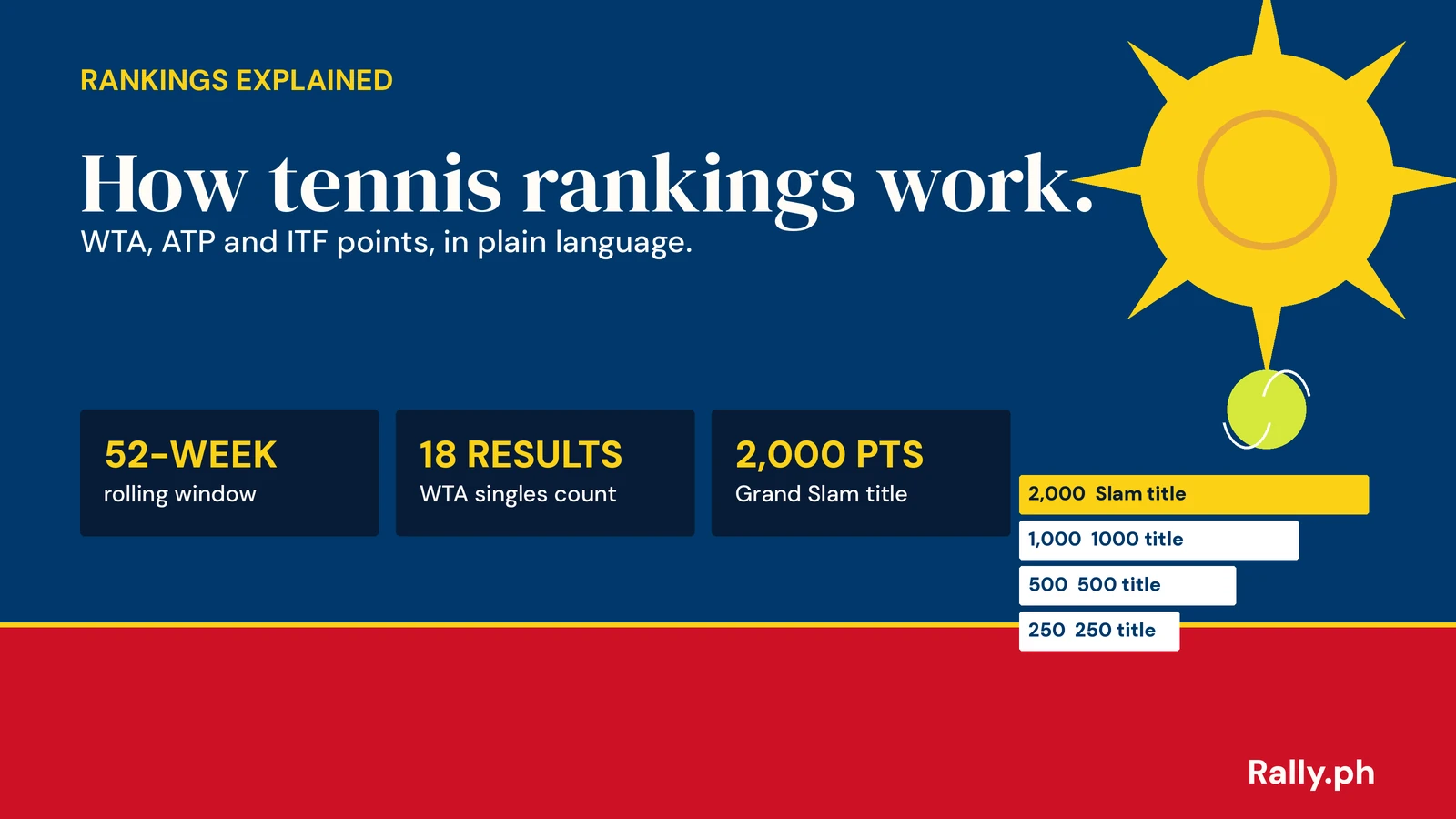
A tennis ranking is not a season total that resets in January. The WTA and ATP lists that decide who gets into a draw, and who is seeded, add up points from a rolling 52-week window. A title earned this week still has to be replaced, or it falls off, the same week next year. That is why a player can win a match and drop in the ranking, or lose and still rise.
This explainer covers the official 2026 WTA, ATP and ITF rules: how points are earned, which results count, how long they last, and how the ITF junior list and PHILTA national rankings sit beside the professional tours. For current numbers, use the official ranking pages linked in Sources. Match scoring — love, deuce, tie-breaks — is covered separately in our scoring guide.
The short answer
- WTA and ATP rankings are 52-week totals used for tournament entry and seeding. They are not the same as the calendar-year races that decide who qualifies for the season-ending finals.
- A WTA singles ranking is built from 18 results: the four Grand Slams, six combined WTA 1000 Mandatory events, one WTA-only 1000, and the best seven other eligible results. The WTA Finals, if played, is added as a bonus 19th result. A WTA doubles ranking uses the best 12 results.
- An ATP singles ranking, for a player counting a full set of mandatory events, is built from the four Grand Slams, eight mandatory ATP Tour Masters 1000 events, the Nitto ATP Finals if played, and the best six other eligible results (United Cup, ATP 500 and 250, Challenger and ITF men's events). An ATP doubles ranking uses a player's best 18 results in the ranking period.
- Points follow the round and the level. A Grand Slam singles title is worth 2,000 points on both tours. A WTA 1000 or ATP Masters 1000 title is worth 1,000. From there the tables step down through 500, 250 and 125 events, Challengers, and ITF World Tennis Tour events.
- ITF junior rankings are a different list. The Combined Junior Ranking takes the six best singles results and one quarter of the six best doubles results from the previous 52 weeks.
- PHILTA national rankings are a third, domestic list. They do not replace a WTA, ATP or ITF ranking. Our PHILTA guide explains where those lists are published.
The 52-week rule
The WTA's official rankings page describes the PIF WTA Rankings as a rolling 52-week, cumulative system, introduced on 3 November 1975, and used to determine entry and seeding in singles and doubles. The 2026 WTA Official Rulebook (Section VIII) adds the precise clock: points stay valid for 52 weeks from the week in which a tournament is included in the WTA Rankings totals. The exception is the WTA Finals, whose points drop off on the Monday after the final WTA tournament that takes place before the following year's Finals.
The 2026 ATP rankings chapter uses the same idea. The PIF ATP Rankings and PIF ATP Doubles Rankings cover the immediate past 52 weeks, except that points from the Nitto ATP Finals drop on the Monday after the last ATP Tour event of the following year. ITF men's events are entered into the ATP system on the second Monday after the tournament week; once entered, they also remain for 52 consecutive weeks.
In practice, that means every result has an expiry date. When a large result falls out of the window and is not replaced by something of similar value, the player's total falls even if she or he is still winning matches. We walked through one such week in what Eala's drop to No. 45 meant for her 2026 season; the arithmetic here is the same system, not a special rule for one player.
WTA rankings are computed and published weekly from the WTA's Florida office. The ATP document says the PIF ATP Rankings and PIF ATP Doubles Rankings are run approximately 45 times a year, so they are not issued on every calendar week.
Which results count
WTA singles and doubles
Subject to the long-term injury and special ranking rules, a player's WTA singles ranking is the total of her points from 18 tournament results in the rolling 52-week period. The 2026 rulebook says those 18 must include:
- four Grand Slams;
- six WTA 1000 Mandatory combined or virtually combined tournaments;
- one WTA 1000 Mandatory tournament that is WTA-only;
- the best seven results from all WTA 1000 Mandatory, WTA 500, WTA 250 and WTA 125 tournaments and ITF W15 and above events.
If she played the WTA Finals, that result is added as a bonus tournament. For each Grand Slam or WTA 1000 Mandatory event she is not required to count, the number of other results that count increases by one.
The WTA's Rankings Explained page names the events in those 1000 groups. The combined 1000s are Indian Wells, Miami, Madrid, Rome, Toronto/Montreal, Cincinnati and Beijing (the best six of those count). The non-combined 1000s are Doha, Dubai and Wuhan (the best one counts).
A WTA doubles ranking is the player's best 12 tournament results in the same 52-week period.
To appear on the WTA Rankings at all, a player must earn ranking points in at least three valid tournaments, or a minimum of 10 singles ranking points or 10 doubles ranking points in one or more valid tournaments. Players under the age of 14 cannot obtain a WTA ranking; if they play, those events do not count for ranking purposes.
ATP singles and doubles
The ATP rankings are the official method for entry and seeding in men's singles and doubles. Every player who has earned points in an eligible professional tournament during the ranking period is included. Eligible events are ATP Tour and ATP Challenger Tour tournaments, the Grand Slams, and ITF M25, M25+H, M15 and M15+H events.
For a commitment player, the year-end ranking published on the Monday after the Nitto ATP Finals is the total of points from the four Grand Slams, the eight mandatory ATP Tour Masters 1000 tournaments, the Nitto ATP Finals, and the best six results from the United Cup, ATP Tour 500 and 250 events, the ATP Challenger Tour and ITF men's World Tennis Tour events. If the player is not in the main draw of a Grand Slam or mandatory Masters 1000 — and was not, and would not have been, a main-draw direct acceptance, and never became one — the number of other results that count increases by one. Once a player is accepted into the main draw of one of those 12 tournaments, as a direct acceptance, qualifier, special exempt or lucky loser, or after accepting a wild card, that result counts whether or not he plays.
The same chapter says that in weeks when there are not four Grand Slams and eight Masters 1000 events inside the 52-week window, the number of a player's other counting results is adjusted accordingly.
A player's ATP doubles ranking is his best 18 results from all eligible tournaments in the ranking period, including the Nitto ATP Finals (doubles). There are no mandatory events for doubles entry, but once a player is in the main draw of a Grand Slam or one of the eight Masters 1000 events, that result counts, whether or not he participates, subject to a once-a-year withdrawal exception described in the rulebook.
The ATP also publishes a separate PIF ATP Doubles Team Rankings, which ranks men's doubles pairs on a calendar-year basis from each team's best 19 results. That list is not the same as an individual player's 52-week doubles ranking.
What the points tables look like
Players are awarded points for the highest round they reach. A wild card receives the same WTA ranking points as any other player. Qualifiers and lucky losers have their own additions, which are spelled out in each rulebook; the figures below are the main-draw values from the official 2026 tables.
The 2026 WTA Official Rulebook prints a table headed "2025 WTA Ranking Point Chart." The same winner and finalist figures appear on the WTA's Rankings Explained page, dated as we read it on 19 November 2026. Selected singles totals:
- Grand Slam: 2,000 for the champion, 1,300 finalist, 780 semi-final, 430 quarter-final, 240 round of 16, 130 round of 32, 70 round of 64, 10 first-round loss in a 128 draw.
- WTA 1000: 1,000 / 650 / 390 / 215.
- WTA 500: 500 / 325 / 195 / 108.
- WTA 250: 250 / 163 / 98 / 54.
- WTA 125: 125 / 81 / 49 / 27.
- ITF World Tennis Tour: a W100 title is 100 points, a W75 is 75, a W50 is 50, a W35 is 35 and a W15 is 15.
The WTA's official page also lists WTA Finals singles points as 1,500 for the champion, 1,080 for the finalist and 750 for a semi-final, plus 125 points for each round-robin match played and 160 for each round-robin win.
The 2026 ATP points table is close, but not identical, at a Grand Slam. Selected singles totals:
- Grand Slam: 2,000 / 1,300 / 800 / 400 / 200 / 100 / 50 / 10. The semi-final (800) and quarter-final (400) are different from the WTA's 780 and 430.
- Nitto ATP Finals: 1,500 for an undefeated champion, built as 200 for each round-robin win, 400 for a semi-final win and 500 for the final win.
- ATP Masters 1000: 1,000 / 650 / 400 / 200.
- ATP 500: 500 / 330 / 200 / 100.
- ATP 250: 250 / 165 / 100 / 50.
- United Cup: 500, with the detail in a separate section of the ATP rulebook.
- Challenger: a Challenger 175 title is 175 points, then 125, 100, 75 and 50 at the lower Challenger levels.
- ITF men's events: an M25 or M25+H title is 25 points; an M15 or M15+H title is 15.
Those ITF figures are WTA and ATP ranking points earned at World Tennis Tour events. They are not the same thing as the ITF's own World Tennis Tour ranking, which the ITF says will be discontinued in 2027. During 2026 those separate WTT ranking points are still awarded, but they count only toward 2026 WTT ranking calculations. At the end of 2026 they are removed, and the ITF says the World Tennis Number will matter more for acceptance into professional WTT events in 2027. The WTA and ATP points in the tables above are not part of that discontinuation.
Rankings are not the Race
The 52-week ranking decides entry and seeding. Qualification for the season-ending championships uses a different leaderboard.
The WTA keeps a Race to the Finals list for a defined "Race Year": tournaments starting the week before the previous year's WTA Finals, through and including tournaments two weeks before the current year's Finals. To qualify for the WTA Finals in singles, a player must have played at least eight WTA 1000 Mandatory or WTA 500 tournaments during the Race Year, unless she qualifies for a long-term injury exception. The singles field is then the top seven players on the Race to the Finals leaderboard, plus, if there is one, the highest-ranked current-year Grand Slam winner who sits between 8 and 20 and is not already qualified; otherwise the next player ranked 8 or below. Year-end WTA rankings are processed immediately after the WTA Finals.
The ATP's year-end ranking, as noted above, is the 52-week calculation published on the Monday after the Nitto ATP Finals. The calendar-year race that fills the Finals field is a separate official list. For the current Race and ranking tables, use the official WTA and ATP ranking pages in Sources.
ITF junior rankings
Juniors who play the ITF World Tennis Tour Juniors are ranked on a different computer list, published by the ITF, not by the WTA, ATP or PHILTA.
Under the 2026 ITF World Tennis Tour Juniors regulations, the Combined Junior Ranking is taken from the preceding 52 weeks: the six best singles results in Grand Slam, J500, ITF World Tennis Tour Junior Finals, International Team Competition, and J300, J200, J100, J60 or J30 tournaments, plus one quarter of the six best doubles results from those same events. Official published rankings use a 52-week rollover. A player may count only the best result from up to two editions of the same J100 or higher tournament inside that window; results from the same J60 or J30 may be counted more than once among the best six.
To appear on the junior ranking, a player must reach a round where points are available. For a 2026 year-end junior ranking, the player must have played in at least six individual junior singles tournaments, including at least four Grand Slam, ITF World Tennis Tour Junior Finals and/or J500 events, and including at least three ranking tournaments outside his or her own country. Each Grand Slam or J500 title counts as two tournaments played, and as one foreign tournament.
The 2026 junior points table awards 1,000 points for a junior Grand Slam or Youth Olympics singles title (700 finalist, 490 semi-final, 300 quarter-final). A J500 title is 500 points, a J300 is 300, a J200 is 200, a J100 is 100, a J60 is 60 and a J30 is 30. No ranking points are awarded until a player has played and won a main-draw round (a first-round bye is not a win; a walkover or a retirement after a match has started is).
Eligibility for the 2026 junior tour is limited to players born between 1 January 2008 and 31 December 2013, who may compete in the year they turn 13 if they have reached that birthday on or before the start of the singles main draw, until the end of the year they turn 18. They must be under the jurisdiction of an ITF member nation, hold an IPIN Juniors membership, and complete the required ITF Academy courses. Age caps on how many junior events a player may play in a year are set out in the same regulations.
National rankings, and where to look
PHILTA, the Philippine Tennis Association, publishes its own national rankings. Those lists are separate from the WTA, ATP and ITF junior computers. How points are earned on the national list, and which local events count, is PHILTA's decision; confirm that with PHILTA or the organiser before you enter. The live lists, membership routes and ITF junior events hosted in Manila are covered in our PHILTA guide.
If you are new to following a Filipino player week to week, New to tennis because of Alex Eala? Start here is the fan primer. Official current rankings are always the WTA, ATP, ITF and PHILTA pages, not a screenshot or a social post.
Sources
- Women's Tennis Association, Rankings Explained, and 2026 WTA Official Rulebook, Section VIII (ranking system and points table), Section VI (Race to the Finals and qualification), and the glossary definition of Race Year
- ATP Tour, 2026 Official Rulebook, Chapter IX, PIF ATP Rankings (52-week rule, singles and doubles composition, points tables, doubles team rankings)
- International Tennis Federation, 2026 ITF World Tennis Tour Juniors Regulations, regulations 4 and 10–14 and the points tables in regulation 31
- International Tennis Federation, World Tennis Tour Ranking points tables, 2026 (discontinuation of the separate WTT ranking after 2026)
- Philippine Tennis Association rankings and membership, as described in our PHILTA guide; official lists are published on philta.org