If you play tennis in the Philippines, someone in your group has probably already asked you to try pickleball. It is the paddle sport now set up in malls, village courts and even a downtown street in Ortigas. The good news for tennis players: you will be rallying within minutes. The catch is that some of your best tennis habits are exactly what loses points here.
This guide covers how the game differs from tennis, why it has grown so fast here, what carries over from your tennis and what doesn't, where to try it in Metro Manila, the gear you actually need, and whether it will hurt your tennis.
What pickleball is, in tennis terms
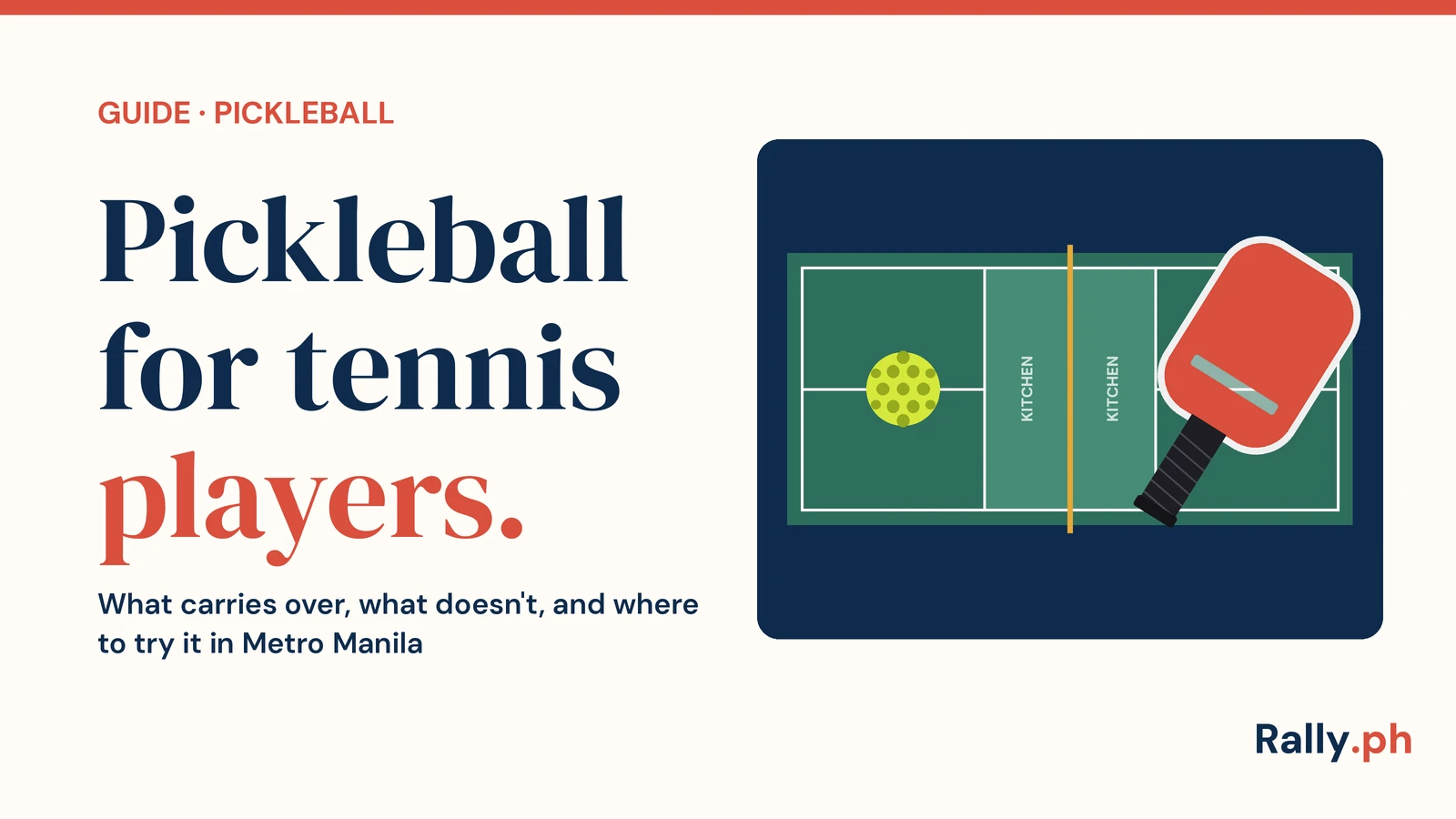
Pickleball is played with a solid paddle and a light plastic ball with holes, over a net, in singles or doubles. The rules below are from USA Pickleball, whose official rulebook sets the standard court size many Philippine venues advertise.
- A much smaller court. A pickleball court is 20 by 44 feet (about 6.1 by 13.4 metres) for both singles and doubles. That is less than a third of the area of a doubles tennis court, so there is far less ground to cover and far less room to hit long.
- A slightly lower net in the middle. It is 36 inches at the sidelines and 34 inches in the centre. A tennis net is 36 inches in the centre.
- Paddle and ball. The paddle has no strings, so you get less pocketing and spin than with a racket. The perforated ball is light and slows down quickly through the air. Outdoor balls are harder and made for wind. Indoor balls are softer.
- An underhand serve. You serve underhand, making contact below the waist, diagonally into the opposite service box. You get one serve, not two, and a serve that touches the kitchen line is a fault.
- The two-bounce rule. The return of serve must bounce, and then the serving side's next shot must bounce too. Only after that can anyone volley. Serve-and-volley does not exist.
- The kitchen. The 7-foot area on each side of the net is the non-volley zone, which everyone calls the kitchen. You cannot volley while standing in it, and it is a fault if your momentum carries you into it after a volley. You can step in to play a ball that has bounced.
- Scoring. In standard scoring, only the serving side wins points. Games are usually to 11, win by 2. In doubles the server calls three numbers: their score, the opponents' score, and whether they are the first or second server. It sounds strange for a game or two, then it sticks. If tennis scoring still trips up your friends, our tennis scoring explainer is the other half of the conversation.
Why it is booming here
The numbers have grown quickly.
- 68,812 players, 595 member clubs and 537 venues. That is the Philippine Pickleball Federation's count, reported by BusinessMirror on 12 November 2026. The same federation directory figures were reported by DYNK on 8 October, which notes clubs from Cebu and Davao to Zamboanga, Negros and Catanduanes.
- 108 SM pickleball courts. SM Supermalls says it has 108 pickleball courts across 33 malls, after opening six at SM City East Ortigas (Philstar, 12 October 2026). It announced the figure with a ₱1-billion investment in sports facilities (Philstar, 2 October 2026). DYNK, citing SM, puts the count at 61 courts at the end of 2025 and 86 by June 2026.
- Cheap to play. PickleBoard, a court directory, tracks 2,591 active venues in the country. Across the 597 that published a rate in August 2026, the median was ₱150 per player for open play and ₱300 an hour to hire a court (PickleBoard rates guide).
Low cost is part of it. Courts are small, so a mall or a single tennis-sized space can hold several. Open play also means you can turn up alone and get rotated into games.
Several of the country's top players came from tennis. Sarah Jane Lim, described by BusinessMirror as the country's top-ranked female pickleball player, played tennis from age nine through university before switching after the pandemic. Leander Lazaro told the same briefing that his training principles are similar to those he followed in tennis.
What transfers from tennis
- Hand-eye coordination and timing. You already track a moving ball and meet it in front. Most tennis players rally comfortably in their first session.
- Volleys and touch at the net. Pickleball doubles is mostly a net game. If you like volleying in doubles, this is your sport.
- Footwork. Split step, small adjustment steps and staying on your toes all apply, over shorter distances.
- Doubles sense. Moving with your partner, covering the middle and reading the opponents' positions carry straight over.
- The continental grip. The grip you use for volleys and serves works for most pickleball shots.
What doesn't
- The big swing. A full tennis groundstroke sends the light ball long on a 44-foot court. Shorten the backswing and push through the ball.
- The serve as a weapon. It is underhand, and you get one. Aim for depth and consistency, not aces.
- Rushing the net after serving. The two-bounce rule means you wait for the return to bounce, then hit, then move up.
- Living at the baseline. Points are won at the kitchen line. The team that gets there first and stays patient usually wins.
- Hitting hard to win. The soft shot that drops into the kitchen, called a dink, is the most important shot in the game. Tennis players tend to skip learning it, and lose to players who haven't.
Lim put the gap well in her interview with BusinessMirror: "It wasn't hard to learn the sport [pickleball]. But to get better at it is different, because it's a different game style."
Where to try it in Metro Manila
Prices below are as each source published them. Rates, hours and booking rules change often, so check with the venue before you go.
- Street Pickleball Ortigas, Pasig. Often called the birthplace of Philippine pickleball. Eight courts are chalked onto Emerald Avenue in Ortigas Center on Saturdays and Sundays from 4 PM to 9 PM, weather permitting. Registration is in front of the Strata 2000 building. The fee is ₱150 per player and includes play, paddles, balls and ice water (Philippine Pickleball Federation). What's On Manila calls it the cheapest way to try the sport. Check the Street Pickleball Facebook group on the day, since rain cancels play.
- Ayala Malls the 30th, Pasig. Courts in the middle of the mall. Open play from ₱150 per player and court hire at ₱250 an hour, per The GAME (21 October 2026).
- Four E-Com Center, Pasay. Six courts near SM Mall of Asia, open 10 AM to 11 PM. Open play is ₱280 per head, court hire ₱600 an hour, and paddle rental ₱100 an hour. Bookings are through SM Tickets, Reclub or walk-in (The GAME).
- The Pickle Spot, Makati. A two-court club on Pasong Tirad with a big open-play community on Reclub. Open play costs ₱280 to ₱300, and there is a ball machine for solo practice (What's On Manila, updated October 2026).
- Activate One Ayala, Makati. Air-conditioned indoor courts at Ayala Malls One Ayala, from ₱1,200 an hour (The GAME). What's On Manila notes that only clean, non-marking indoor court shoes are allowed and court bookings cannot be cancelled or refunded.
- SM Pickleball. SM's courts are spread across its malls, including six at SM City East Ortigas (Philstar). Rates vary by mall, so check the branch you plan to visit.
Most clubs post open play on the Reclub app, where you can join a session alone. Weekday evenings and weekend mornings fill first.
Gear basics for a tennis player
- Paddle. Rent or borrow one before you buy. Street Pickleball Ortigas includes paddles, and Four E-Com rents them by the hour. Once you know what you like, pick a mid-weight paddle you can swing comfortably for an hour.
- Balls. Use outdoor balls outdoors and indoor balls indoors. Most open play sessions supply them.
- Shoes. Your tennis shoes are a good choice. Court shoes with side support suit the quick lateral steps. Running shoes don't. Indoor venues often require clean, non-marking soles.
- Everything else. Tennis clothes, a towel and water. Outdoor courts in the middle of the day are hard work, so play early or after sunset. Our guide to playing in Philippine heat applies here too.
Will it hurt your tennis?
Honestly, it depends on how you use it.
What can slip. Pickleball rewards short, compact swings and soft touch. Switch straight from a pickleball session into a tennis match and your groundstrokes may feel short and your timing late for a few games, since the tennis ball comes through faster and heavier. Hitting off a solid paddle also feels different from a strung racket.
What can improve. Volleys, reflexes at the net, soft hands and doubles positioning all get plenty of practice, because pickleball is played mostly at the net.
How to keep both. Keep at least one tennis session a week if your tennis matters to you. Take a few minutes of full-swing rallying to warm up before tennis matches when you've been playing pickleball. If you play both on the same day, you may find it easier to play tennis first. Doing both is common: BusinessMirror reports Lazaro talking about young athletes who already play the two sports.
Whichever you play, BusinessMirror's report also notes that pickleball still needs proper conditioning, warm-ups and the right shoes. A small court doesn't mean no injuries, especially if you are new to regular exercise. Our 20-minute warm-up works before either sport.
Looking for people to play with in the first place? Start with our guide to tennis communities and groups.
Sources
- USA Pickleball, What Is Pickleball? and rules summary
- John Eiron R. Francisco, Pickleball inclusion in Palarong Pambansa could boost youth sports, BusinessMirror, 12 November 2026
- DYNK, How Big Has Pickleball Become in the Philippines?, 8 October 2026
- Philstar.com, SM Sports and Leisure invests P1 billion to multi-sports facilities nationwide, 2 October 2026, and SM Pickleball expands to SM City East Ortigas, 12 October 2026
- PickleBoard, Pickleball Court Rates in the Philippines
- Philippine Pickleball Federation, Street Pickleball Ortigas
- RJ Ballecer, 6 More Pickleball Courts Where You Can Play in Metro Manila, The GAME, 21 October 2026
- What's On Manila, Where to Play Pickleball and Padel in Manila, updated October 2026