If your racket starts turning in your hand halfway through the first set, the problem may not be your technique. PAGASA puts the Philippines' mean annual temperature at 26.6°C, with average monthly humidity between 71% in March and 85% in September. In those conditions hands sweat quickly, and a grip that felt fine in an air-conditioned shop can turn slick long before the end of a session.
The fix is cheap and takes about two minutes, but only if you pick the right kind of grip and change it often enough. This guide covers the difference between a replacement grip and an overgrip, tacky versus dry, how an overgrip changes your grip size, when to change it, and how to wrap one properly.
The short answer
- Hands get wet early in a session: try a dry, absorbent overgrip. Tennis Warehouse's guide points players who want the most sweat absorption, or who play in hot and humid conditions, towards dry overgrips.
- Hands stay fairly dry: a tacky overgrip will feel more secure.
- Change it every 5 to 10 hours of play, sooner if it feels slippery, looks frayed or stays damp. That is the general rule from Babolat and the LTA, Britain's tennis federation.
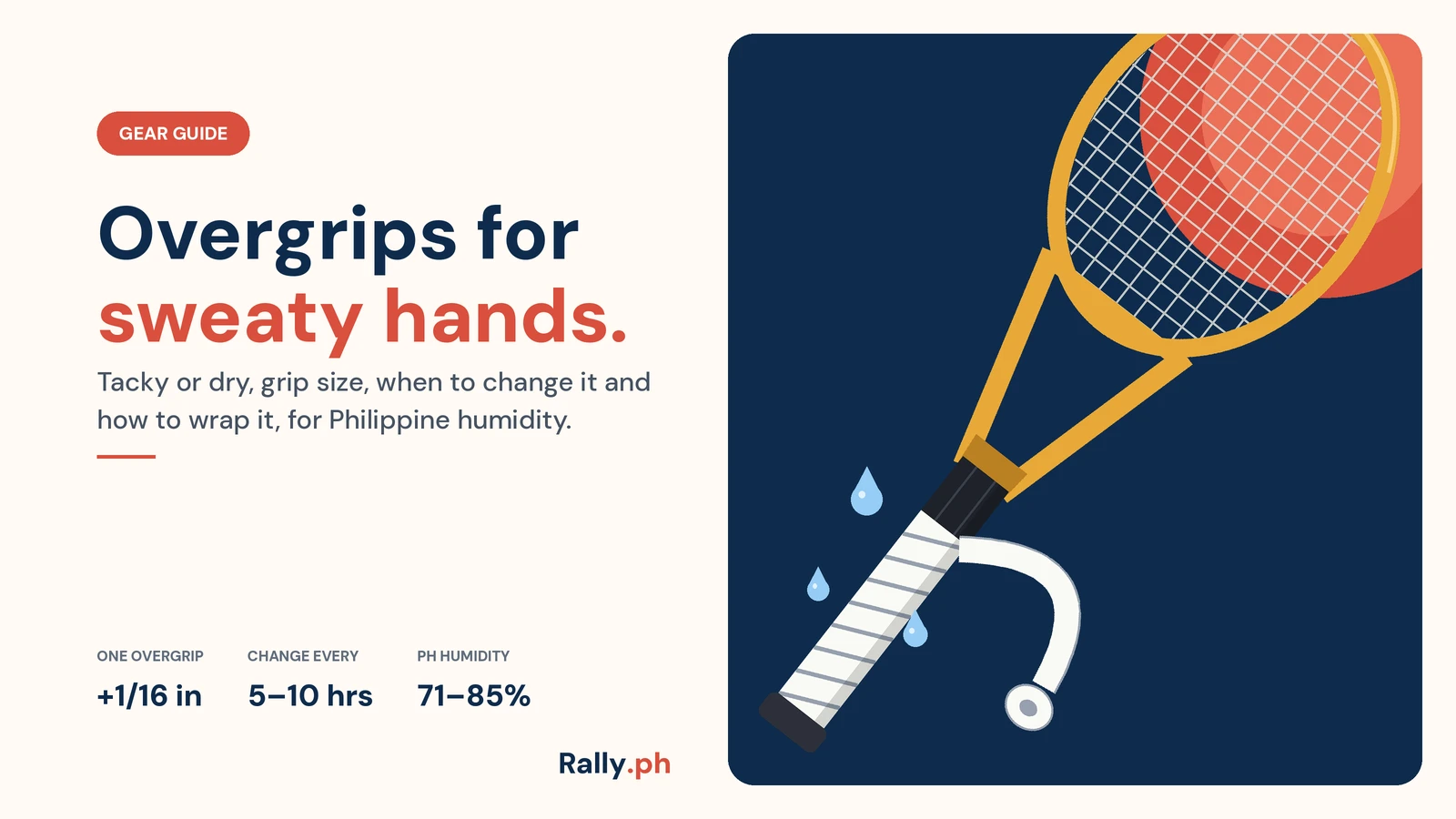
- Between two grip sizes? Buy the smaller handle and add an overgrip. A typical overgrip adds about 1/16 inch to the handle.
- Leave the replacement grip alone until it is worn out. The overgrip on top takes the wear.
Replacement grip or overgrip: what's on your handle
Every racket leaves the factory with a replacement grip, sometimes called the base grip. It is the thicker, cushioned wrap stuck directly to the handle with adhesive, and it provides most of the comfort you feel. Tennis Warehouse Australia's grip guide notes that replacement grips cost noticeably more than overgrips but last much longer, and are usually sold one to a pack.
An overgrip is a thin wrap that goes on top of the replacement grip. It has no cushion of its own and relies on the grip underneath for comfort. Its job is the surface your hand touches: tack, sweat absorption and a fresh feel. Overgrips usually come in packs of 3, 10 or 30, because you are meant to change them often. Babolat adds one more reason to use one: an overgrip protects the original grip, so the base grip lasts longer.
Most club players keep the factory grip and change only the overgrip. Replace the base grip itself when it is worn out, or when you want a different feel underneath.
Tacky or dry
Overgrips come in two broad feels.
Tacky overgrips have a slightly sticky surface that holds your hand in place from the first ball. They suit players whose hands stay fairly dry. Yonex's Super Grap is a well-known example: Yonex describes it as a tacky polyurethane overgrip, launched in 1987, 0.6 mm thick and 1,200 mm long, that absorbs shock and moisture. Babolat describes its Pro Tour 2.0 as tacky with excellent sweat absorption, and its VS Original as its thinnest overgrip, so thin that the company says it won't affect handle size.
Dry overgrips feel smoother, almost like cloth, and are built to soak up sweat. Tennis Warehouse recommends them for the heaviest sweaters and for hot, humid conditions, and the LTA's guide also says players who sweat heavily may prefer an absorbent grip. The best-known dry grip is Tourna Grip, the light blue overgrip that Tourna says is used by hundreds of touring pros. Tourna says it was invented in the United States in 1977, starts with a dry feel and becomes tackier as you sweat, because it wicks moisture through the grip and away from your hand. Those are the maker's claims, not Rally PH test results.
How to choose:
- Your hand is wet by the end of the warm-up, or you play outdoors at midday: start with a dry grip.
- You want to feel the handle's bevels clearly: pick a thin tacky grip.
- You play both hot afternoons and cooler evenings: our suggestion is to keep one of each in the bag and see which still feels secure by the second set in each condition.
What you can find in the Philippines
Toby's Sports listed these overgrips in its online store:
- Tourna Grip XL, as a 3-pack in blue and as single rolls, plus the Tourna Grip Roll sold per piece in blue, pink, white and black. Toby's own description calls Tourna Grip "fantastic for sweaty hands" and says it performs best on hot, humid days.
- Yonex AC102EX grips, including single pieces. Yonex Mexico lists AC102EX as Super Grap. Toby's files it under badminton grips, but its listing describes the grip for tennis, badminton and squash and gives the same 0.6 mm thickness.
We have left out prices, which change often. Stock also varies between branches and other shops, so check before you go. Our beginner equipment guide covers the rest of a starter kit.
Overgrips and grip size
Grip size is the distance around the handle, measured in inches. Most rackets come in sizes between 4 1/8 inches (size 1) and 4 5/8 inches (size 5). Tennis Warehouse and the LTA describe the same two ways to check yours:
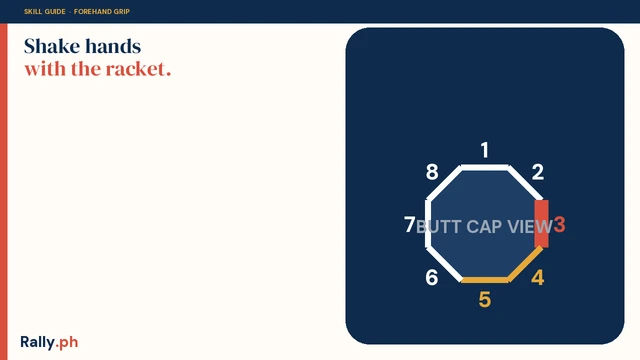
- The finger test: hold the racket with an eastern forehand grip, the "shake hands" grip. The index finger of your other hand should just fit in the gap between your ring finger and your palm. No room means the grip is too small; extra space means it is too big.
- The ruler test: open your hitting hand with the fingers together and measure from the lower crease of your palm to the tip of your ring finger. Compare the result with a grip-size chart.
Both sources give the same advice if you fall between sizes: choose the smaller handle and build it up. A typical overgrip adds about 1/16 inch, roughly half a size. Tennis Warehouse says some players use two overgrips, and that a heat-shrink sleeve under the grip adds about 1/8 inch, a full size. It puts the added weight of a grip at 4 to 8 grams, with negligible effect on balance.
Getting this right matters for more than comfort. Tennis Warehouse warns that long use of a grip that is too small or too big can contribute to tennis elbow, because either one takes more muscle strength to control. A handle that is too small has to be squeezed to stop it twisting, so if the racket turns in your hand even with a fresh overgrip, check the size before you blame the grip. Our forehand grip guide explains the eastern grip used in the finger test.
When to change your overgrip
Babolat and the LTA both give the same rule of thumb: every 5 to 10 hours of play. Babolat adds that this varies with how hard you play, how much you sweat and the conditions. Tennis Warehouse says there is no hard rule and that some players change it every session.
Change it sooner if you notice any of these signs, which Babolat, the LTA and Tennis Warehouse list:
- It has lost its tack, and the racket feels slippery.
- It is frayed, torn, discoloured or noticeably thinner.
- It stays damp, or has gone hard and flat.
- It is visibly dirty.
- You are getting blisters.
What that means in practice. At one two-hour session a week, 5 to 10 hours works out to a new overgrip every three to five weeks. That is our arithmetic, not a maker's rule, and players who sweat heavily in Philippine heat will usually hit the warning signs sooner. If you play several times a week, buy a 10-pack or a bulk roll rather than single grips.
Making a grip last in this climate
Babolat's care advice reads like it was written for Philippine courts:
- Avoid leaving grips in heat and humidity. Babolat says excessive exposure reduces an overgrip's absorption. In practice that means not leaving your bag in a hot car between sessions. That last point is our advice, based on Babolat's warning.
- Wash your hands before you play, so dirt doesn't build up on the grip.
- Keep the racket in a cover when you are not using it.
- Store spare overgrips in their packaging in a cool, dry place, and use them within a year of buying them.
Our own suggestion for sweaty players: carry a spare overgrip and a small towel in your bag. Drying your hand between points and changing the grip at a set break is quicker than playing a whole match with a slick handle.
How to wrap an overgrip
You need a pair of scissors and, if you like, a pen. These steps follow Tennis Warehouse's how-to guides and the LTA's instructions.
- Unwrap it. Unroll the overgrip, remove the plastic film and set the finishing tape aside.
- Peel the adhesive tab. Most overgrips have a short sticky strip on the tapered end. Peel off its backing. Tennis Warehouse notes that Tourna Grip has no tapered end or adhesive, so you simply start with the square end.
- Start at the butt cap. Place the tapered end at the bottom of the handle, on one of the short bevels, angled upwards.
- Wrap in the right direction. If you are right-handed, hold the racket upside down and pull the grip to the right as you wrap. Left-handers pull to the left.
- Keep the tension even. Overlap each turn by about 1/16 inch and avoid gaps and creases. The tighter you pull, the thinner the grip will feel.
- Trim and tape. At the top of the handle, cut off the excess. Some players draw a line around the grip first to get a neat finish. Secure the end with the finishing tape.
Replacing the base grip takes the same steps, with two extras. First remove the old grip and its staple and clean any leftover adhesive off the handle. Then start the new grip on the same bevel as the old one so the handle feels the same.
The rest of your hot-weather kit
The grip is your only contact with the racket, so it is worth getting right. Our guides to tennis balls for Philippine heat and humidity, string type and tension for Philippine humidity and conditioning for Philippine heat cover the rest.
Sources
- PAGASA, Climate of the Philippines
- Tennis Warehouse, Best tennis overgrips, How to change your tennis overgrip, How to measure your tennis grip size, How to increase your tennis grip size and How to replace a replacement grip
- Tennis Warehouse Australia, Tennis racquet grips (overgrips)
- LTA, Understanding tennis racket grip sizes and overgrips
- Babolat, How do I choose the right overgrip?
- Yonex, Super Grap product page, and Yonex Mexico, Super Grap AC102EX
- Tourna, Tourna Grip XL and Grips
- Toby's Sports, product listings for Tourna Grip XL (3 Pack), Tourna Racket Sports Grip Single XL, Tourna Grip Roll and Yonex AC102EX Grip