Most Philippine tennis happens outdoors, in a climate PAGASA puts at a mean annual temperature of 26.6°C, with average monthly humidity between 71% in March and 85% in September. The heat is obvious. The ultraviolet radiation is not, and it is what the hat, the shirt and the sunglasses are actually for.
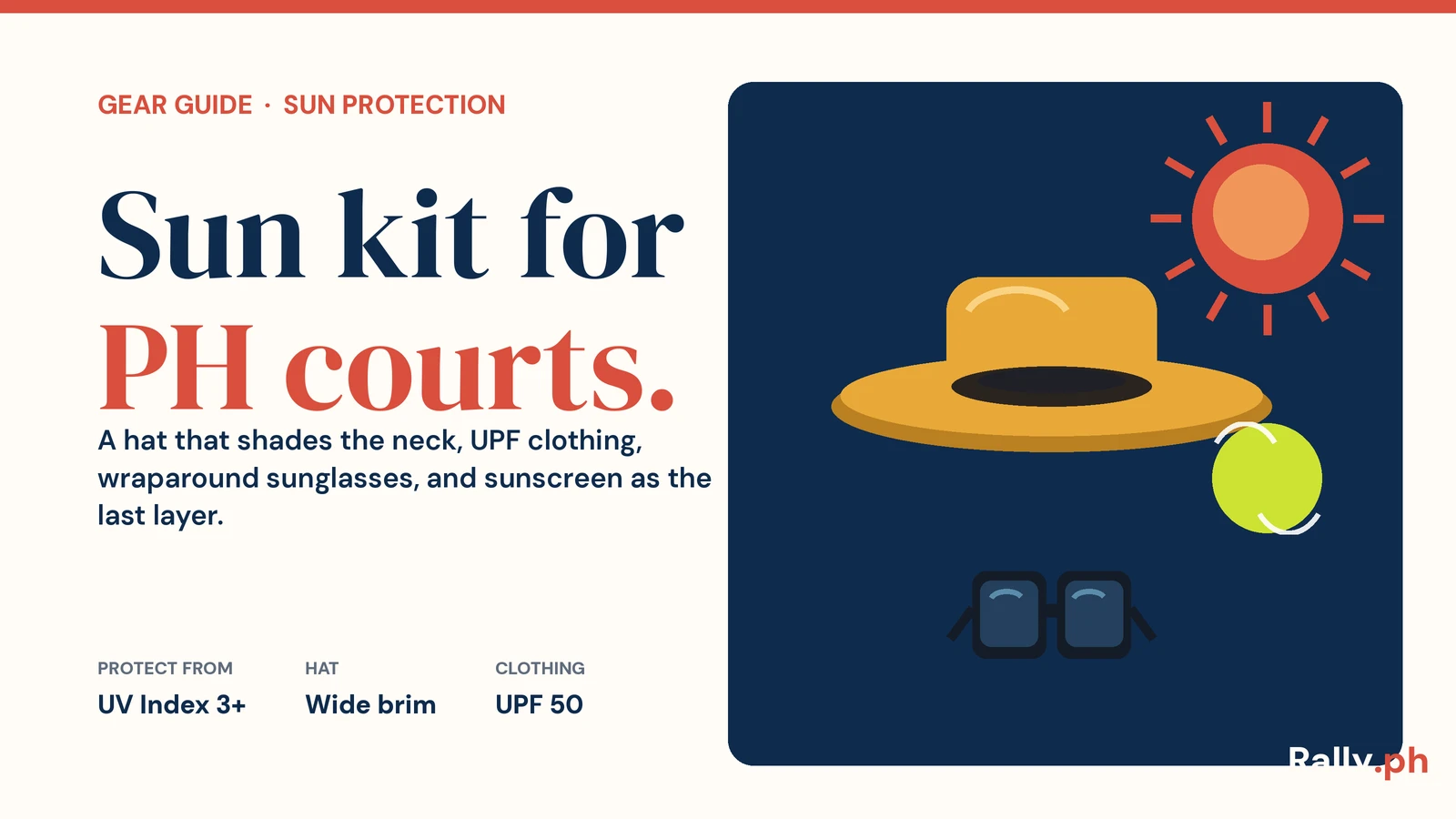
The World Health Organization recommends sun protection whenever the UV Index is 3 or above. You can look the day's index up on a weather service or app; the WHO also points to the SunSmart Global UV app. This guide is about the gear that goes with that advice: a hat that actually shades the ears and neck, clothing with a useful UPF rating, wraparound sunglasses, and sunscreen used as the last layer, not the only one.
Our beginner equipment guide already lists a hat or visor, SPF 50+ sunscreen and sunglasses as smart additions. This piece explains how to choose them, and why a visor on its own is not enough.
The short answer
- Protect whenever the UV Index is 3 or higher. The WHO's UV Index scale says that at 3 to 7 you should seek shade in the middle of the day and wear a shirt, sunscreen and a hat; at 8 and above, avoid being outside at midday if you can, and those three items are a must.
- Clothing and shade do more than sunscreen. The WHO is direct: sun protection is best achieved by seeking shade and wearing clothes rather than applying sunscreen, and sunscreen should not be used to stay out longer.
- Cancer Council Australia says caps and visors do not provide enough protection. Choose a broad-brimmed, legionnaire or bucket hat that shades the face, ears and neck. SunSmart's tennis advice is a broad-brim off court, and a legionnaire hat on court if you can play in one; if you wear a cap, be extra careful with sunscreen on the face, ears and neck.
- Look for UPF 50 clothing where you can. The WHO explains that a UPF 50 fabric blocks 98% of the sun's rays. SunSmart's tennis tips call long-sleeved shirts with collars ideal, in fabric rated UPF 50.
- Sunglasses should be wraparound and block 99 to 100% of UVA and UVB, which is the WHO's recommendation. Cancer Council adds that a broad-brimmed hat and sunglasses worn together can reduce UV reaching the eyes by up to 98%.
- Use broad-spectrum sunscreen of at least SPF 30 on skin that clothes do not cover. That is the WHO's minimum. Cancer Council and SunSmart's tennis page recommend SPF 50 or SPF 50+, water-resistant, applied at least 20 minutes before you go out and reapplied at least every two hours, and more often when you are sweating.
Why a visor is not enough
A visor shades the eyes and feels cooler than a closed cap. It does not shade the ears or the back of the neck, which Cancer Council notes are common sites for skin cancers, and it does not count as enough protection on its own. Caps have the same gap at the ears and neck.
The hats that do the job, according to Cancer Council, are:
- A broad-brimmed hat, which shades the face, nose, neck and ears
- A legionnaire hat, with a flap at the back and sides
- A bucket-style hat, if the brim is wide enough to shade the same areas
WHO's wording is the same idea in shorter form: a hat with a wide brim offers UV protection for the eyes, ears, face and the back of the neck.
On a tennis court, the brim can get in the way of a serve toss or an overhead. SunSmart's tennis advice splits the difference: wear a broad-brimmed hat when you are off court, and on court use a cap or, for full protection, a legionnaire hat, which also helps protect the cheeks, ears and neck. If you play in a cap, SunSmart says you have to be extra careful with sunscreen on the face, ears and neck.
Our suggestion is to keep a broad-brim or bucket hat in the bag for warm-up, changeovers and the walk back to the car, and to use a legionnaire hat or a cap plus careful sunscreen once you start the match. A visor can still help with glare; it just should not be the only thing on your head.
Clothing: UPF, colour and wet fabric
The WHO says the best UV protection outdoors is clothing. Tightly woven or knitted fabrics let less UV through. Darker colours usually block more UV radiation than lighter ones. Synthetic fibres such as polyester or lycra generally protect better than cotton, especially when the garment is wet — which, in this humidity, it will be. Clothes that are over-stretched, wet or worn out may lose some of their UV protection.
Some shirts carry an ultraviolet protection factor, or UPF, which the WHO describes as the clothing equivalent of SPF. The higher the number, the less UV reaches the skin. A UPF 50 fabric, the WHO says, blocks 98% of the sun's rays and lets 2% (one-fiftieth) through. Those textiles are useful for people who work or play outdoors.
SunSmart's tennis tips are practical: cover as much skin as possible, and look for athletic clothing rated UPF 50. Long-sleeved shirts with collars are ideal. In Philippine heat that can feel like a lot of fabric, but a light, long-sleeved UPF shirt will usually protect better than a cotton tee that starts white and ends translucent with sweat. The beginner guide already prefers synthetics over cotton for comfort; the UV case is a second reason.
You do not need a full covered kit to start. A collared, longer-sleeved practice shirt, or even a light long-sleeve under a regular tennis top, is a better step than buying another visor. Sleeves, a collar and a darker or tightly woven fabric are the features to look for if a UPF label is missing.
Sunglasses that actually block UV
Court surfaces can reflect high levels of UV, SunSmart's tennis page notes, so eye protection is a must, not a style choice. The WHO recommends wraparound-style sunglasses that provide 99 to 100% UVA and UVB protection. You cannot judge that from how dark or expensive the lenses look; the WHO says UV transmission varies, and darkness, colour and price are not a reliable guide.
Cancer Council recommends close-fitting wraparound sunglasses that meet the Australian Standard (cited on its page as AS/NSZ 1067), and says they should be worn during daylight hours. A broad-brimmed hat and sunglasses together, it adds, can reduce UV radiation exposure to the eyes by up to 98%.
SunSmart also notes that some sunglasses are made specifically for tennis: they are designed not to slip when you move, and to leave more peripheral vision. If you already play with glasses, the useful test is whether they stay put on a sweaty face, wrap around enough to cut the light from the side, and state a UV-blocking claim you can read, not just a tint.
Sunscreen as the last layer
Sunscreen is for the skin that clothing does not cover: face, ears, neck, arms, the back of the hands, and the lower legs if you play in shorts or a skirt. The WHO's rule is to apply a broad-spectrum sunscreen (UVA and UVB) of at least SPF 30 liberally, about three to four heaped tablespoons for a full adult body, 20 to 30 minutes before going out, and to reapply every two hours, especially after sweating. It flags the ears, nose, forehead and neck as easy to miss, and notes that most people do not put on enough to get the protection on the label.
Cancer Council and SunSmart's tennis advice go further on the number: SPF 50 or SPF 50+, broad-spectrum and water-resistant, applied at least 20 minutes before play. SunSmart also suggests a dry-touch or "active" formula that will not turn greasy and affect your racquet grip, and it tells players to keep a tube in the tennis bag and aim to reapply at the end of each set, because you should reapply at least every two hours and more often when you are sweating. Cancer Council reminds readers that sunscreen is not a suit of armour, and should be used with the other measures, not instead of them.
We are not recommending a brand or listing prices. Check the label for broad-spectrum protection and a water-resistant claim, use at least SPF 30 (SPF 50 or 50+ if you are following the tennis-specific advice above), put it on before you leave for the court, and reapply on changeovers. If sunscreen makes the handle slick, wash or wipe your hands before you play, and use an overgrip; our overgrips guide covers that separately.
Shade, timing and the rest of the bag
The WHO's UV Index peaks in the four hours around solar noon, which, depending on where you are, falls between noon and 2 p.m. At an index of 8 or above it advises avoiding being outside in those midday hours if you can. SunSmart's tennis advice is to schedule training and matches earlier in the morning or later in the day, and to seek shade between games.
Shade helps, but it is not complete. The WHO warns that trees, umbrellas and canopies do not offer full UV protection, because scattered radiation and reflections still reach you, especially off bright surfaces. Cancer Council makes the same point: use shade together with clothing, a hat and sunscreen. A court with no walls and a light surface is one of those bright surfaces.
A water bottle still belongs in the bag; Philippine heat and a long session are a hydration problem as well as a UV problem, which our beginner equipment and heat-conditioning guides already cover. So do tennis shoes built for hard courts in this heat, which we review in a separate guide. The sun kit is the part that is easiest to skip and the part WHO and SunSmart treat as essential once the UV Index is 3 or higher.
Sources
- PAGASA, Climate of the Philippines
- World Health Organization, Radiation: the ultraviolet (UV) index, Radiation: protecting against skin cancer and Ultraviolet radiation fact sheet
- Cancer Council Australia, Be SunSmart
- SunSmart (Cancer Council Victoria), Sun protection tips for tennis