A backhand is the shot you play when the ball comes to your non-dominant side: the left side if you play right-handed, the right side if you play left-handed. For many new players it feels weaker and more awkward than the forehand, and the usual reason is a late turn or contact that is too close to the body.
This guide follows LTA expert coach Matt Smith, writing for Britain's Lawn Tennis Association, on how beginners can start the backhand. It sits next to our forehand grip guide, which covers eastern, semi-western and western grips on the other side. The backhand has its own choice to make first: two hands, or one.
The short answer
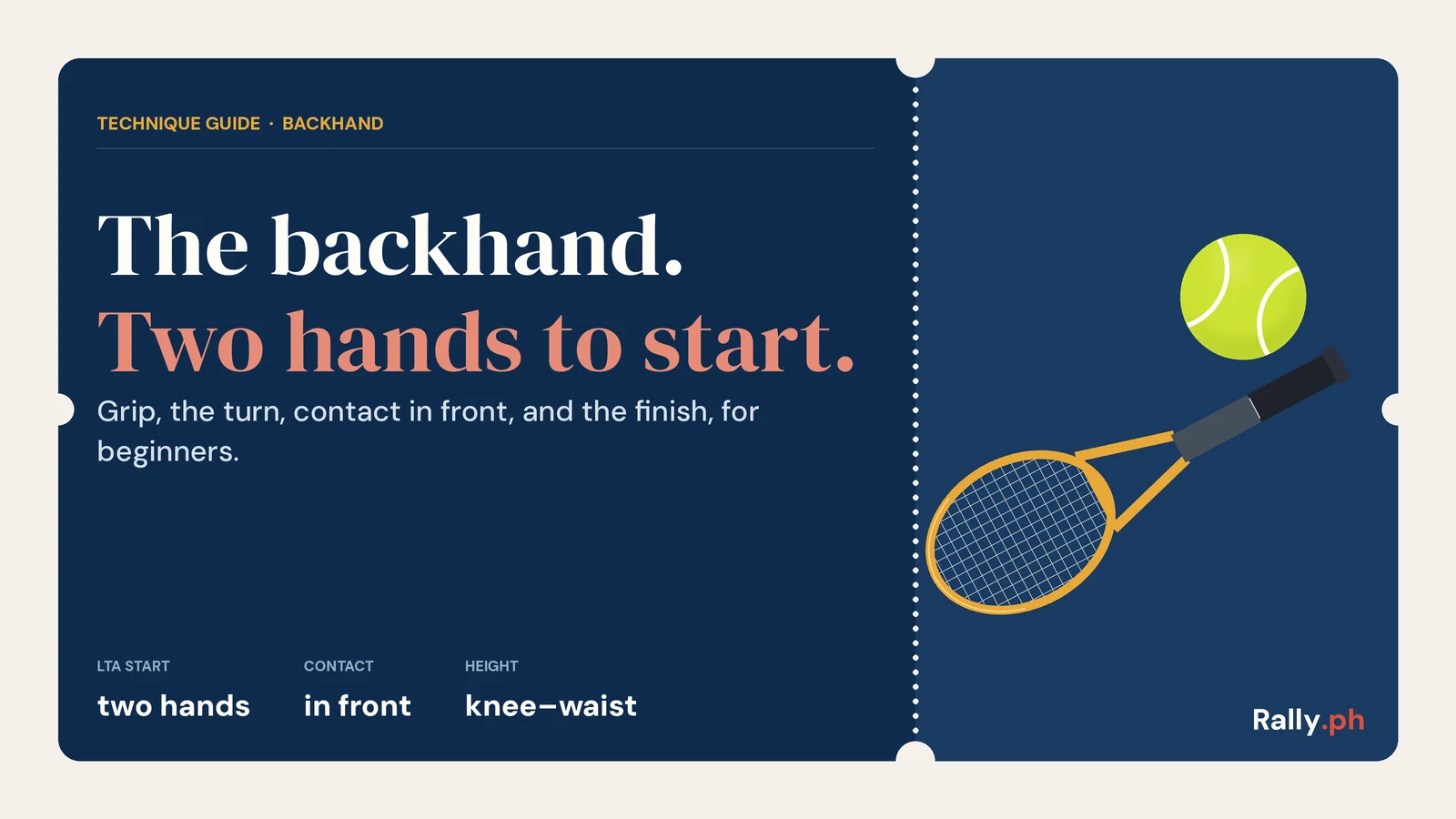
- The LTA recommends that beginners start with two hands on the backhand, because the extra hand gives the shot more stability.
- Dominant hand at the bottom of the handle, non-dominant hand above it. Start in a comfortable grip and adjust with a coach if the ball keeps flying or dribbling into the net.
- Be ready, then turn sideways on your non-dominant side before the ball bounces. Smith says to use your dominant shoulder to track the incoming ball.
- Meet the ball in front of you, around knee-to-waist height after the bounce, and swing through. Two-handed players finish over the shoulder until the non-dominant elbow points down the court.
- Recover to the middle of the baseline and get ready again. Start with a shorter swing and build length as the shot becomes consistent.
Two hands or one
Smith is direct: there are two ways to hold the racket for a backhand, and for beginners he recommends two hands for more stability.
The two-handed backhand, the grip he says players use most often, puts the dominant hand at the bottom of the handle — he compares that bottom hand to a standard forehand grip — and the non-dominant hand above it. To start, he says, just hold a comfortable grip, take the racket back behind you on your non-dominant side, and swing across your body, making contact in front of you.
The one-handed backhand uses only the dominant hand, in a firm but relaxed grip, with the strings facing forward down the court. Smith says this can feel more natural for some players, but it takes longer to master and needs stronger timing and coordination. The preparation is the same idea: racket back on the non-dominant side, swing across the body, contact in front.
You do not have to decide forever on the first lesson. Our suggestion, based on the LTA's beginner recommendation, is to start with two hands, then try one hand later if a coach thinks it suits your timing and your shoulder. A one-handed slice, which is a different shot, is not covered here.
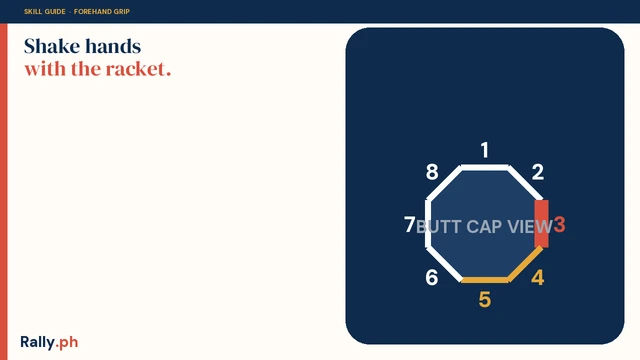
If the grip still feels vague in your hands, book a lesson rather than copying a still photograph. Our guide to finding a tennis coach in Metro Manila covers where to look. Our beginner's guide to starting tennis in the Philippines covers the rest of getting on court.
The five steps Smith uses
Be ready. Stand in an athletic ready position with the racket in front of you, on the balls of your feet. Smith compares it to a goalkeeper waiting for a penalty: eyes on the incoming ball, ready to move. Tennis has a lot of moving parts — the ball coming, the ball leaving, you and the opponent — and the ready position is what lets you start the next step on time.
Get into position. Turn sideways-on, on your non-dominant side, and get your feet set before the ball crosses the net or bounces on your side. Bring the racket back across your body, with one hand or two. Smith's tip for a consistent turn is to use your dominant shoulder to track the incoming ball before it bounces. For a right-hander, that means the right shoulder helps you turn to the left-hand side of the court.
Keep the contact point in front. After the bounce, try to hit the ball as it reaches between knee and waist height. The main cue, Smith says, is to hit it in front of you. That lets you get your weight behind the ball, and your body weight then helps the shot. Contact that is late, beside the hip, is the usual reason a new backhand feels jammed or sails long.
Swing through. The finish depends on the grip. With two hands, after contact, swing the racket through and over your shoulder until the non-dominant elbow is pointing down the court. With one hand, swing through and open the chest. Smith says a longer swing sends a longer, more powerful shot, and that this is something to think about once you are more confident. Best, he says, to start small and build up with consistency.
Recover. After the shot, recover to a good position for the next ball. That is usually back to the middle of the baseline, ready, and then the same steps again.
A simple way to practise
You can work on this with a partner feeding gentle underarm balls to your backhand side, or with a coach. Stand far enough from the bounce that you can step in and still meet the ball in front, between knee and waist. Count only the ones that land in the court and leave you on balance. When those are regular, ask for the feed to come a little wider or a little shorter, still one ball at a time, and keep the same turn and contact.
The serve and the backhand are different skills. Our serve guide covers the toss and the throwing motion that start the point. The backhand is what you need once the return or the rally comes to your non-dominant side, including in doubles when you are pulled wide.
A comfortable, repeatable two-handed swing will do more for your rallies than a stylish one-hander you cannot time. Start with stability, then add length.
Sources
- LTA, Matt Smith, How to hit a tennis backhand for beginners