Public tennis courts in the Philippines are bookable, but they rarely work like a hotel reservation. Some are first come, first served. Some go through a city or provincial office during weekday hours. Some look public on a map and turn out to be a club, a village or a school. This guide explains how to tell those apart, which questions to ask, and where Rally PH has already documented a public or walk-up option.
It does not replace the city guides. When a rate or a phone number appears below, it is copied from a published Rally guide or court page, with the same "confirm before you go" caveat. We checked those sources on 19 November 2026 (Asia/Manila). We do not invent fees.
The short answer
- First, read the access line on the court directory page. "Public," "walk-in," "members-only" and "residents-only" mean different things. A village court is not a public court.
- Ask for the total, not just the court rate. Lighting, entrance and after-dark surcharges can be extra. The Iloilo guide is the clearest example.
- A published rate can be old. Iloilo's posted figures come from a 2017 provincial ordinance. Quezon City figures in the QC guide come from the city Citizen's Charter and a 24 August 2026 GMA News report. Confirm today's total before you travel.
- Office hours are not always court hours. ISDMO in Iloilo takes booking requests 8:00 AM–5:00 PM, Monday to Friday, except holidays. That is the office, not the court.
- If there is no phone number, you still need a plan: go early, bring cash, and be ready to leave if the court is reserved or closed to visitors.
Public court, club court, village court
These are the three buckets you will meet. The labels come from Rally court pages and city guides, not from a national booking app — there isn't one.
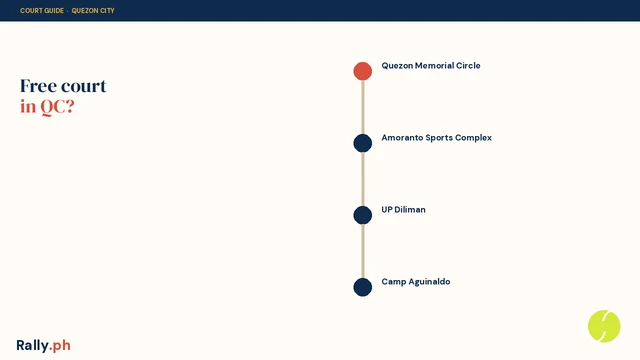
Public and government courts are run by a city, a province, a freeport, a school or a government complex. Amoranto Sports Complex in Quezon City is a city-run example. Iloilo Sports Complex is a provincial example. Clark Parade Grounds Tennis Courts are public courts inside a freeport. Camp Aguinaldo Tennis Court is listed as public, walk-in only, first come, first served, and open to civilians. Benguet Sports Complex Tennis Courts is a public government sports venue; the directory says walk-in play is likely, but you should confirm access, fees and the schedule.
Clubs may sit on public land or look open from the street, but play usually goes through membership or a guest arrangement. Eco-1 Tennis Center in Davao and Chamber B Elite Tennis Club in San Pablo are examples. Quezon City Sports Club is a proprietary members' club; non-members need a member or guest arrangement. Call before you go.
Village and subdivision courts are typically residents-only. The standard directory language is that outsiders must ask the HOA or gate guard, and that guest access is not guaranteed. Richgate Tennis Court in Baguio and several Laguna village courts in the Laguna guide follow that pattern. Do not treat a pin inside a gated community as a public booking.
Some listings sit in between. UP Diliman Tennis Courts and UPLB Lawn Tennis Court are campus courts. The QC guide documents a path and a published rate note for UP Diliman; the UPLB page says outsider access is not confirmed. Ask the school before you go.
How public booking actually works
There is no single method. These are the patterns already documented on Rally.
Walk-in, first come, first served. The Camp Aguinaldo listing, and the Quezon City guide that cites it, describe public courts that are walk-in only and open to civilians. There is no public number on that listing. Go prepared to wait, and confirm the current fee on site. The QC guide records a figure from a 24 August 2026 GMA News report (₱120 per player plus ₱50 per game). Confirm it when you arrive.
City complex with a published rate card. Amoranto Sports Complex Tennis Courts are city-run. The QC guide and the court page give daytime and night rates from the QC Citizen's Charter, hours of 8:00 AM–5:00 PM except when the courts are booked for exclusive use, and a contact number, 0917-137-3563. Call to ask whether your slot is free and what the total is.
Campus courts with a contact number. UP Diliman Tennis Courts are on Ylanan Street, run by the UP College of Human Kinetics, with a number on the listing (+63 977 258 7423). The QC guide records a ₱120 per hour court fee from the same 24 August 2026 GMA News report, and hours on the directory. Confirm both before you go.
A provincial office that takes requests. Iloilo Sports Complex is the cleanest documented example. The Iloilo guide says outside (non-government) clients may request use of the courts through ISDMO, at (033) 320 1152 or iloilosportscomplex@iloilo.gov.ph, during office hours, 8:00 AM–5:00 PM, Monday to Friday except holidays. The 2017 fee schedule is the source for ₱100 per hour per court, plus ₱75 per hour after 6:00 PM, plus a ₱10 entrance fee. Confirm the current total, including any after-6 surcharge, when you request the court.
Public, fee not posted. Clark Parade Grounds Tennis Courts are three public lighted hard courts. The Clark and Subic guide says hours and rates are not posted, and that players report a court fee — bring cash and confirm the amount when you arrive. Laguna BelAir Tennis Court is listed as public, with one court, and "looks open for walk-up play," with no phone number and an unconfirmed surface. College Country Club in Los Baños is listed as a public school or municipal venue, with a phone number (+63 49 549 2504) and unconfirmed access. Call first.
Club-run "public" courts. Pardo Tennis Court in Cebu is described in the Cebu guide as a club-run public option whose walk-in rates are not posted. Message the club before you show up. Relationships still matter more than apps at courts like this.
Questions to ask, every time
Use this list when you call, email or walk up:
- Can non-members or non-residents play today? If the answer depends on a member, a student ID or a barangay certificate, you need that now, not at the gate.
- How do I reserve a slot — or is it walk-in only? If it is walk-in, ask how long a group may keep a court.
- What is the total fee for our time slot? Court rate, entrance, lighting, after-dark surcharge, and whether the rate is per court or per player.
- What are the hours today, and is the court reserved for a league, clinic or exclusive booking? Amoranto's page already warns that exclusive use can close the courts to regular play.
- What is the surface, and are running shoes allowed? For why that matters, see the court surface guide.
- Do you take cash only? Several walk-up courts do not publish a payment method. Bring cash.
A simple booking path
- Open the court directory, find the city, and read the access line on the court page.
- If Rally has a city guide, read that next: Metro Manila, Quezon City, Makati and BGC, indoor courts, Clark and Subic, Laguna, Baguio and La Trinidad, Cebu, Iloilo, Bacolod, Tacloban and Davao.
- Call or email when a contact is published. If it is not, plan a walk-up only at courts the directory already describes as public or walk-in, and have a backup court.
- Confirm the total fee and the slot, then go. For a partner, use Find a tennis partner.
Public courts are scarce in some cities, which is why the documented ones are worth the extra phone call. The Quezon City guide puts it plainly: many Metro Manila courts belong to private clubs or villages that do not welcome walk-ins. The same pattern shows up in Laguna, Davao and Baguio. Reading the access line first will save you a wasted trip.
Sources
- Philippines tennis court directory
- Where to play tennis in Quezon City, including the Amoranto, UP Diliman and Camp Aguinaldo listings
- Where to play tennis in Metro Manila
- Where to play tennis in Iloilo
- Where to play tennis in Clark and Subic
- Where to play tennis in Cebu
- Where to play tennis in Davao
- Where to play tennis in Laguna
- Where to play tennis in Baguio and La Trinidad
- Court pages cited in the sections above, including Amoranto, UP Diliman, Camp Aguinaldo, Iloilo Sports Complex, Clark Parade Grounds, Benguet Sports Complex, Laguna BelAir and College Country Club