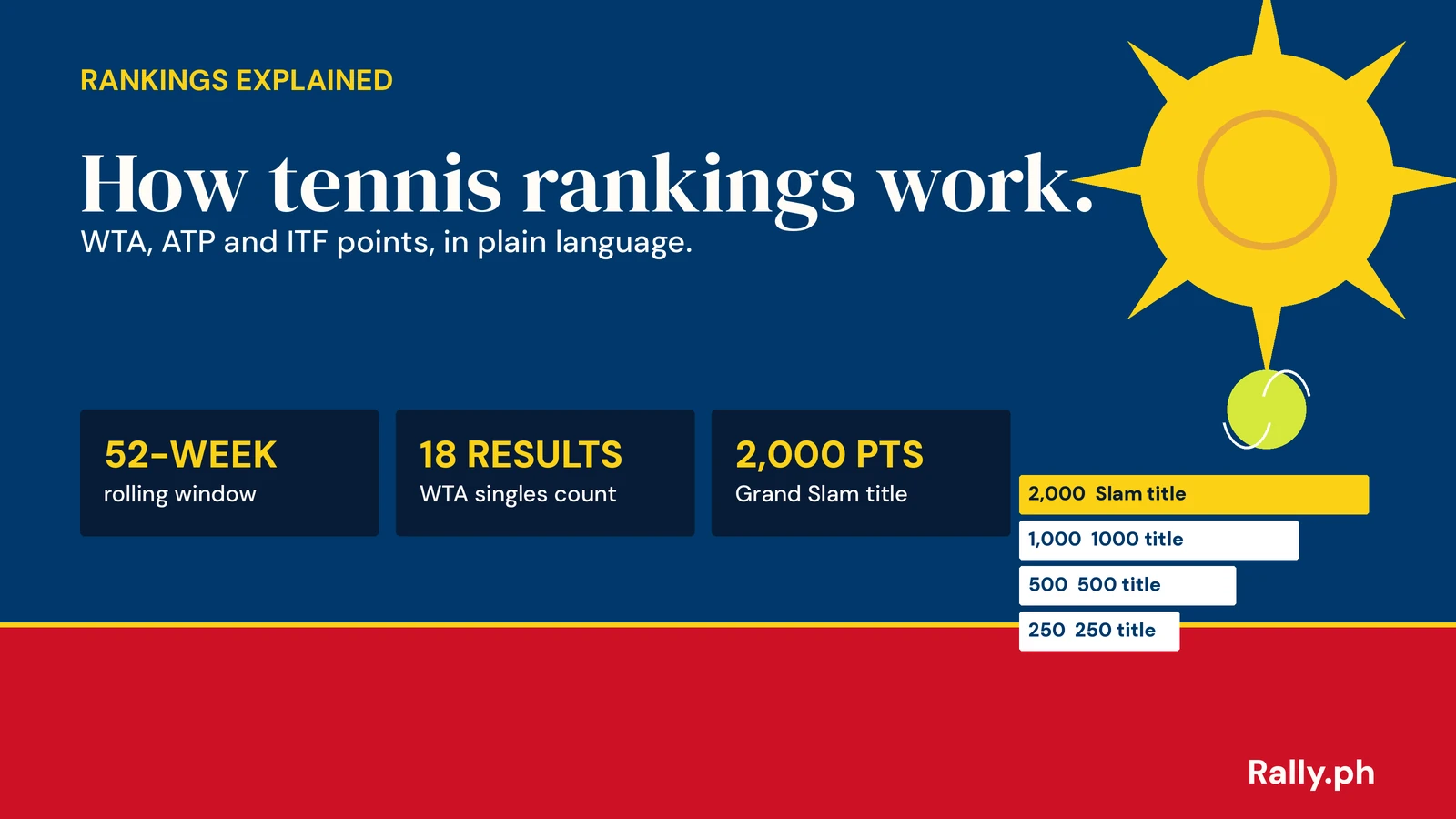
The 2026 Official Grand Slam Rule Book is blunt about what the majors are: "the four official International Championships of Australia, France, Great Britain and the United States." Those four events — the Australian Open, Roland-Garros, Wimbledon and the US Open — are the biggest tournaments in the sport. A singles title at any of them is worth 2,000 ranking points on both the WTA and ATP lists, twice a WTA 1000 or ATP Masters 1000 title. The draws are the largest on the calendar: 128 players in singles, 64 teams in doubles, unless Grand Slam Tennis authorises something else.
This guide is the map Filipino fans need for the 2027 majors: when and where they are played, on which surface, how the draw and the seed list are built, and how to turn a local start time on the order of play into Manila time. Match scoring itself — games, sets and tie-breaks — is in our scoring guide. How those 2,000 points sit on the 52-week ranking is in our rankings explainer. If you arrived here because of Alex Eala, New to tennis because of Alex Eala? Start here is the shorter fan primer; this article is the system.
The short answer
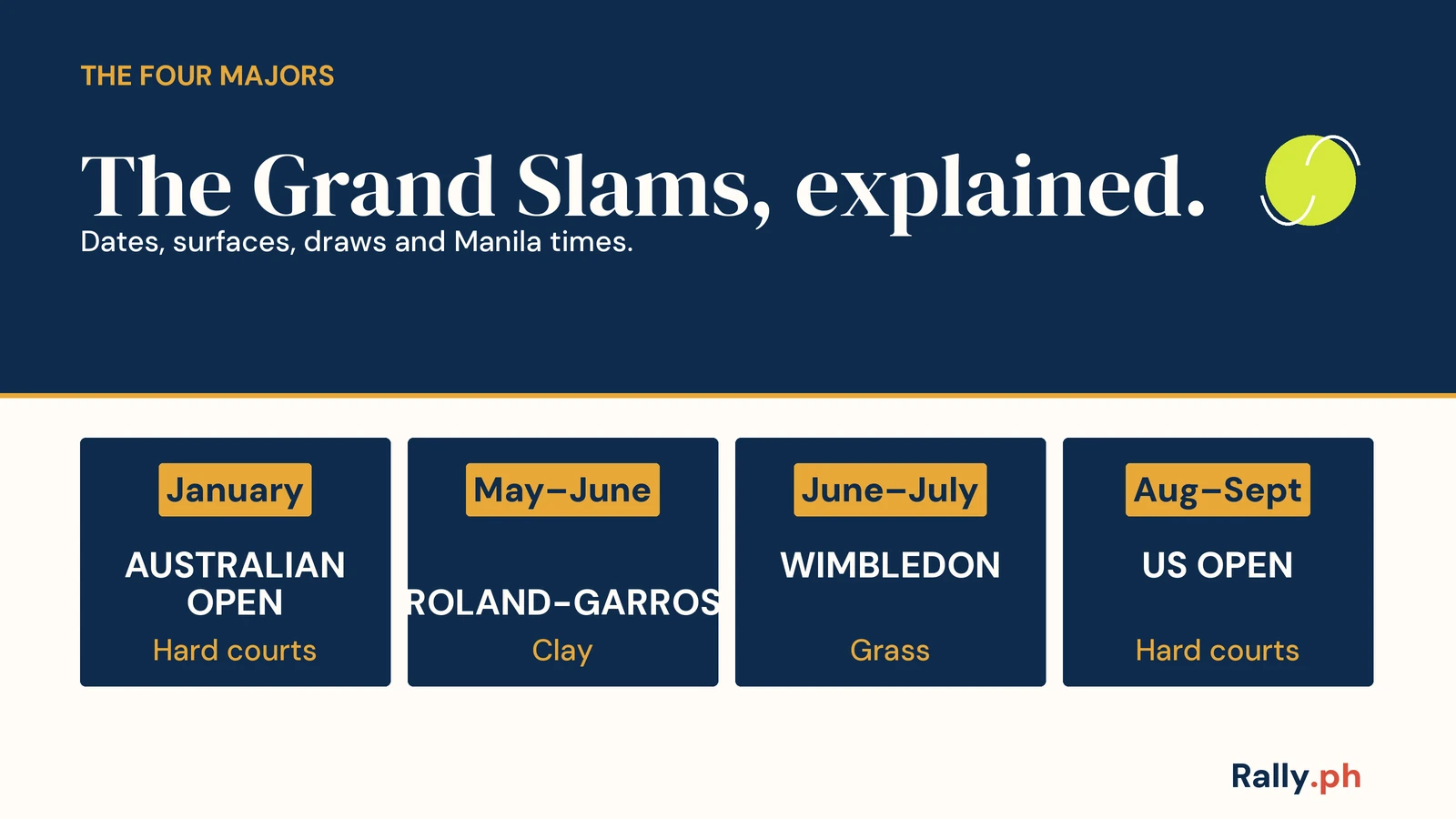
- There are four Grand Slams each year, in this order: Australian Open (hard courts, January, Melbourne), Roland-Garros (clay, May–June, Paris), Wimbledon (grass, June–July, London) and the US Open (hard courts, August–September, New York).
- For 2027, official calendars and tournament announcements put the Australian Open main draw on 17–31 January (Opening Week, including qualifying, from 11 January); Roland-Garros on 17 May–6 June, with the main draw from 23 May; Wimbledon on 28 June–11 July; and the US Open on 29 August–12 September. Dates can still be adjusted by the organiser; use the official tournament page in the week of the event.
- A 128-player singles main draw is built from direct acceptances (from a ranking list dated about 42 days before the tournament), usually eight wild cards, and 8, 12 or 16 qualifiers. Seedings use a later ranking list, dated about seven days before, and are not official until the draw is made. The top seed is placed at the top of the draw and the second seed at the bottom, so they can meet only in the final if both win through.
- Men’s singles main-draw matches are the best of five sets. All other matches are the best of three, unless that Grand Slam decides otherwise. A 10-point tie-break is used in the final set.
- Manila is on UTC+8 year-round. Melbourne in January is three hours ahead, so a late-morning start there is mid-morning here. Paris and London in early summer are six and seven hours behind, so afternoon play there falls in the Philippine evening and night. New York in August and September is 12 hours behind, so a US Open evening session starts the following morning in Manila.
The four majors, month by month
The 2026 Grand Slam Rule Book names the four official championships. The 2027 dates below are those published on official WTA tournament pages, the 2027 ATP calendar, and, where we have them, the tournaments’ own announcements.
Australian Open — January, hard courts, Melbourne. Tennis Australia announced on 23 March 2026 that Australian Open 2027 is set for Melbourne Park on 11–31 January. Opening Week, which includes the qualifying competition, runs 11–16 January. Main-draw play begins on Sunday 17 January. The singles finals are on 30 and 31 January. The WTA’s official tournament page lists the main-draw window as 17–31 January, on a hard court. The ATP’s 2027 calendar lists the Australian Open as a Grand Slam in Melbourne, on hard courts, with a 128-player draw and a Sunday start.
Roland-Garros — May and June, clay, Paris. The official Roland-Garros site bills the 2027 tournament as 17 May–6 June. A 12 November 2026 ticketing announcement on that site uses the same span. The WTA page lists 23 May–6 June on clay in Paris, which is the main-draw window; official travel pages on the same site treat 17–21 May as Opening Week and the main draw as starting on 23 May, with the finals on 5 and 6 June. The ATP calendar lists Roland-Garros as a Grand Slam in Paris, on clay, with a 128-player draw and a Sunday start.
Wimbledon — June and July, grass, London. The Lawn Tennis Association said on 27 May 2026 that Wimbledon 2027 starts on Monday 28 June and runs through Sunday 11 July. The WTA page lists those same dates, on grass. The ATP calendar lists The Championships, Wimbledon, as a Grand Slam in London, on grass, with a 128-player draw. The LTA’s day-by-day round list for 2027 is based on the 2026 event and is marked as subject to change; the start and end dates are the figures to diary now.
US Open — August and September, hard courts, New York. The WTA’s official tournament page lists 29 August–12 September 2027, on a hard court in New York. The ATP calendar lists the US Open as a Grand Slam in New York, on hard courts, with a 128-player draw, beginning in the week of 29 August, with a Sunday start. That Sunday-to-Sunday span is 29 August–12 September.
The calendar, in short: hard courts to start the year, clay in late spring, grass at midsummer, then hard courts again into September.
How the 128-player draw is built
Each Grand Slam specifies the time and place at which the referee will make the singles draw in public. Under the 2026 rule book, unless otherwise agreed, a 128-player singles main draw is composed of:
- 104, 108 or 112 direct acceptances, players who get in on their singles ranking. The ranking used is the list dated approximately 42 days before the tournament starts.
- 8, 12 or 16 qualifiers, who earn their place in a qualifying competition. If the main draw is made before qualifying finishes, qualifier slots are drawn into the draw as empty places, and the actual qualifiers are drawn into those places after qualifying ends.
- Eight wild cards, named at the tournament’s sole discretion when the draw is made. Wild cards may be seeded. A player who has already competed in that tournament’s qualifying cannot be named as a wild card. If a wild card withdraws after the draw, the place is filled from the entry list, or by a lucky loser once qualifying has started — not by a new wild card, except in the remake-of-draw situation set out in the rule book.
The four Grand Slams are open to internationally ranked players with a ranking of 500 or better, subject to the WTA Age Eligibility Rule as adopted by the slams. Players under 14, using their age on the first day of the main draw, are not eligible to enter. There is no entry fee.
Vacancies among unseeded players after the draw is made, and before qualifying starts, are filled by the next-highest player on the original entry list. Once qualifying has started — the first ball of the first qualifying match — those vacancies may only be filled by eligible lucky losers.
How seeding works
Seeds are the players given preferential positions in the draw so that the highest-ranked players are kept apart until later rounds. The rule book is specific:
- There is only one seeding list, and every Grand Slam has a seeded draw.
- The ranking list dated approximately seven days before the tournament is the basis for selecting seeds. That is a later, more current list than the 42-day list used for direct acceptance, which is why a player can be inside the cut and still not be seeded, or vice versa, if rankings move in those weeks.
- Seedings are not official until the final draw is made.
- The minimum number of seeds in the main draw is 16. The same rule book also sets out how to place 32 seeds in a 128-player draw.
The placement procedure, for a 128-player draw, starts by putting seed 1 on line 1 and seed 2 on line 128. The remaining seeds are then drawn in pairs or groups (seeds 3 and 4 together, then 5–8, 9–12, 13–16, and, if there are 32 seeds, 17–24 and 25–32) into prescribed lines from the top and bottom of the draw. The rest of the field, including qualifiers, is drawn into the vacant spaces, beginning at the top. The point of putting the top two seeds at opposite ends is straightforward: they can meet only in the final, and the top four can meet only in the semi-finals, if all of them win their earlier matches.
If two or more of the top eight seeds withdraw more than 48 hours before the start, the tournament may remake the draw or leave it. If a seed withdraws before the first day’s order of play is released, the rule book sets a replacement path that uses the 5th, 17th and then the next eligible seed, depending on which band withdrew. After the first order of play is out, a seed’s vacancy is filled by an eligible lucky loser.
Lucky losers are players who lost in the last round of qualifying, or earlier qualifying rounds if more are needed. The four highest-ranked of those players are drawn in random order; the rest follow their rankings, with a larger random group if there are more than two main-draw withdrawals when qualifying finishes.
What a Grand Slam match looks like
The ITF Rules of Tennis apply, except where Grand Slam Tennis specifies otherwise. On scoring, the 2026 rule book is short:
- All men’s singles main-draw matches are the best of five sets.
- All other matches are the best of three sets, unless that Grand Slam determines otherwise.
- The tie-breaks in the Rules of Tennis may be used in qualifying and in the main events, including the final set, "where a 10 point tie-break will be played."
So a men’s singles main-draw match can run to five sets, and a final set does not play on and on: at 6–6, the players play a 10-point tie-break. Women’s singles, doubles and most other events at the slams are best of three, unless that tournament says otherwise for a given event.
Watching from the Philippines
The order of play — who plays whom, on which court, and at what local time — is published by each tournament, usually the evening before. We have not invented 2027 session start clocks here, because those can change and are not always posted months ahead. What does not change is the time difference between the host city and Manila, which is on UTC+8 all year.
Use the local start time on the official order of play, then convert:
- Australian Open, Melbourne, January. Melbourne is then on Australian Eastern Daylight Time (UTC+11), three hours ahead of Manila. An 11:00 AM start in Melbourne is 8:00 AM in Manila; a 12:00 noon start is 9:00 AM; a 7:00 PM night session is 4:00 PM the same day.
- Roland-Garros, Paris, May–June. Paris is then on Central European Summer Time (UTC+2), six hours behind Manila. An 11:00 AM start in Paris is 5:00 PM in Manila; a 3:00 PM start is 9:00 PM; an 8:00 PM night session is 2:00 AM the next day in Manila.
- Wimbledon, London, June–July. London is then on British Summer Time (UTC+1), seven hours behind Manila. An 11:00 AM start in London is 6:00 PM in Manila; a 1:00 PM start is 8:00 PM; a 2:00 PM start is 9:00 PM.
- US Open, New York, August–September. New York is then on Eastern Daylight Time (UTC−4), 12 hours behind Manila. An 11:00 AM start in New York is 11:00 PM the same calendar date in Manila; a 7:00 PM evening session in New York is 7:00 AM the next morning in Manila.
Those conversions are why the US Open is the most watchable slam in Philippine morning hours, and why Australian Open day sessions fall comfortably in the Philippine morning, while Roland-Garros and Wimbledon often run into the Philippine evening and late night. A match that starts at the published time can still run hours long, especially a best-of-five men’s singles match.
Broadcast rights in the Philippines change and are not listed in the Grand Slam rule book. Check the official tournament site, the WTA and ATP "where to watch" pages, and your local rights-holder for the week of the event. We have not named a Philippine broadcaster here.
Sources
- Grand Slam Tennis, 2026 Official Grand Slam Rule Book: Article I (the four official championships; entry, ranking-of-500, under-14 rule); Tournament Regulations C (draw sizes), L (best of five / best of three, 10-point final-set tie-break); and the singles main-draw regulations (42-day acceptance ranking, wild cards, qualifiers, 128-draw composition, seven-day seeding list, seed placement, lucky losers)
- Tennis Australia, Australian Open 2027 dates announced, 23 March 2026, and the AO 2027 provisional schedule (August 2026)
- Fédération Française de Tennis, Roland-Garros official site and 2027 ticketing announcement, 12 November 2026 (17 May–6 June 2027)
- Lawn Tennis Association, What is the schedule for Wimbledon 2027?, 27 May 2026
- WTA official 2027 tournament pages: Australian Open, Roland-Garros, Wimbledon, US Open
- ATP Tour, 2027 ATP Tour calendar (Melbourne, Paris, London and New York Grand Slams; surfaces; 128-player draws; Sunday starts)
- WTA and ATP 2026 ranking point tables, as cited in our rankings explainer (2,000 points for a Grand Slam singles title)