Tennis elbow has a misleading name. The American Academy of Orthopaedic Surgeons (AAOS) describes it as a painful overuse condition of the elbow, and notes that racquet sports can cause it — but so can many other jobs and hobbies. Painters, plumbers, carpenters, cooks and people who type or use a mouse all appear on the same list. The NHS, Britain's public health service, says anyone can get it, and that it is more common in people between 35 and 54.
For weekend players in the Philippines, the useful part is this: the condition is about repeated load on a forearm tendon, not about being unfit or unlucky. This guide explains what tennis elbow is, the equipment and technique factors doctors flag, and what published medical guidance says to do if the outside of your elbow already hurts. It is not a diagnosis or a treatment plan. If your elbow is painful, see a doctor.
The short answer
- Tennis elbow is pain on the outside of the elbow, often with a weaker grip. The AAOS says it usually builds gradually, without a single injury.
- It is an overuse problem, most often in the extensor carpi radialis brevis (ECRB) tendon, which helps to stabilise the wrist when the elbow is straight — including on a tennis groundstroke.
- Improper stroke technique and improper equipment may be risk factors in racquet sports, according to the AAOS. A grip that is too small or too large can also contribute, says Tennis Warehouse, because either one takes more muscle strength to control.
- If it already hurts, rest the arm from the activities that provoke the pain. The NHS says tennis elbow usually eases with rest, and to see a GP if the pain is still there after at least two weeks of rest and self-care.
- Most people improve without surgery. The AAOS puts the success rate of nonsurgical treatment at about 80 to 95 percent.
What it actually is
The bony bump on the outside of your elbow is the lateral epicondyle. Forearm muscles that extend the wrist and fingers attach there through tendons. The AAOS says the tendon usually involved in tennis elbow is the ECRB, and that the condition involves degeneration or, in some cases, microtearing of those tendons from repeating the same motions.
The ECRB helps to stabilise the wrist when the elbow is straight. The AAOS uses a tennis groundstroke as the example. When the muscle is weakened by overuse, microscopic tears form in the tendon where it attaches to the bone, and that produces pain directly over the outside of the elbow. The academy also notes that the muscle's position may add wear, because it can rub against bone as the elbow bends and straightens.
The main symptom, the NHS and the AAOS both say, is pain on the outside of the elbow. The NHS adds that it may range from mild discomfort when you move your arm to constant pain that can affect your sleep, and that it may be worse when you lift or bend the arm, grip objects or move your wrist. Other NHS symptoms include tenderness or swelling, pain in the forearm, and difficulty fully straightening the arm. The AAOS also lists a weaker grip, and sometimes pain at night. It says the dominant arm is most often affected, though both arms can be.
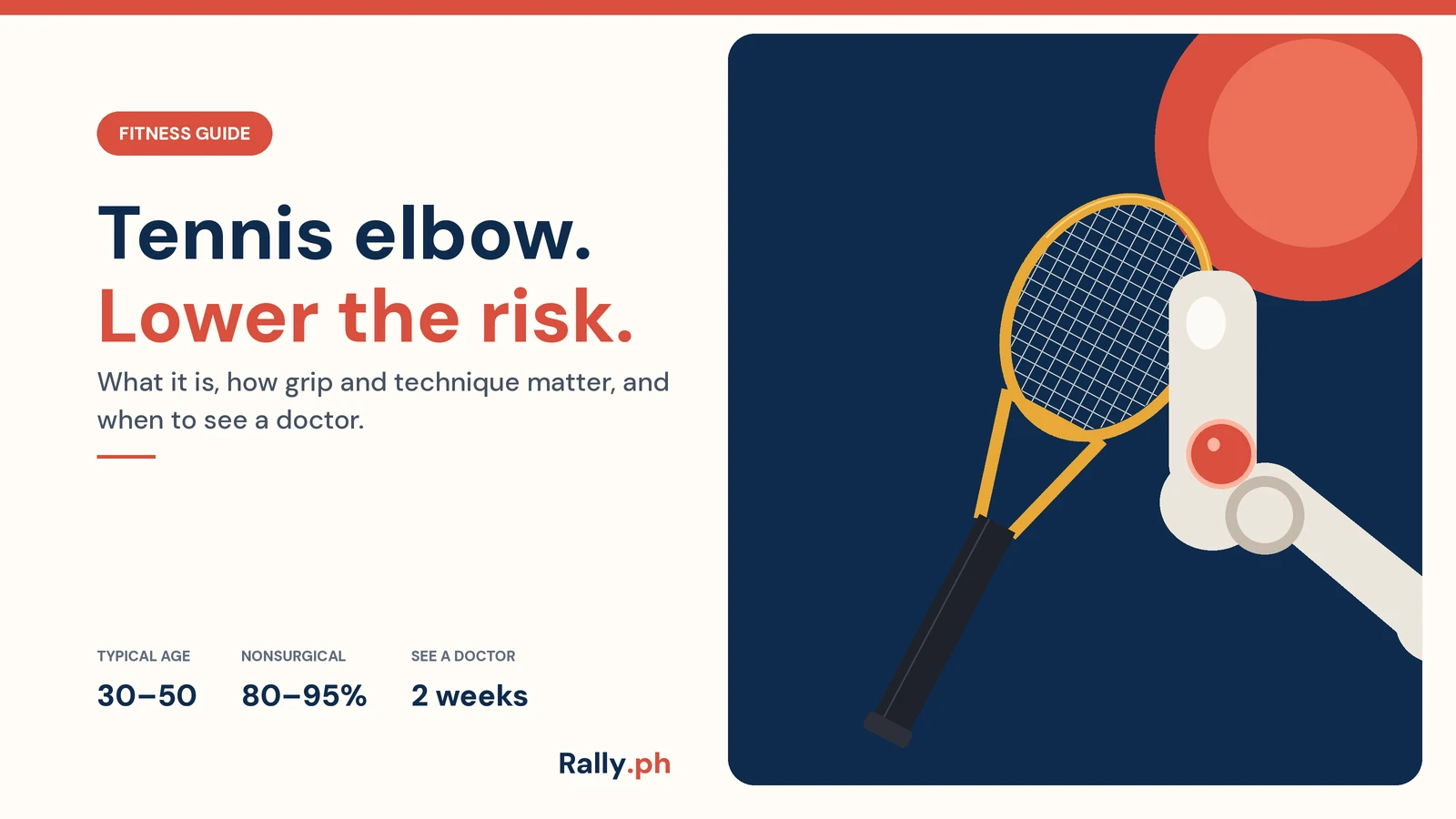
The AAOS gives a slightly younger typical age range than the NHS: most people who get tennis elbow are between 30 and 50, although anyone with the risk factors can get it. It can also appear without a recognised repetitive injury. The AAOS calls that idiopathic, meaning the cause is unknown.
Why recreational players get it
You do not have to play every day. The load can come from a long weekend session, from a sudden jump in hours after weeks off, or from the same motion repeated at work and then again on court. The AAOS is clear that athletes are not the only people who get tennis elbow, and that repetitive, vigorous use of the forearm muscle or repeated wrist extension is the common thread.
Two tennis-specific factors are named in the sources we checked.
Technique. The AAOS says that in racquet sports, improper stroke technique may be a risk factor. It does not spell out a single "wrong" stroke in that article. Our suggestion, based on that warning, is to treat a new or worsening ache on the outside of the elbow as a reason to have a coach watch your strokes, especially the backhand and the delayed follow-through, rather than to keep hitting through the pain. Our guide to finding a tennis coach in Metro Manila covers where to look.
Equipment. The same AAOS article says improper equipment may also be a risk factor, and its treatment section is more specific. If you play a racquet sport, your doctor may encourage you to have your equipment checked for proper fit. The academy says stiffer racquets and looser-strung racquets often can reduce the stress on the forearm, because the forearm muscles do not have to work as hard, and that if you use an oversized racquet, changing to a smaller head may help prevent symptoms from recurring. Those are the AAOS's statements, not Rally PH product tests.
Grip size belongs on the same list. Tennis Warehouse warns that long use of a grip that is too small or too large can contribute to tennis elbow, because either extreme takes more muscle strength to control. A handle that is too small has to be squeezed to stop it twisting. Our overgrips guide explains the finger and ruler tests, and that a typical overgrip adds about 1/16 inch. Our string guide covers tension and string type in Philippine humidity, which is useful context if a doctor later suggests a looser string job.
If your elbow already hurts
Do not treat this section as a plan to follow on your own. It summarises what the NHS and the AAOS tell patients, so you know what good care usually involves.
The NHS says tennis elbow usually goes away with rest, but can sometimes last over a year, and that there are treatments that can help if needed. Its first advice is to avoid or reduce the activities that make your symptoms worse. It also lists paracetamol or an anti-inflammatory gel, a hot or cold pack (or a bag of frozen peas) wrapped in a towel on the area for up to 20 minutes every two to three hours, simple exercises such as bending and straightening the arm, and a forearm strap or a wrist or elbow brace sold in pharmacies. The NHS says to see a GP if you still have elbow pain after resting the elbow and trying self-care for at least two weeks. A GP may offer anti-inflammatory tablets, and physiotherapy may help if symptoms have not improved after trying treatments at home for six weeks.
The AAOS starts in the same place: give the arm proper rest, which means stopping or decreasing the sports and heavy work that cause painful symptoms for several weeks. It says about 80 to 95 percent of patients have success with nonsurgical treatment. That can include medication a doctor recommends, physical or occupational therapy with specific forearm-strengthening exercises, and a counterforce brace centred over the back of the forearm. The AAOS also describes steroid injections, platelet-rich plasma and shock-wave therapy as options a doctor may discuss; it notes that steroid injections should be used very sparingly because excessive use can weaken the bone where the tendon attaches, and that shock-wave therapy is considered experimental by many doctors. If symptoms do not respond after 6 to 12 months of nonsurgical treatment, the AAOS says a doctor may recommend surgery.
The AAOS also publishes a separate therapeutic exercise programme for epicondylitis, designed to be done under clinical guidance to build forearm endurance and resistance to repetitive stress. That is a reason to ask a clinician for a programme, not a reason to invent your own.
If the pain is severe, the arm is hard to move, or the swelling comes with a high temperature, seek urgent medical care rather than waiting on the two-week NHS self-care window. That last point is our own caution, based on general NHS advice for elbow and arm pain, not a substitute for emergency guidance.
Lowering the risk before it starts
No source we checked offers a guaranteed way to prevent tennis elbow. The useful steps are the ones that reduce unnecessary load:
- Build up court time gradually, instead of jumping from a week off to a three-hour match. That is our suggestion, based on the AAOS description of overuse.
- Check your grip size with the tests in our overgrips guide, and change a worn overgrip so you are not squeezing a slick handle.
- Have a coach look at your technique if you are new, returning after a long break, or already feeling tightness on the outside of the elbow.
- Ask a stringer or coach about racket fit if a doctor later flags equipment, rather than buying a new frame on a guess. The AAOS talks about stiffness, string tension and head size as things to check, not as a shopping list.
- Do not play through worsening pain on the outside of the elbow. The NHS is clear that reducing the activities that make symptoms worse is the first step once pain has started.
A proper warm-up and sensible session timing in the heat will not, on their own, prevent tennis elbow. They are still worth doing, because they prepare you to play and help you last the session.
Sources
- American Academy of Orthopaedic Surgeons, Tennis Elbow (Lateral Epicondylitis) and Therapeutic Exercise Program for Epicondylitis
- NHS, Tennis elbow
- Tennis Warehouse, How to measure your tennis grip size