You do not need to buy a paddle for your first pickleball session in the Philippines. You should know what the official rules actually require before you spend anything, and you should try more than one paddle in the heat before you settle.
This guide stays with what can be sourced: the 2026 USA Pickleball Official Rulebook, the Equipment Standards Manual (Revision 3.0, January 2025), and the approved paddle list. It does not list street prices, which move too quickly to publish without a dated receipt. For how to get on a court first, see how to start playing pickleball in the Philippines.
Rent or borrow first
The Philippine Pickleball Federation’s Street Pickleball Ortigas page says the ₱150 session fee includes paddles and balls. That is a complete first test: several hours, in the evening, on a street court, with loaner gear. Some mall and club venues also rent paddles; those fees change, so ask when you book.
Play at least a couple of sessions before you buy. A paddle that feels light for a 15-minute rally can feel different after an hour in humidity, when your hand is wet and your shoulder is tired. If you already play tennis, our tennis-to-pickleball guide is worth reading first, because the solid face has no strings and will not pocket the ball the way a racket does.
What the official rules actually cap
Rule 3.D sets the paddle specifications. For sanctioned play, the paddle must appear on the USA Pickleball Approved Paddle List and carry the “USA Pickleball Approved” seal or text treatment, unless it is an older model that was listed before the seal was required (Rule 3.D.1). Casual open play in the Philippines does not, by itself, impose that list. The Equipment Standards Manual still recommends that equipment used in all forms of the sport meet the same specifications, and it is a useful quality check when you are looking at a paddle in a shop.
The hard limits in Rule 3.D.2 are about size, not weight:
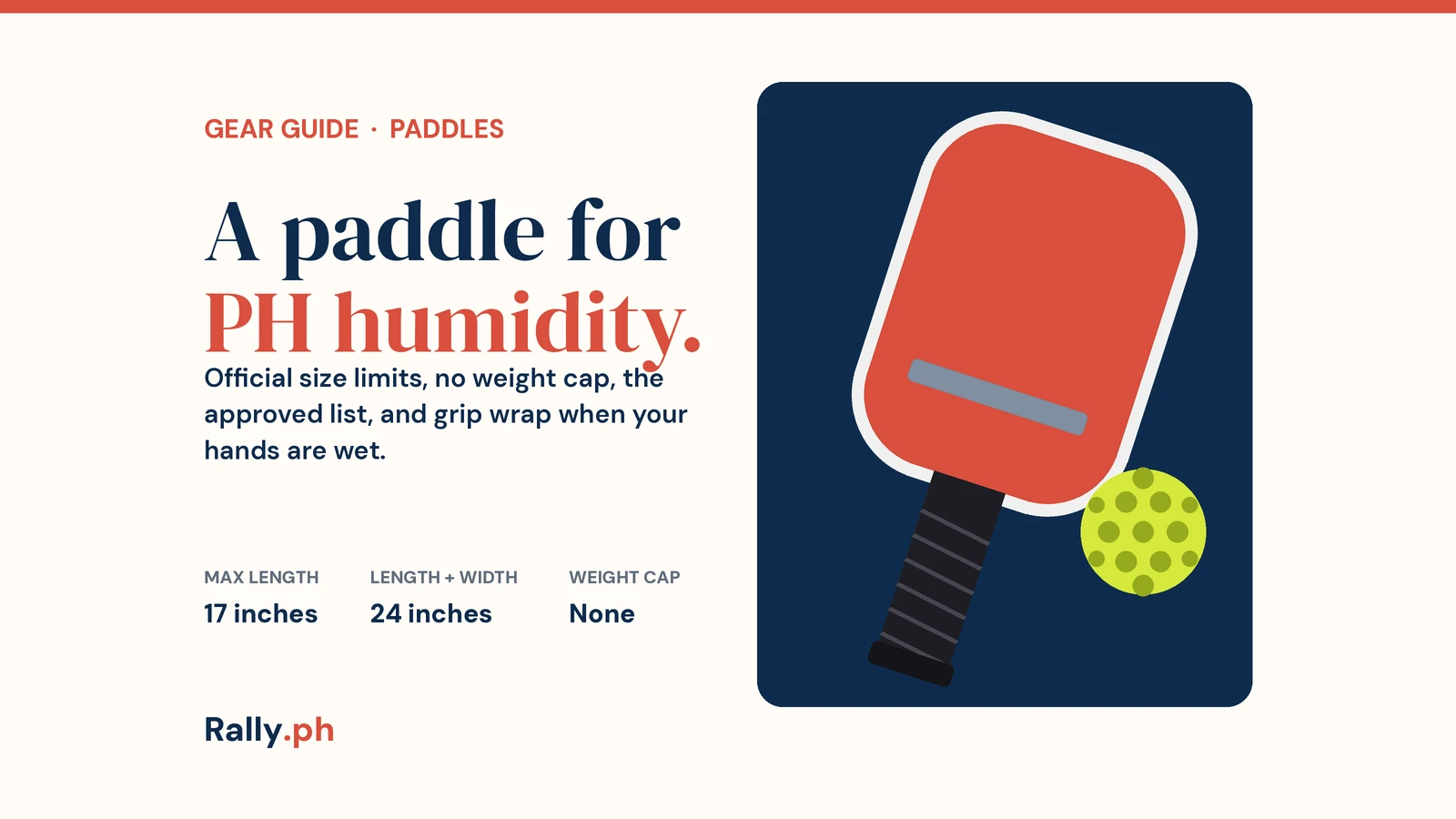
- Combined length and width, including any edge guard and butt cap, must not exceed 24 inches (60.96 cm).
- Length must not exceed 17 inches (43.18 cm).
- There is no restriction on paddle thickness.
- There is no restriction on paddle weight (Rule 3.D.3).
That last point is the one shopping lists often bury under unofficial “ideal” ranges. The rulebook does not tell you to buy a mid-weight paddle. It tells you the paddle must be rigid and non-compressible, and that the hitting surface must not have holes, cracks, delamination, indentations, rough texture or other features meant to add excessive spin (Rules 3.D.4 and 3.D.5). If a face is peeling or the core has gone soft, it may no longer meet those surface rules, even if it started as an approved model.
USA Pickleball’s equipment manual, revised January 2025, also describes a power test (paddle/ball coefficient of restitution) used in certification. You do not need to read the lab method to choose a first paddle. You do need to be wary of a paddle marketed with a surface that looks sanded, dimpled or sticky in a way the official rules would not allow.
The practical test, with no official weight number attached, is simple. Swing the paddle for a full session, not a shop tap. If you cannot keep the head stable on a soft dink, or if your arm is cooked after 30 minutes, try a different paddle — lighter, heavier, or a different grip size — before you pay for this one.
Grip wrap in Philippine humidity
Sweaty hands are not a side issue here. They are the usual condition of play. Rule 3.D.6 lists the alterations a player is allowed to make to a commercially produced, certified paddle. Among them: replacement of OEM interchangeable grips (3.D.6.d), changes to grip size via inserts (3.D.6.g), and addition or replacement of grip wrap (3.D.6.h). Overgrips and replacement wraps are legal, not a modification that voids a legal paddle.
Change the wrap when it gets slick, not when it looks tired. In our tennis overgrips guide we go into replacement signs and the difference between a tacky wrap and a dry one; the same wrap logic applies to a pickleball handle, which is shorter but gets just as wet. Carry a spare overgrip in the bag. A paddle that feels fine at 4:00 PM on a dry indoor court can twist in your hand at 5:00 PM on an outdoor one.
If a shop offers to sand the face, add a sticky overlay, or drill the hitting surface, that is a different matter. Those are not in the allowed-alterations list, and they run into the prohibited surface features in Rule 3.D.5.
Balls and shoes belong in the same decision
The paddle is only one part of what you feel at contact. The official rulebook says all approved balls may be used indoors or outdoors (Rule 3.C.1), and it notes that the ball with larger holes is customarily used indoors, while the ball with smaller holes is customarily used outdoors (Figure 3-2). Open-play sessions usually supply balls. If you buy a pack, match it to the court you actually use. Our heat and rain guide covers that choice in more detail.
Shoes matter as much as the paddle for a first purchase. Indoor mall courts often require clean, non-marking soles. For tropical hard courts, our hard-court shoe guide is written for tennis but the lateral-support and heat points still apply.
If you later play sanctioned events
Then the approved-list rule is no longer a suggestion. Rule 18.A, in the tournament section of the rulebook, tells players to confirm that their paddle is approved and listed. Check the current paddle list before an event, because listings are added and, at times, models come off the list. Until you are entering those events, a legal-sized paddle you can hold onto in the humidity, tried over a full session, is enough.
Sources
- USA Pickleball, 2026 Official Rulebook: Rules 3.C.1, 3.C and Figure 3-2 (balls); Rules 3.D.1–3.D.7 (paddle identification, dimensions, weight, material, prohibited surfaces, allowable alterations including grip wrap); Rule 18.A (tournament paddle confirmation)
- USA Pickleball, Equipment Standards Manual, Revision 3.0, January 2025
- USA Pickleball, Approved Paddle List
- Philippine Pickleball Federation, Street Pickleball Ortigas (session fee includes paddles and balls)