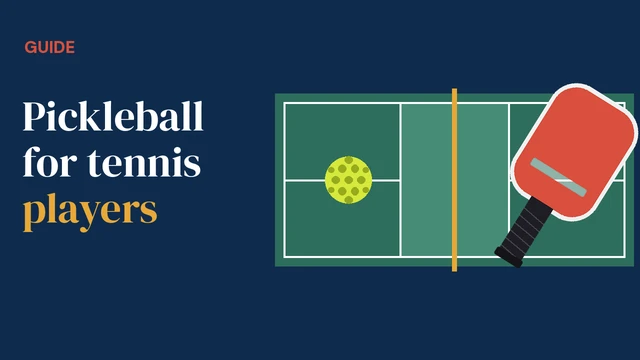
Pickleball is the paddle sport that has filled malls, village courts and a downtown street in Ortigas. You can be rallying in your first session. The two things that usually surprise first-timers are not the paddle or the plastic ball. They are the kitchen, and the rule that the serve and the return must both bounce.
This is a start-here guide for the Philippines: what the game is, how a first session actually works, where a beginner can try it without buying gear, and what to bring. If you already play tennis, our earlier guide to pickleball for tennis players covers what transfers from your game, what does not, and a dated list of Metro Manila venues.
What pickleball is
USA Pickleball, which publishes the sport’s official rulebook, describes pickleball as a paddle sport that blends tennis, badminton and table tennis. It is played indoors or outdoors, in singles or doubles, with a solid paddle and a perforated plastic ball.
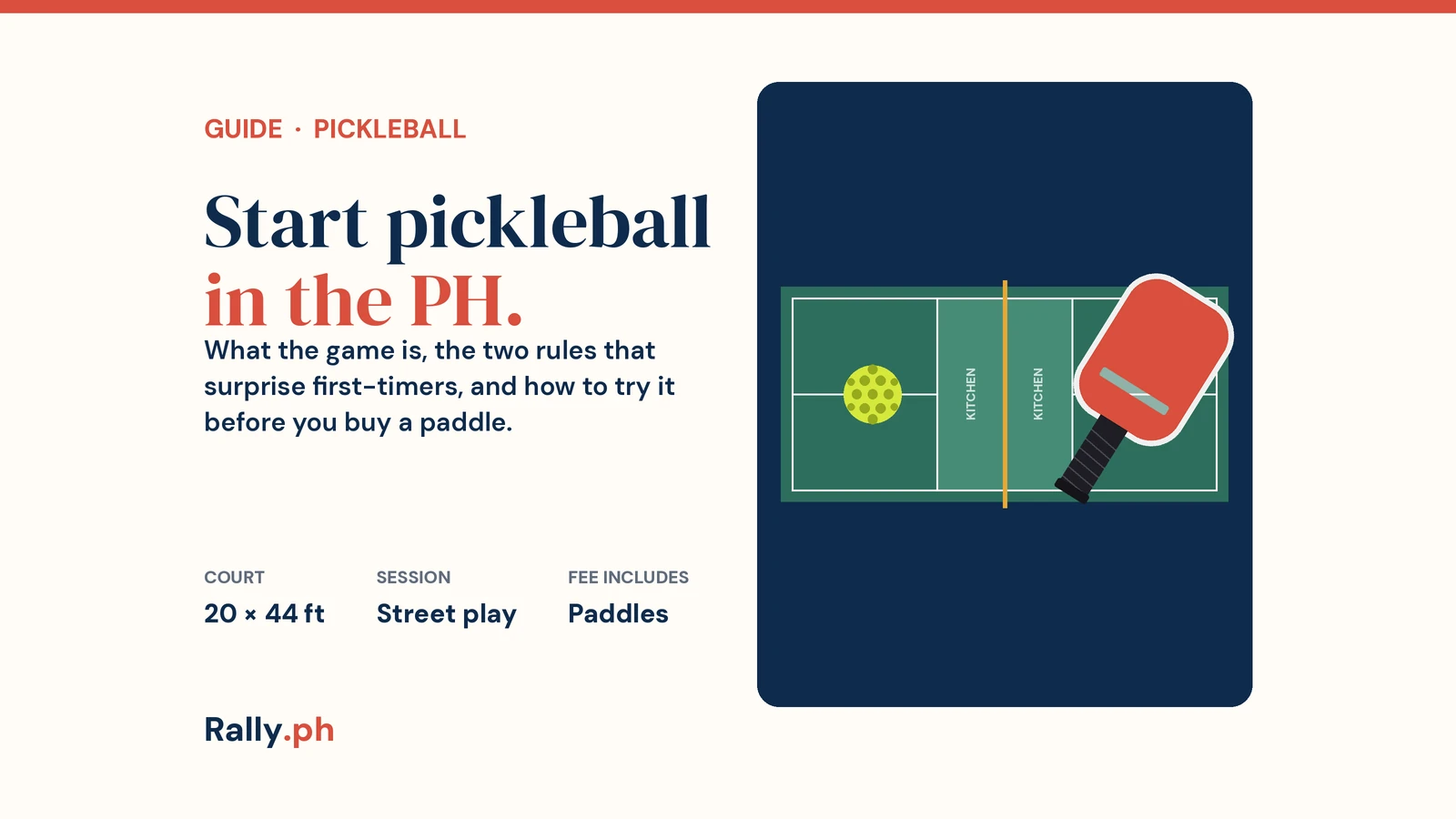
The standard court is 20 feet wide by 44 feet long (6.10 by 13.41 metres) for both singles and doubles, under Rule 3.A.1 of the 2026 USA Pickleball Official Rulebook. That is the size of a badminton doubles court, and far smaller than a tennis court, which is why several pickleball courts can fit in a mall atrium or on one street block. The net is 36 inches high at the sidelines and 34 inches in the centre (Rules 3.B.6 and 3.B.7).
Each side of the net has a 7-foot by 20-foot non-volley zone, which everyone calls the kitchen. You may stand in it. You may not volley — hit the ball out of the air — while you, or anything you are wearing or carrying, are in contact with it. Our kitchen explainer covers the momentum faults that catch new players.
Doubles is the usual format at open play. Games are typically played to 11 points, win by 2, and in standard scoring only the serving side can score. The server (or, in doubles, the serving team) calls the score before every serve. Our rules and scoring guide walks through the three-number score call and why a game starts “zero – zero – two.”
The two rules that change the first session
The two-bounce rule (Rule 10.A). After the serve, the receiver must let the ball bounce before returning it. The serving side must then let that return bounce as well. Only after those two bounces may anyone volley. You cannot serve and immediately rush the net. On a 44-foot court, that first exchange often looks slower than tennis, and that is deliberate: the official rules summary notes that the two-bounce rule removes the serve-and-volley advantage and extends rallies.
The kitchen. The zone exists so players cannot stand at the net and smash everything. You can step in to play a ball that has bounced. You have to be completely back out, with both feet on the playing surface outside the zone, before you volley again (Rule 11.A.3). If your momentum after a volley carries you onto the kitchen line, it is still a fault, even if the rally already looks over (Rule 11.A.2).
Those two rules are why a first session feels easy to start and then suddenly tactical. Soft shots that drop into the kitchen, called dinks, matter more than a hard drive from the baseline.
A first session in the Philippines
You do not need to buy a paddle to try the sport. Several venues rent them, and at least one official community session includes paddles and balls in the fee.
Street Pickleball Ortigas, in Pasig, is the place the Philippine Pickleball Federation calls the birthplace of Philippine pickleball. The federation’s page says play runs on Saturdays and Sundays, weather permitting, from 4:00 PM to 9:00 PM on Emerald Avenue in Ortigas Center, with registration in front of the Strata 2000 building. Eight courts are chalked on the street and portable nets are installed. The published cost is ₱150 per player, and that includes unlimited play for the session, paddles, balls and ice water. The same page asks you to search “Street Pickleball Ortigas” on Facebook for more information. Check the group on the day, because rain cancels play, and confirm the hours and fee before you go, because published details can change.
That session is a practical first stop: you turn up, you can borrow a paddle, and you are playing with other people rather than hiring a whole court alone. For open-play manners — rotating fairly, calling the score, and not jumping the queue — see our etiquette guide.
Mall and club courts have spread quickly. Philstar reported on 12 October 2026 that SM Supermalls had 108 pickleball courts across 33 malls, after opening six at SM City East Ortigas, and on 2 October 2026 it reported a ₱1-billion SM investment in sports facilities. Rates, hours and whether a branch offers open play or court hire change often, so confirm with the mall or club before you go. We collected several Metro Manila examples, with the rates as each source published them, in pickleball for tennis players.
If you already have a tennis group, going with one friend is enough. Open play is built for people who arrive alone: you are rotated into games, then off again so the next players get a turn.
What to bring, and what can wait
- A paddle, or not. Borrow or rent one for the first few sessions. Once you know whether you like the sport, our paddle guide covers official size limits, the USA Pickleball approved list, and grip wrap in humidity — without unsourced prices.
- Shoes. Court shoes with side support and a non-marking sole are the safe choice, especially indoors. Running shoes do not hold lateral stops well. Indoor venues often require clean, non-marking soles; the USA Pickleball tournament rule (18.B.2) also requires shoes that do not mark or damage the playing surface.
- Clothes, water, a towel. Outdoor sessions in the middle of the day are hard work. Street Pickleball Ortigas is an evening session, which helps. For heat, rain and the difference between indoor and outdoor balls, see our guide to playing in Philippine heat and rain.
- A warm-up. A small court is not a reason to skip one. Our 20-minute warm-up works before pickleball as well as tennis.
After the first games
Learn the three-number score call and the kitchen line before you worry about strategy. Then play enough open play to feel the rhythm of rotating on and off a court. If you later want a competitive path, the Philippine Pickleball Federation’s site describes a national player registry and sanctioned events; that is a later step, not a requirement for Saturday night play.
If you also play tennis and want to keep both, the tennis-to-pickleball guide is honest about what can slip in your tennis, and how to keep a tennis session in the week.
Sources
- USA Pickleball, 2026 Official Rulebook (via usapickleball.org/rules): Section 1; Rules 3.A.1, 3.B.6, 3.B.7, 3.A.4.c, 10.A, 11.A.2, 11.A.3; Rule 18.B.2 (footwear in tournament play)
- USA Pickleball, What Is Pickleball? and Basic Rules Summary (Rev. 1/1/2026)
- Philippine Pickleball Federation, Street Pickleball Ortigas
- Philstar.com, SM Pickleball expands to SM City East Ortigas, 12 October 2026, and SM Sports and Leisure invests P1 billion to multi-sports facilities nationwide, 2 October 2026