The first adult racquet you buy does not have to be the last, but it should be chosen for how it actually plays, not for the name on the throat. Tennis Warehouse groups racquets by the job they do (power, "tweener," and player's frames) and then by a handful of specs: head size, length, weight, balance, stiffness, swingweight and string pattern. Those numbers are what change how the racquet feels when you pick it up and when you swing it.
This guide explains those specs, which ranges tend to suit beginners and advancing players, and how that fits a first or second racquet on Philippine courts. It does not rank models or list prices. For a first shopping list see our beginner equipment guide; for frames sold under a tight budget, see our budget racquets guide. Brand differences are covered separately in Yonex vs Wilson vs Head.
The short answer
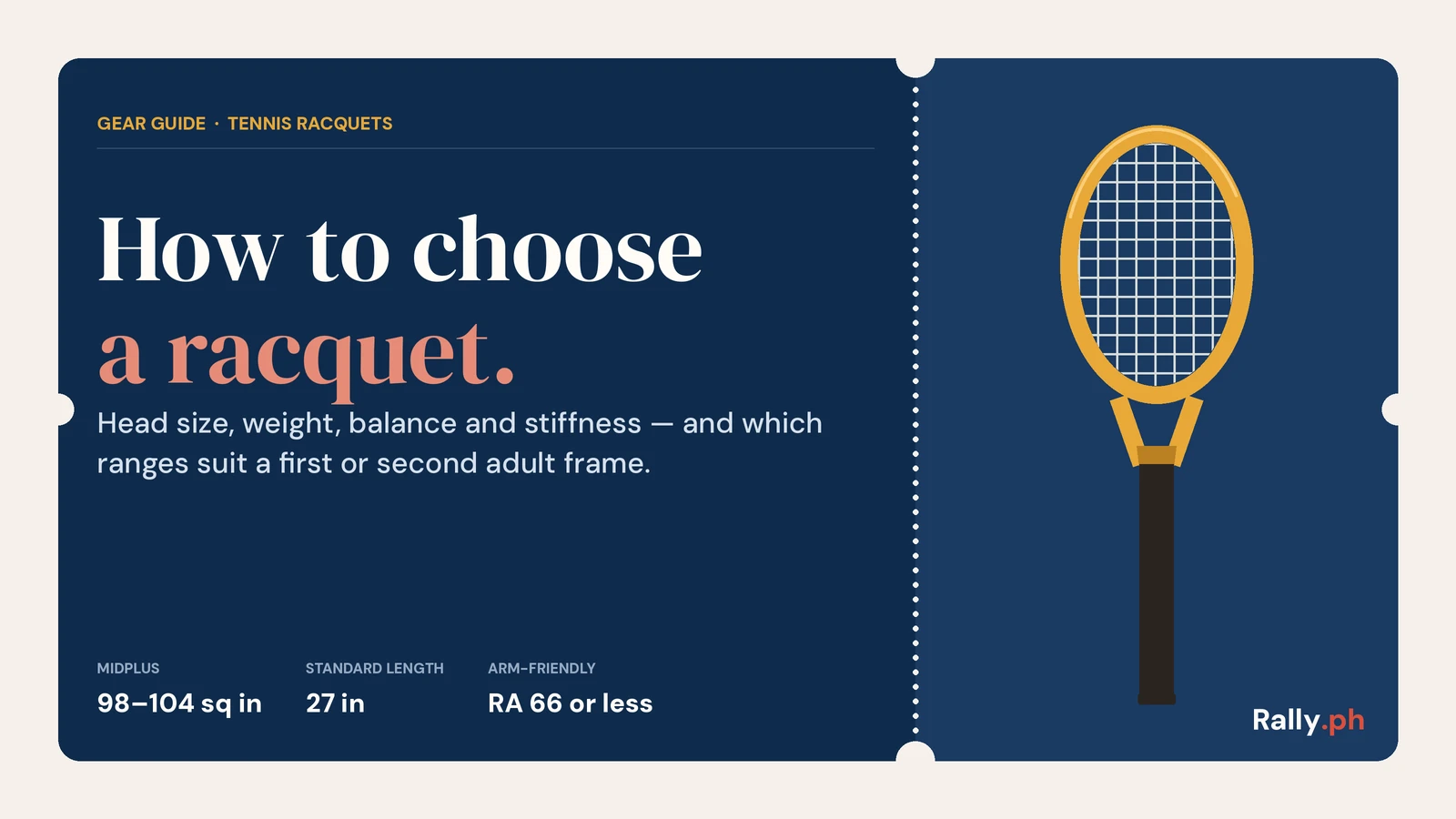
- Most players will be well served by a racquet around 98 to 104 square inches, in the midplus range Tennis Warehouse describes as the most common "tweener" head size. Today's most common heads, it says, are 97 to 100 square inches, and a racquet at or close to 100 offers a solid blend of power and control for many players.
- Beginners usually want a larger, more forgiving head and a lighter, easier-to-swing frame. Tennis Warehouse's power-racquet category uses oversized heads (107 to 135 square inches) and lighter, often head-heavy frames for players with shorter, slower swings who want the racquet to supply more of the pace.
- Heavier racquets are more stable and more powerful, all else equal, but harder to manoeuvre. You can add weight later. Tennis Warehouse notes that taking weight out is almost impossible.
- The standard adult length is 27 inches. Racquets can legally go up to 29 inches; the ITF Rules of Tennis (Appendix II) cap overall length at 73.7 cm (29.0 inches). Longer is not automatically better.
- If you have a sore arm or shoulder, Tennis Warehouse suggests looking at frames with a stiffness rating (RA) of 66 or less. A very stiff frame transmits more shock to the wrist, elbow and shoulder.
Four broad types of racquet
Tennis Warehouse divides the market into four groups. The names are trade shorthand, not official classes, but they are a useful map.
Power racquets are built for players with shorter, slower swings who want more power from the frame. In most cases, Tennis Warehouse says, they have oversized to super-oversized heads (107 to 135 square inches), are lightweight (8 to 9.5 ounces), may be longer than 27 inches, are stiffer, and are balanced head-heavy or even, so enough weight stays in the hitting zone.
Tweener racquets sit between power frames and player's frames, and Tennis Warehouse calls them the most popular type it sells. They are often light to medium weight (9.5 to 11 ounces), balanced anywhere from slightly head-light to slightly head-heavy, and have midplus heads (98 to 104 square inches). The power level typically runs from low-medium to medium-high, which is why they appeal to intermediate through advanced players. Because they feel light and fast, with a midplus head, they also tend to be spin-friendly.
Modern player's racquets grew out of the heavy-topspin style at the top of the game. They are lighter and faster than traditional player's frames, with midplus heads often around 98 to 100 square inches, and a strung weight typically between 11 and 12 ounces. Tennis Warehouse says their power level is similar to, or the same as, tweeners, and that they suit players who attack the ball at an aggressive angle for spin.
Traditional player's racquets are the ones Tennis Warehouse associates with professionals and high-level club or college players. They are typically heavier (11.5 to 12-plus ounces), have smaller heads (85 to 98 square inches), thinner and more flexible beams, and a head-light balance so they stay manoeuvrable despite the weight. The result is a low-power racquet for players who already supply their own pace and want control.
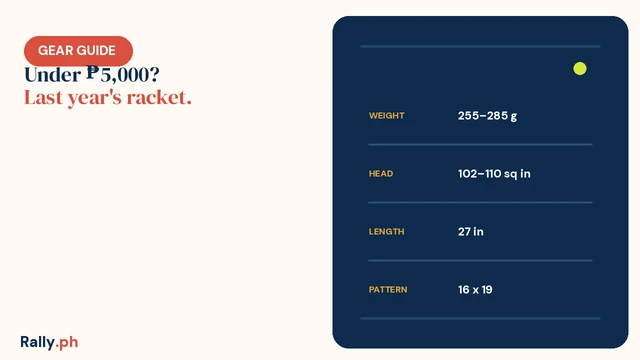
If you are buying a first adult racquet, start in the power or tweener groups, not with a traditional player's frame. Our beginner guide points to about 255 to 285 grams unstrung and a 102 to 110 square-inch head for that first stick. Those figures sit on the lighter, more forgiving side of the ranges above.
Head size
Tennis Warehouse still uses the older size labels, even though the market has bunched around the middle of the range:
- Midsize: 85 to 96 square inches
- Midplus: 96 to 106 square inches
- Oversize: 107 to 115 square inches
- Super oversize: 116 square inches and larger
It also notes that racquets today are offered from 93 to 135 square inches, with 97 to 100 the most common.
Power is directly related to head size: a larger head provides more power than a smaller one, all other things being equal, and a larger sweetspot, which is more forgiving on off-centre hits. A smaller head generally appeals to more accomplished players who want more control.
For most club players here, a midplus head around 100 square inches is the unexciting, sensible place to start. Go larger if you are still missing the centre of the strings often, or if you want the racquet to help with pace. Go smaller only if you already hit the ball cleanly and want a smaller, more precise hitting area.
Weight and balance
These two specs, Tennis Warehouse says, most influence how a racquet feels in your hand and when you swing it.
Weight. A heavier racquet is more powerful, more stable and transmits less shock than a lighter one, all else equal. The extra mass helps the racquet "win" the collision with the ball, which is why reviewers talk about plow-through. From the baseline, players with long, fast strokes can get good depth and pace from that weight; at net and on the return, the stability is useful. A lighter racquet is easier to move, so you can get the head into position and accelerate it for spin, angles, dipping passing shots and quick volleys.
The practical rule Tennis Warehouse adds is lopsided, and it matters when you are buying: you can always add weight if a racquet is too light, but reducing weight is almost impossible. If you are unsure, it is safer to start a little light than a little heavy.
Balance. A racquet is head-light, head-heavy or even-balanced. Head-light means more of the mass sits toward the handle; head-heavy means more sits in the tip. Traditional player's racquets are usually head-light so they still feel manoeuvrable despite being heavy overall. Lightweight power racquets tend to be head-heavy, which keeps some stability in the hitting zone even though the frame is light. Medium-weight racquets often sit at, or close to, even balance, which Tennis Warehouse describes as a blend of stability and manoeuvrability.
On a spec sheet, balance is often written as centimetres from the butt, or as points head-light or head-heavy. You do not need to memorise the scale. You do need to notice whether two racquets of the same weight feel different because the weight is in different places.
Swingweight is the number that captures how heavy the racquet feels when you swing it, not just when you hold it. Tennis Warehouse gives a simple decoding:
- Low: 305 and below — manoeuvrable, suitable for beginners
- Medium: 310 to 325 — moderate manoeuvrability and stability, suitable for all levels, and ideal for intermediates
- High: 325 and above — very stable, suitable for advanced players
Higher swingweight means more comfort, power and stability at impact, and a harder swing. Lower swingweight is easier to accelerate, but less stable, especially against a heavier ball. Advanced players often want the higher number so they can redirect pace; beginners and intermediates usually want the lower one so they can get the racquet around in time.
Frame stiffness
Tennis Warehouse measures stiffness on an RA scale and publishes it on its racquet pages:
- Flexible: 63 and below
- Medium: 64 to 67
- Stiff: 68 and above
A stiffer frame bends less at contact, so it drains less energy from the ball and plays with more power. A common myth, which Tennis Warehouse is careful to knock down, is that a flexible frame "catapults" the ball back. The ball is on the strings for about 3 to 5 milliseconds, which is shorter than the time the frame takes to recover, so the frame absorbs energy rather than returning it.
Stiffness also affects control and comfort. More power generally means less control, though that depends on the player and the string. An advanced player with a long, fast swing may prefer a flexible frame for feel and control, because they already supply the pace. A beginning or intermediate player may prefer a stiffer frame for an easier mix of power and control. Many advanced players also pair a stiffer, more powerful frame with a stiffer, control-oriented string so they can hit with power and spin. Tennis Warehouse notes that this combination has come to define the modern power game at the elite level, and that a stiff racquet with a stiff string can cause comfort problems for amateur players.
To a point, stiffer racquets are generally less comfortable than more flexible ones. A very stiff frame transmits more impact shock to the wrist, elbow and shoulder. Comfort is personal, but Tennis Warehouse's advice for players with arm or shoulder problems is to look at frames with an RA of 66 or less.
Strings change this picture as much as the frame does. Our string guide for Philippine humidity covers type, tension and how often to restring in this climate.
Length
The standard adult tennis racquet is 27 inches long. Tennis Warehouse says racquets are also sold from 26.5 to 29 inches, and that 29 inches is the legal maximum for tournament play. That matches Appendix II of the ITF Rules of Tennis, which caps overall length at 73.7 cm (29.0 inches) and overall width at 31.7 cm (12.5 inches).
A longer racquet gives more reach on groundstrokes, more leverage on the serve and slightly more power, all else equal. It also raises swingweight, so the racquet takes more effort to move. Many power racquets are made lighter so they stay manoeuvrable even when they are stretched. Unless you have a reason to want that extra reach, 27 inches is the default, and the length almost every demo, cover and bag is built around.
Junior players moving up should start at 27 inches, not at an extended frame. Our kids' racquet sizing guide covers the lengths below that, and why a child should not skip them.
String pattern, grip and the rest of the kit
String pattern is easy to ignore and still changes how the racquet plays. An open pattern (fewer mains and crosses, more space between strings) deflects more at impact, gives a higher launch angle and, Tennis Warehouse says, should feel livelier at the same tension: easier depth and pace, and more movement in the main strings, which helps with spin. A denser pattern does the opposite: a more controlled, lower launch and a firmer string bed. You will see patterns written as 16×19 (more open) or 18×20 (denser), among others.
Grip size is a separate decision from the frame, and it is one you can fine-tune with an overgrip. Our overgrips guide for sweaty hands covers how to measure grip size, how much thickness an overgrip adds, and why that matters in Philippine humidity.
If a shop will let you hit with two or three frames in the same category, do that before you buy. That is our suggestion, not a formal demo programme: specs tell you the neighbourhood, a few balls on a hard court tell you whether the racquet is actually easy to get around in the heat. And once you have chosen a frame, keep it out of a parked car. The same heat that wears out strings and grips is not kind to a graphite racquet either.
Sources
- Tennis Warehouse, How to pick the right tennis racquet and Tennis racquet and string terms
- International Tennis Federation, ITF Rules of Tennis 2026, Appendix II (maximum racquet dimensions)