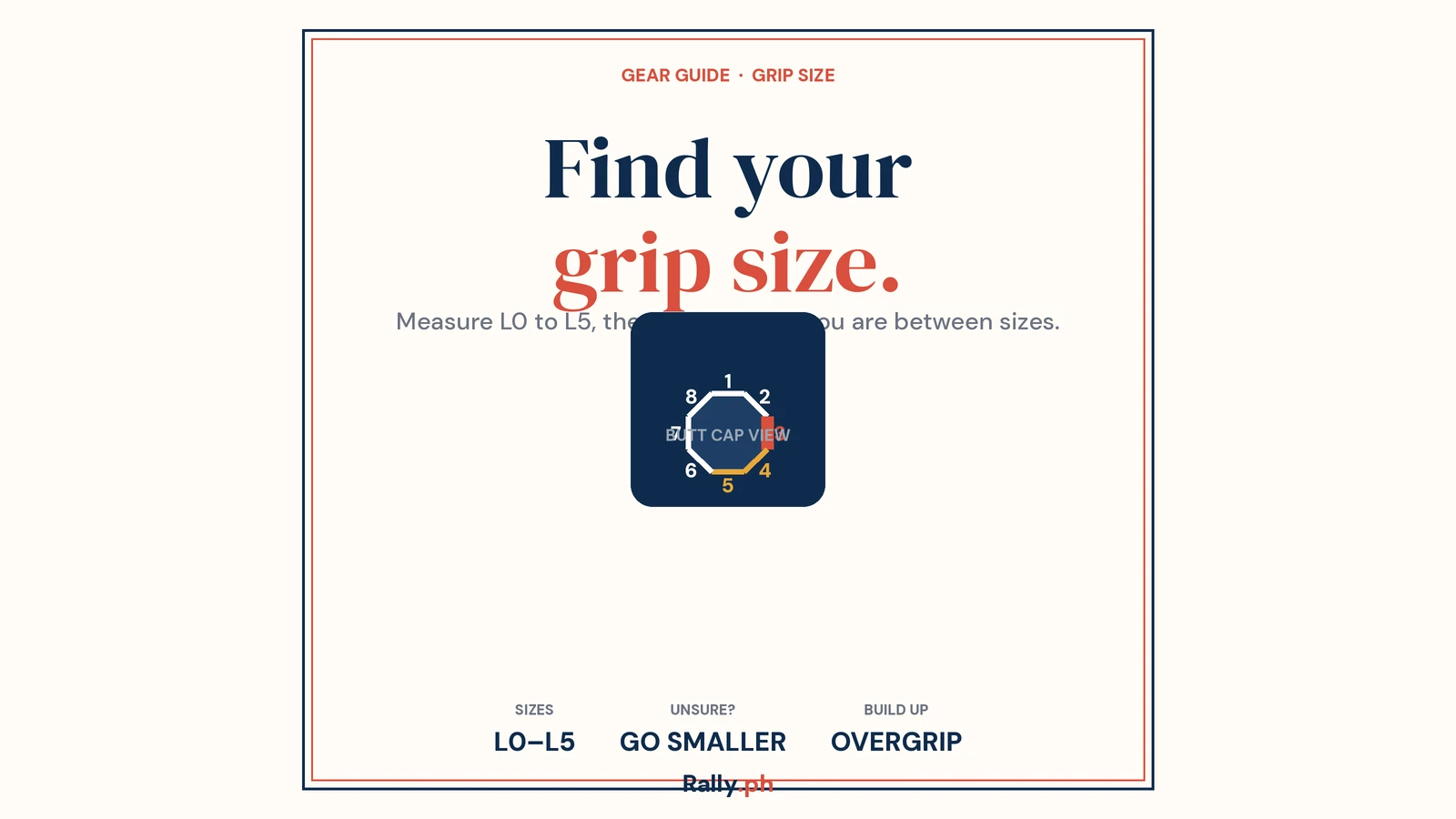
Grip size is the circumference of the handle, usually given as a number from 0 to 5, or as inches from 4 to 4 5/8. A handle that is too small or too large is uncomfortable, and a poorly fitting grip can contribute to arm strain. The good news is that you can measure it, and that if you are between sizes you can usually build a smaller handle up.
This guide follows Wilson's four-step grip-size advice and the Lawn Tennis Association's grip-size guide, then adds a practical note for overgrips in Philippine humidity. It does not replace a fitting in a shop. For juniors, use the kids' racquet sizing guide. For the rest of the racquet, see How to choose a tennis racquet.
The short answer
- Read the end cap first. Wilson says the bottom of the handle lists a number, typically 0, 1, 2, 3, 4 or 5, and that in the United States the same sizes are written in inches. Size 3 is 4 3/8 inches; size 2 is 4 1/4 inches. If you already like the size you have, Wilson's advice is to stick with it.
- Wilson's adult sizes are: 0 (4 inches), 1 (4 1/8), 2 (4 1/4), 3 (4 3/8), 4 (4 1/2) and 5 (4 5/8). The LTA lists the same range, and also notes a specialty size 6 at 4 3/4 inches, which is not in Wilson's table.
- If you are not sure, go smaller. Both Wilson and the LTA say you can add an overgrip to build the handle up. Wilson notes that this is much easier than trying to shave a handle down.
- Two simple checks are worth doing: the LTA ruler test, and a finger-space check on a racquet you can hold. They will often narrow you to two sizes. The one that feels secure, without a squeeze, is the one to try.
The ruler test
The LTA describes this as follows. Open your dominant hand with the fingers extended and held together. Find the lower crease that runs across your palm. Measure from that crease to the tip of your ring finger, then compare the measurement with the grip-size chart. If you fall between two sizes, choose the smaller grip; you can increase it later with an overgrip.
This is a starting measurement, not a custom fitting. Hands and handle shapes vary, and the way you hold a forehand is not identical to a serve.
The finger-space check
Wilson's version: hold the racquet in a continental, or "handshake," grip, with the knuckle of your index finger lined up with the top-right bevel. You want some space between the tips of your fingers and your palm. If the fingers wrap all the way around and run back into your hand, Wilson says you need a larger grip.
The LTA describes a related index-finger test: hold the racquet in a standard eastern grip, then place the index finger of your other hand between your fingertips and the palm side of the handle. Too much space means the grip is too big; no space means it is too small.
Use whichever test matches the racquet you have in your hand, and do not treat a one-finger gap as a law. Wilson also notes that players who hit a lot of topspin often prefer a slightly smaller grip for more wrist action, and that this is acceptable so long as the fingers are not touching the hand. The LTA's comfort test is similar in spirit: you should be able to hold the racquet securely without excessive squeezing, and the handle should not twist during the swing.
Common sizes, not assigned sizes
Wilson says the most common grip sizes, based on gender, are 4 1/4 inches (size 2) for women and 4 3/8 inches (size 3) for men, and immediately adds that a much smaller or larger hand may need a different size. The LTA publishes a similar "typical user" column, with size 2 as average for women and size 3 as average for men. Those are starting points, not rules. Measure your hand, then try the size.
If you have had a sore elbow or wrist, a badly fitting grip is one of the things worth checking, along with technique, string tightness and how often you play. See our tennis elbow prevention guide. This article is not medical advice.
Overgrips, humidity and building up a size
In the Philippines, most club players add an overgrip on top of the factory grip, and replace it often, because sweat flattens and slips the handle. That slightly increases the circumference. It is also why both Wilson and the LTA tell you to start smaller if you are between sizes: you can add thickness, and you cannot easily take it away.
Our suggestion: measure without a worn, bunched overgrip if you can, then put on a fresh overgrip and repeat the finger-space check. If the handle suddenly feels bulky, the underlying size may already be large enough. For how often to change an overgrip in this climate, see overgrips for sweaty hands.
If a shop will let you hold two sizes of the same model, do that. Feel matters more than the chart once you are next to a racquet.
Sources
Wilson Sporting Goods, "Four Steps to Determine Your Tennis Racket Grip Size," and Wilson's "How to Choose a Tennis Racket" grip-size section, for end-cap numbers, the inch conversion table (sizes 0 to 5), the continental finger-space check, the advice to go smaller if unsure and add an overgrip, and the most common size 2 and size 3 starting points. We do not repeat Wilson's stated overgrip thickness figure, which we could not reconcile with a one-eighth-inch size step.
Lawn Tennis Association, "Tennis grip size guide: racket grips & overgrips," for the definition of grip size as handle circumference, the ruler test, the index-finger test, the standard size chart including a specialty size 6, and the advice that a poorly fitting grip can contribute to tennis elbow.
Our suggestions: re-check the handle with a fresh overgrip in humid conditions, and try two sizes in a shop when you can.