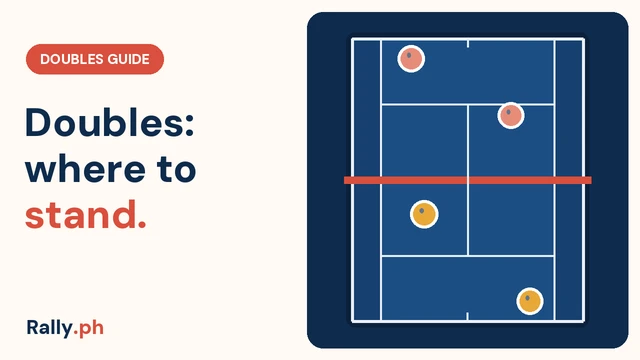
Most open play in the Philippines is doubles. The court is the same size as singles — 20 by 44 feet — so the extra player is not covering more ground. The extra player is why serving order, who stands where, and who may move after the return become the whole game.
The positioning rules below are from Section 5 of the 2026 USA Pickleball Official Rulebook. The score-calling rules are in Section 6. If the three-number score is still new, read this alongside our rules and scoring guide. Tennis players who want the transfer, not the rotation, should start with pickleball for tennis players.
The short answer
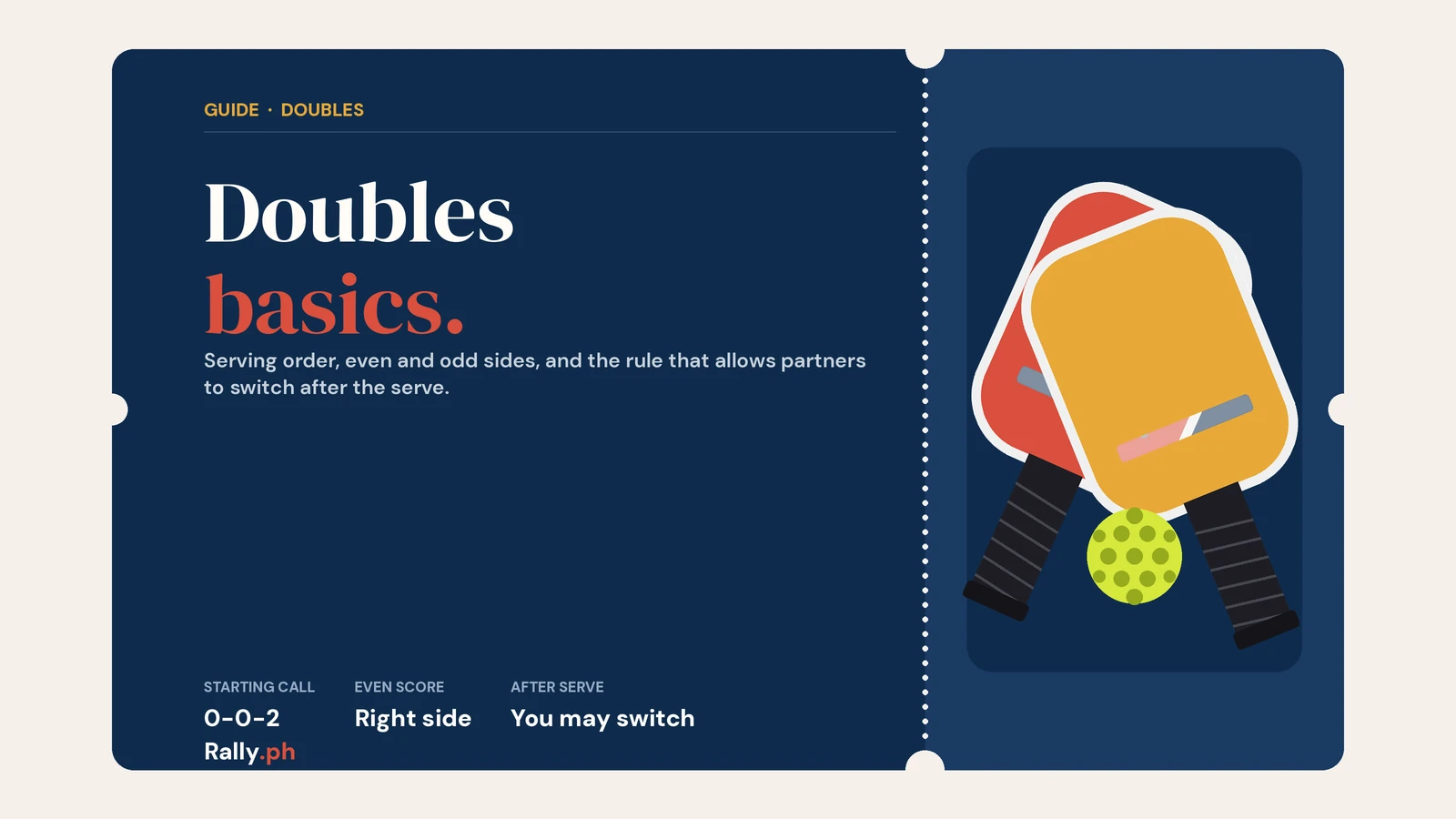
- Both partners normally serve before a side out, except at the start of each game, when only the starting server serves, as a second server. That is why the first call is “zero – zero – two.”
- The starting server’s side is tied to their own team’s score: right side when that score is even or zero, left side when it is odd, whether they are serving or receiving (Rule 5.B.3).
- The correct server must serve, and the correct receiver must return the serve. After that, Rule 5.B.4 does not restrict where partners stand, on or off the court, as long as they stay on their own end of the net while the ball is live. That is the official basis for what players call stacking.
- The two-bounce rule still comes first. The receiving team cannot volley the serve, and the serving team cannot volley the return. You do not both sprint to the kitchen on the serve.
Starting a game, and why the first serve is a short rotation
Before the first serve, each team designates a starting server (defined in Section 2). That player will serve first for their team at the beginning of the game.
The team that serves first does not get both partners’ turns. Rule 5.B.2 says the starting server for the team that starts the game is designated as a second server for that first service rotation. After that player loses a rally, it is a side out, and the serve passes to the other team. From then on, each team gets a first server and a second server in every rotation.
That is why the opening score is called “zero – zero – two” (Rule 6.B.2). The “two” is not a mistake and it is not the number of serves you have left in a tennis sense. It tells everyone that the next fault by the serving team will be a side out.
After a side out, service begins with whichever player is correctly positioned on the right side according to that team’s score. For the rest of that rotation, that player is the first server and their partner is the second server (Rule 5.B.2). The first server keeps serving, alternating right and left serving areas after each point won, until the team loses a rally. Then the second server does the same, until the next side out (Rules 5.B.5 and 5.B.6).
Even and odd: the positioning rule that prevents mix-ups
Rule 5.B.3 is the one to learn before any formation talk.
- When your team’s score is zero or even, your starting server should be on the right side of the court when serving or receiving, and that player’s partner should be on the left.
- When your team’s score is odd, the starting server should be on the left, and the partner on the right.
Notice that this is your score, not a combined score, and not the opponents’ score. Each team tracks its own even and odd. If you win a point and your score goes from 4 to 5, the starting server should now be on the left for the next serve or return of serve.
The official rules summary says the same thing in slightly more everyday language: when the serving team’s score is even (0, 2, 4, 6, 8, 10), the player who was the first server in the game for that team will be in the right-side court when serving or receiving; when the score is odd, that player will be in the left-side court.
If you lose track, you are allowed to ask. Rule 5.C says that before the serve is hit, a player may ask the opponent who the correct server or receiver is, or whether players are in the correct positions, and the opponent must answer. If someone is in the wrong place and you stop the rally to say so, a correct claim is a replay; an incorrect claim is a fault on the player who stopped play (Rule 5.C.1). If nobody notices until the rally is over, the result of the rally stands (Rule 5.C.2).
After the serve: the rule behind stacking
“Stacking” is the common name, not a word the rulebook uses as a heading. The rule is 5.B.4: except while serving and receiving, there is no restriction on the position of the players, on or off the court, as long as they are on their respective end of the net while the ball is live (with a narrow exception for legally crossing the plane of the net under Rule 13.I).
In practice that means:
- At the serve, the correct server must be in the correct serving area, and the correct receiver must receive.
- The server’s partner and the receiver’s partner may already be standing on the “other” side, or they may switch as soon as the return is in play, so that each partner ends up on the side they prefer for the rally.
- You still have to get back to the correct sides before the next serve or return of serve, according to your team’s score, unless you are again using a legal switch after that serve is taken.
Partners stack so a left-side player, or a stronger forehand in the middle, can spend more of the rally there. It is legal. It is also optional. In beginner open play, staying on your scored side for the whole point is simpler and avoids wrong-receiver faults. Rule 5.C.1.c is strict: if the correct server and receiver were in the correct positions when the score was called, it is a fault if someone other than the correct receiver returns the serve, even if the rally is finished before the fault is called. That fault must be called before the next serve.
The two-bounce rule decides your first two shots
None of the positioning above lets you volley the serve or the return of serve. Rule 10.A still requires both of those balls to bounce. The serving team, in particular, should not follow the serve to the kitchen. The usual pattern in doubles is:
- Serve from behind the baseline, then stay back to take the return off the bounce.
- The returner also stays back enough to take the serve off the bounce, then can move forward.
- After those two bounces, both teams try to close to the kitchen line together, because that is where the point is usually won.
The kitchen explainer covers why you want to arrive at that line without stepping on it. Communication is the other half. Call “mine,” “yours,” and “bounce it” early, especially on balls down the middle. Our tennis doubles positioning guide is a different sport, but the habit of talking before the ball is halfway to you is the same.
A simple way to practise the rotation
Play a few practice games in which the only goal is to call the three-number score correctly and to have the starting server on the right side at every even score. Do not stack. When that feels automatic, add a switch after the return of serve and see whether you still arrive on the correct sides for the next point. If you get lost, ask before the serve, as Rule 5.C allows, rather than guessing and arguing after the rally.
Sources
- USA Pickleball, 2026 Official Rulebook: Section 2 (Starting Server, First Server, Second Server); Rules 5.B, 5.B.2–5.B.6, 5.C, 5.C.1, 5.C.2; Rule 6.B.2; Rule 10.A; Rule 13.I
- USA Pickleball, Basic Rules Summary, Rev. 1/1/2026 (service sequence; even and odd court for the starting server)