The kitchen is the rule that makes pickleball look simple and then catches you. You are not banned from the area by the net. You are banned from volleying there. The difference matters on every tight ball at the line.
The official name is the non-volley zone. The 2026 USA Pickleball Official Rulebook uses that term throughout. The official rules summary, revised 1 January 2026, says the zone is commonly called “the kitchen,” which is how you will hear it at open play in the Philippines. For the rest of the scoring and serve rules, see our rules and scoring guide. To find a first session, see how to start.
What the zone actually is
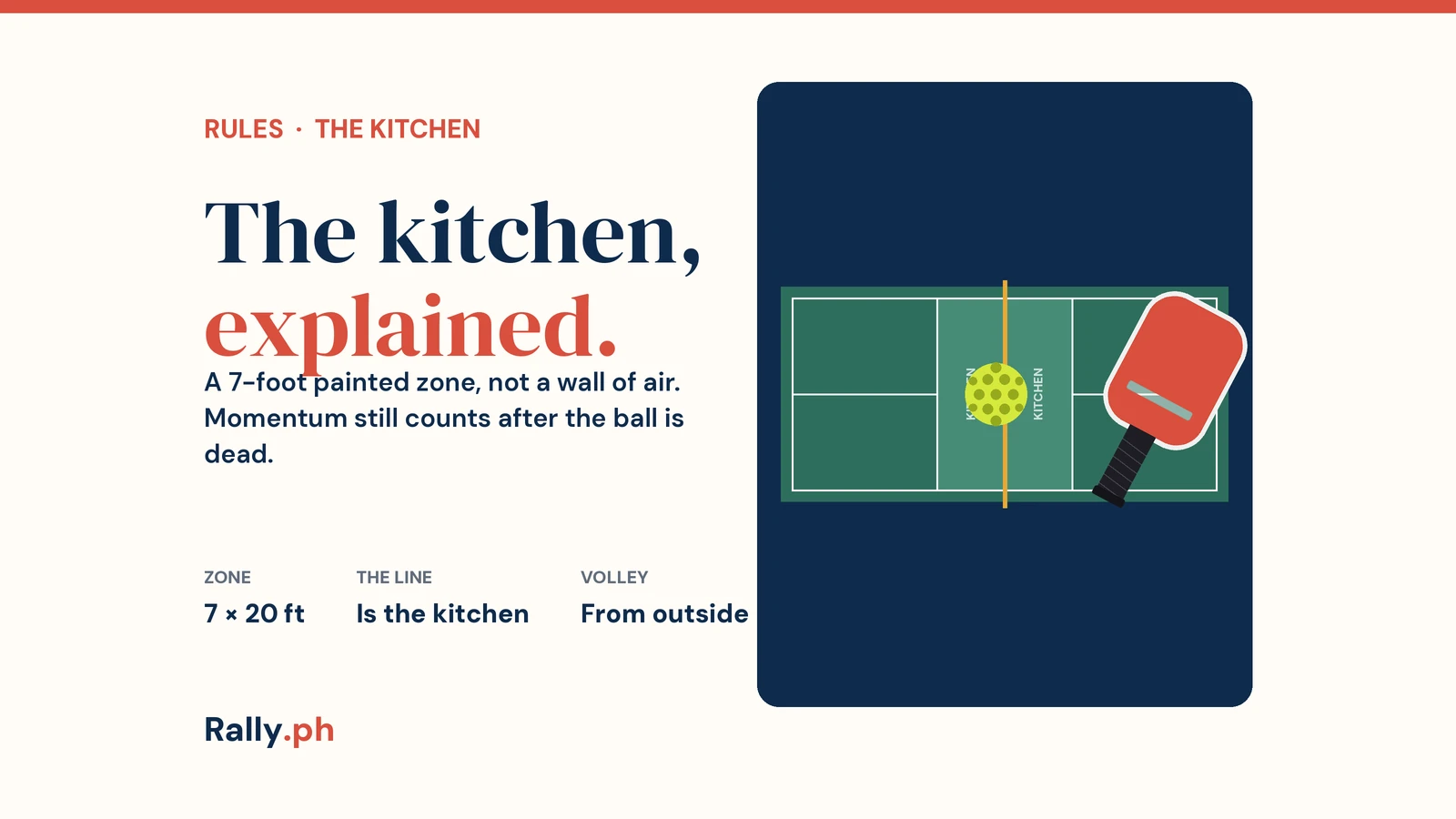
Rule 3.A.4.c describes a rectangle 7 feet by 20 feet (2.13 by 6.08 metres) adjacent to each side of the net, running the full width of the court. The non-volley zone lines run parallel to the net, 7 feet from it, and all lines that bound the zone are part of the zone. Step on the kitchen line during a volley and you are in the kitchen.
The same rule adds a detail most first-timers never hear: the non-volley zone is two-dimensional and does not extend above the playing surface. It is paint on the court, not a wall of air. You may reach over the kitchen, in the air, to volley a ball, as long as you, your paddle, your hat and anything else in contact with you do not touch the zone or its lines. That is why a player can lean in from behind the line and still hit a legal volley, and why a paddle that taps the line on the follow-through is not.
Court measurements are taken to the outside edge of the perimeter and non-volley zone lines (Rule 3.A.2). The lines are supposed to be 2 inches wide (Rule 3.A.4.e). On a chalked street court the line may be rougher than a painted mall court; the rule is the same: the line belongs to the kitchen.
What you may do in the kitchen
Rule 11.A is the heart of it: all volleys must be initiated outside the non-volley zone. A player, or anything in contact with the player, may contact the zone at any time except during the act of volleying a ball.
So you may:
- Stand in the kitchen, or walk through it, between shots.
- Step in to play a ball that has bounced in the kitchen or near it. The official summary says a player may legally be in the zone any time other than when volleying.
- Let a ball bounce and then hit it, even if both feet are inside the lines.
You may not volley — strike the ball before it bounces — while you are in contact with the zone. The definition of “Volleying, Act of” in Section 2 matters here. The act of volleying begins when the ball is hit out of the air and ends when the player’s movement from the follow-through (momentum) stops. The kitchen rule lasts for that whole movement, not just the instant of contact.
The three kitchen faults that actually decide points
1. Contact while volleying (Rule 11.A.1). If the volleying player, or anything that has contact with that player — including that player’s partner — contacts the non-volley zone, it is a fault. A paddle, a hat, a towel, a shoe on the line, or a partner you reach out and touch can all count. The official summary puts it plainly: it is a fault if, when volleying, you step on the zone, including the line, or if your momentum causes you or anything you are wearing or carrying to touch it.
2. Momentum after the ball is dead (Rule 11.A.2). This is the fault that feels unfair until you have seen it a few times. If your momentum from a volley carries you into anything that is in contact with the kitchen, it is still a fault even after the ball becomes dead. A smash that lands in, followed by a stumble onto the line, is a fault. The point you thought you had just won is lost. Section 2 defines momentum as the property that causes a player to continue in motion after contacting the ball, and says it ends when the player regains balance and control or stops moving toward the non-volley zone.
3. Not getting all the way out before the next volley (Rule 11.A.3). After you have contacted the kitchen, you may not volley again until both feet have contacted the playing surface completely outside the zone. A hop that still has one foot on the line, or a volley hit while you are still stepping out, is a fault. The practical habit is: if you went in to take a bounce, get both feet behind the line and settle, then volley.
On the serve, the kitchen also has a special line rule. A serve must clear the opponents’ non-volley zone, including the kitchen line, and land in the correct service court (Rule 7.E). A serve that touches the kitchen line is short. A ball in a rally that later lands on the kitchen line is in, because that line is in play — you just cannot volley from on it.
Why the rule exists, and how to play with it
The official summary says the prohibition on volleying in the zone “prevents players from executing smashes from a position within the zone.” Without it, the taller or more aggressive player would live at the net on a 20-foot-wide court. With it, the soft shot that drops into the kitchen — the dink — becomes the shot that moves people in and out of the zone and creates errors.
That is the tactical point a rules list does not make. If you stay one step behind the kitchen line, you can volley. If your opponents drop the ball short, you have to let it bounce, step in, and then get out again before you can volley the next one. The team that gets to the line first, and stays patient, usually wins. Tennis players who treat every short ball as an approach-and-smash chance are the ones who step on the line.
In doubles, partners often try to arrive at the kitchen line together after the two-bounce sequence is over. In open play, call a kitchen fault on yourself as soon as it happens. The USA Pickleball sportsmanship guide asks you to watch your own and your partner’s feet for non-volley-zone foot faults, and to accept those calls graciously. Our etiquette guide puts that in the context of Philippine open play.
If you came from tennis, the kitchen is also one of the habits that does not transfer. The longer version of that comparison is in pickleball for tennis players.
Sources
- USA Pickleball, 2026 Official Rulebook (via usapickleball.org/rules): Rule 3.A.2, 3.A.4.c, 3.A.4.e; Section 2 definitions of Momentum, Non-Volley Zone, and Volleying, Act of; Rules 7.E, 11.A, 11.A.1, 11.A.2, 11.A.3
- USA Pickleball, Basic Rules Summary, Rev. 1/1/2026 (non-volley zone faults; the zone is commonly called the kitchen)
- USA Pickleball, Essential Sportsmanship Guide