The first time you hear a pickleball score, it sounds like a radio check: “four – two – one.” The numbers are not random. In doubles they tell you who is serving, from which side, and whether a point or a side out is at stake.
The rules below are from the 2026 USA Pickleball Official Rulebook, which is the standard Philippine venues advertise when they mark a 20-by-44-foot court. A shorter rules summary, revised 1 January 2026, is useful on court; if the two disagree, the rulebook wins. For getting started in the Philippines, begin with our start-here guide. For the kitchen specifically, use the non-volley zone explainer.
The short answer
- Only the serving side scores, in standard scoring (Rule 4.A). If you win a rally on receive, you do not get a point. You get the serve, or your partner does.
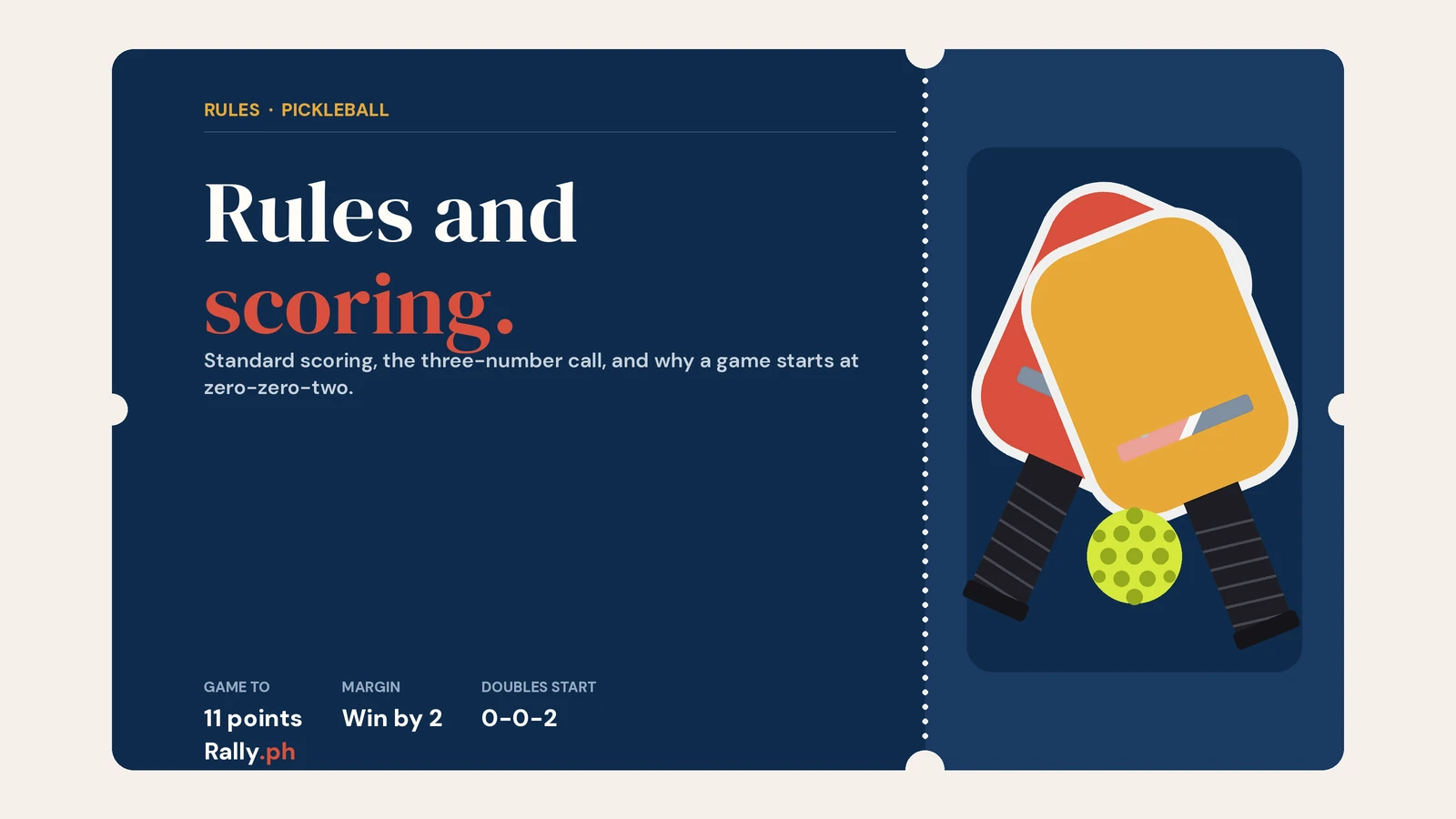
- Games are typically to 11, win by 2. That is how the rulebook’s introduction and the official summary put it. Tournament matches may be played to 15 or 21, still win by 2.
- You get one serve, not two. A fault on the serve costs you the serve (and, in standard scoring, any chance at a point on that turn).
- The serve and the return must bounce before anyone may volley (Rule 10.A).
- In doubles, the score is three numbers: serving team’s score, receiving team’s score, then whether this is the first or second server. A new game is called “zero – zero – two.”
How standard scoring works
Rule 4.A is short: a point is scored by serving the ball and winning the rally. That is “side-out” or standard scoring. Rally scoring, where a point is awarded after every rally, is a provisional option under Rule 14.A. Unless a session or tournament says otherwise, assume standard scoring.
The introduction to the 2026 rulebook says that, typically, the first player or team to score 11 points and lead by at least two points wins the game. The official summary says the same, and adds that tournament games may be played to 15 or 21, still win by two. Rule 4.B refers to scoring the “winning point.” If your open-play group wants a shorter game to 7, or a single long game to 15, agree that before you start.
A fault by the receiving team gives the serving side a point. A fault by the serving side costs that server the serve. In doubles, after the second server faults, it is a side out and the other team serves.
Why doubles starts at “zero – zero – two”
In singles, Rule 6.B.1 says the score is two numbers: server’s score, then receiver’s score. A game starts “zero – zero.”
In doubles, Rule 6.B.2 requires three numbers: serving team’s score, receiving team’s score, then the server number, 1 or 2. The first call of the game is “zero – zero – two.”
That third number is the part people skip, and then the sides get confused. Here is why it starts on 2. Under Rule 5.B, both players on a team normally serve before a side out — except at the start of each game, when only the starting server serves, and that player is designated as a second server for the team’s first service rotation (Rule 5.B.2). So the first team to serve gets only one service turn before the serve passes. Calling “two” at 0–0 tells everyone that a fault will be a side out, not a hand-off to a partner.
After a side out, service begins with the player who is correctly on the right side according to that team’s score. That player is the first server for that rotation; their partner is the second server. The first server keeps serving, switching sides after every point they win, until their team loses a rally. Then the second server does the same, until the next side out (Rules 5.B.5 and 5.B.6).
The starting server’s position is tied to their own team’s score, not the opponents’. When that team’s score is zero or even, the starting server should be on the right while serving or receiving; when it is odd, on the left (Rule 5.B.3). If you remember only one positioning rule, remember that. Our doubles basics covers the rotation, and the legal mid-rally movement people call stacking.
The serve, in the rules that actually matter on court
You serve diagonally, from behind the baseline, into the opposite service court. At least one foot must be in contact with the correct serving area, and neither foot may be on the court, when the paddle hits the ball (Rule 7.A). The served ball must clear the opponents’ kitchen — including the kitchen line — and land in the correct service court (Rule 7.E). A serve that touches the kitchen line is short and a fault. A serve that touches any other line of the correct service court is in (official summary; Rule 8.B).
Two details surprise tennis players.
A serve that touches the net can still be good. Rule 7.E says the served ball must clear the kitchen, “with or without touching the net,” and land in the correct service court. There is no tennis-style service let that makes you take the serve over. If it clips the net and dies in the kitchen, it is a fault. If it clips the net and lands in, play on.
You may use a drop serve. A volley serve — hitting the ball out of the air — must travel in a clear upward arc, with the paddle head not above the wrist joint, and with the ball no higher than the server’s waist at contact (Rule 7.C). A drop serve, under Rule 7.D, is different: you drop the ball from a natural height, without tossing or throwing it, and hit it after it bounces. The official summary states that the upward-arc, waist and paddle-head requirements do not apply to a drop serve. You still have to place the serve in the correct court.
The entire score must be called before you hit the serve (Rule 6.C). After the score call is finished, you have 10 seconds to serve (Rule 6.D). If you are not ready, Rule 6.A lists the valid signals: paddle above the head, non-paddle hand above the head, or completely turning your back to the net. After the score call has started, those signals no longer count as “not ready,” except to indicate a hinder.
The two-bounce rule, and then the rest of the rally
Rule 10.A: the serve must bounce before the receiver hits it, and the return of serve must bounce before the serving side hits it. Volley the serve, or volley the return of serve, and it is a fault. After those two bounces, either side may volley or play the ball off the bounce. A ball may bounce only once on your side before you return it (Rule 10.B).
From there, the kitchen rule shapes the point. You may not volley while in contact with the non-volley zone. You may step in to play a bounced ball. The dedicated kitchen guide is the place for momentum faults and the fact that the zone is only the painted surface, not the air above it.
Line calls are made by the players on the end where the ball landed, and either doubles partner may call the line (Rule 8.A). The sportsmanship guide that accompanies the official rules says to resolve uncertainty in favour of your opponents. That matters more in open play than any other single habit; we apply it in our etiquette guide.
If you play tennis as well
The scoring is simpler than tennis in one way — no 15–30–40, no deuce in the tennis sense — and more fiddly in another, because of the third number and the one-serve rule. Our tennis scoring explainer is useful if you are translating between the two games. For what else carries over, see pickleball for tennis players.
Sources
- USA Pickleball, 2026 Official Rulebook (via usapickleball.org/rules): Section 1 (standard scoring typically to 11, win by 2); Rules 4.A, 4.B, 5.B, 5.B.2, 5.B.3, 5.B.5, 5.B.6, 6.A, 6.B, 6.C, 6.D, 7.A, 7.C, 7.D, 7.E, 8.A, 8.B, 10.A, 10.B, 14.A; Section 15 (tournament games to 11, 15 or 21, win by 2)
- USA Pickleball, Basic Rules Summary, Rev. 1/1/2026
- USA Pickleball, What Is Pickleball?