Open play is how most people in the Philippines actually start pickleball: you turn up, often alone, and you are rotated into games with people you have just met. The official rules still apply. So does a second document that USA Pickleball publishes for exactly this kind of session: the Essential Sportsmanship Guide.
The guide is clear about its place. The Official Rules of Pickleball take precedence in any conflict. The sportsmanship guide is there to encourage respect, fair play, and graciousness in winning and losing. It is not a Philippine federation code, and local clubs may have their own rotation system. Use the official guide as the shared baseline, then follow the house practice of the court you are on.
For the rules themselves, see our scoring guide and kitchen explainer. For a first session, start with how to start playing pickleball in the Philippines.
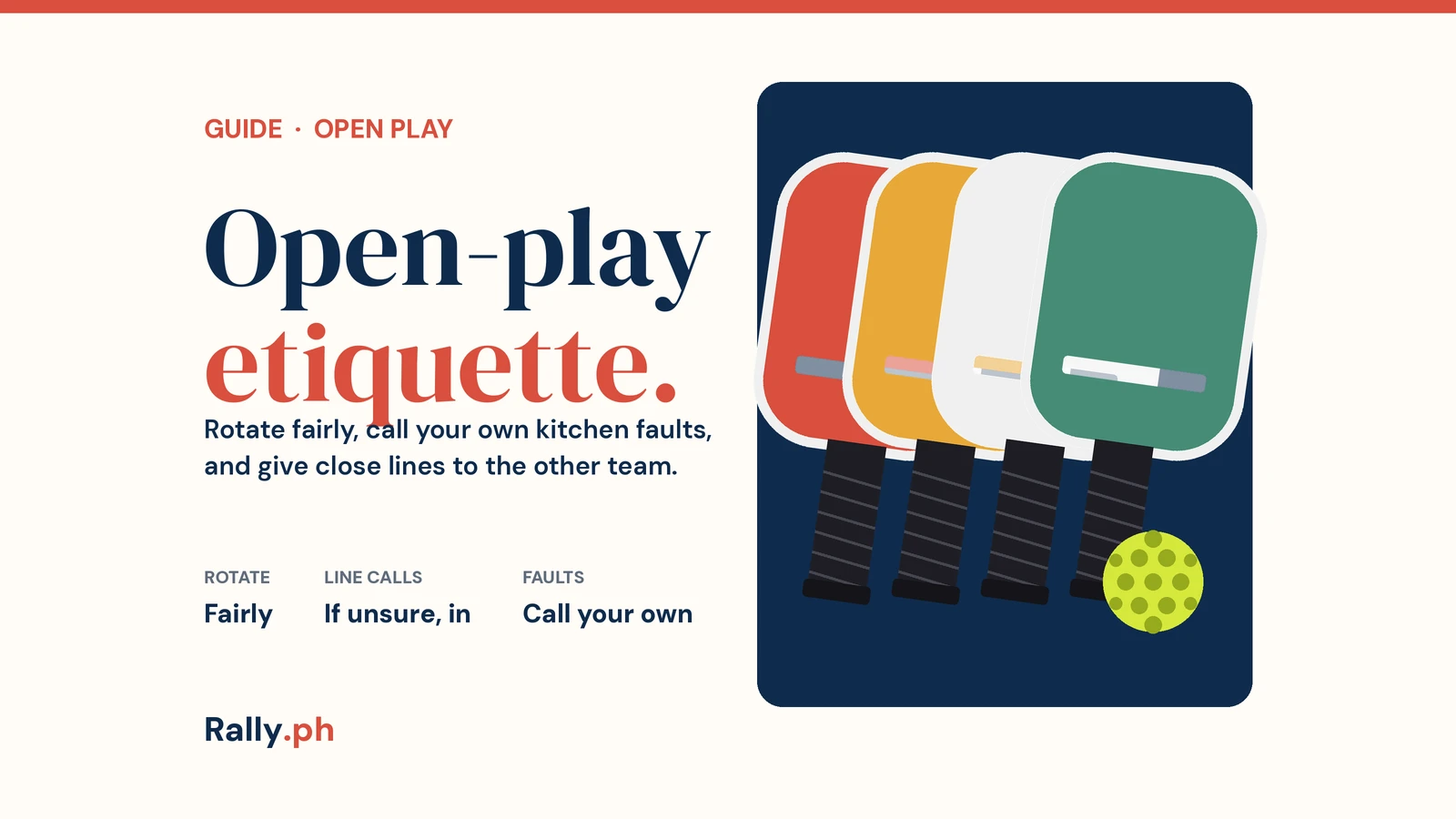
Rotate fairly, and follow local practice
Item 6 of the sportsmanship guide is the open-play section: rotate on and off courts fairly, courteously, and in accordance with local practice.
- Do not jump ahead of people who are waiting.
- Do not invite someone else forward in line, or rearrange paddles so they can move up to play with you. Move yourself back instead.
- Do not call a lower score, or start a second game, to avoid leaving the court.
- Be prepared to play when it is your turn.
- If you must cross over or behind an active court, wait until play is stopped, then cross quickly in a single group.
Those five bullets travel well to a mall atrium, a village court or Street Pickleball Ortigas. The “local practice” clause is the important one in the Philippines, because the queue is not always the same. Some sessions line up paddles. Some use a board, an app or a marshal. Some run games to 11, others to 7 or to a time cap so more people play. Ask when you arrive, then follow that system. Do not invent a second queue.
The Philippine Pickleball Federation’s Street Pickleball Ortigas page describes a weekend community session that includes paddles and balls in the fee, and it points players to the Street Pickleball Ortigas Facebook group for more information. Confirm the hours, the fee and the rotation method before you go, because those details can change, and rain cancels street play.
If you came from tennis, the same courtesy about not walking behind a live court appears in our tennis etiquette guide. The difference in pickleball is how tight the courts often sit next to each other, especially when eight street courts share one avenue.
Call the lines, and give the opponent the doubt
The official rulebook already assigns line calls: players are responsible for “out” calls on their end of the court, and in doubles either partner may make the call (Rule 8.A). The sportsmanship guide adds the manners that keep that system from becoming an argument.
- Respect your opponents’ right to make all calls on their end of the court.
- Call your own shot out if you see that it is out.
- If you question an opponent’s call, do so respectfully and do not argue.
- If you defer a line call to your opponents, accept their call graciously.
- Do not call a ball out unless you see it clearly and are certain it is out.
- Promptly correct any wrong call your partner may make.
- Resolve any uncertainty in favour of your opponents.
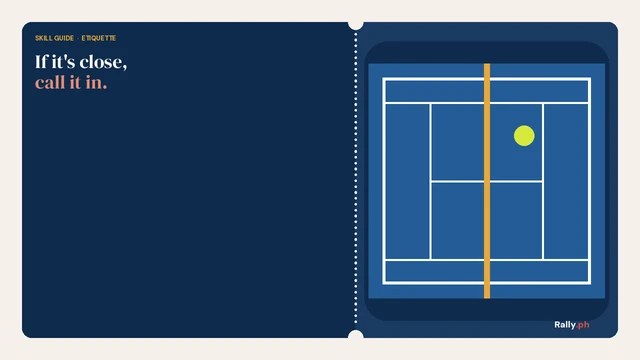
That last point is the one to practise. “I think it was out” is not a call. If you did not see it clearly, it is in. The rulebook’s underlying principles say the same thing in different words: a sense of fair play, by giving the opponent the benefit of any doubt, is essential.
Call kitchen and serve faults on yourselves
Item 4 of the sportsmanship guide asks you to call a fault on yourself or your partner as soon as it happens, whether or not the opponents noticed.
- Watch your own and your partner’s feet for service or non-volley-zone foot faults.
- Accept your opponent’s and partner’s fault calls graciously.
- Admit if the ball hits you or your paddle on the way out of bounds.
Kitchen momentum faults are the ones people miss, because the ball may already be dead when a foot still slides onto the line. Our kitchen guide explains why that is still a fault under Rule 11.A.2. Calling it on yourself is how open play stays honest when there is no referee.
You may also ask, before the serve, who the correct server or receiver is, or whether players are in the correct positions. Rule 5.C says the opponent must answer. Use that instead of playing a whole rally in the wrong order and then disputing it. Our doubles basics covers the rotation.
Safety on a tight bank of courts
Item 7 of the sportsmanship guide treats safety as part of manners, not a separate lecture.
- If a ball comes onto your court, make eye contact with the right person and roll or toss it back without disrupting play on other courts.
- If your ball enters another court, warn anyone in danger immediately, loudly, with “ball” or a similar call. If the ball is only rolling behind their court and is not a danger, do not interrupt their rally; wait until play stops to retrieve it or ask for it back.
- Never throw your paddle, or strike the ball, in anger or frustration.
On a street or mall court the “ball” call matters more than it does on a fenced tennis court, because a stray ball can roll under someone’s foot in the kitchen. Stop your own play if a ball arrives in a place that could cause a fall.
The same guide asks stronger players in social play to be kind: avoid hitting excessively to a weaker player, and do not slam the ball directly at other players. It also asks you to be willing, sometimes, to play with less-skilled players, and not to demand a game with stronger ones. Introduce yourself to people you do not know. At the end of a game, meet the others at the net and acknowledge them.
Coaching belongs in a lesson, not in a random partner’s ear, unless they ask. The guide says to provide coaching and advice only when requested, and to avoid criticism and negative non-verbal communication.
A short checklist before you walk on
Arrive ready: shoes that will not mark an indoor surface, water, and a paddle or the knowledge that loaner paddles are available. Call the score clearly. Rotate off when the format says you should. Give close line calls to the other team. Call your own kitchen faults. Say “ball” when it matters, and stay quiet when it does not.
None of that requires a rating or a federation ID. It is how a first-timer and a regular can share the same court for an evening.
Sources
- USA Pickleball, Essential Sportsmanship Guide
- USA Pickleball, 2026 Official Rulebook: underlying principles in Section 1; Rules 5.C, 8.A, 11.A.2
- Philippine Pickleball Federation, Street Pickleball Ortigas